
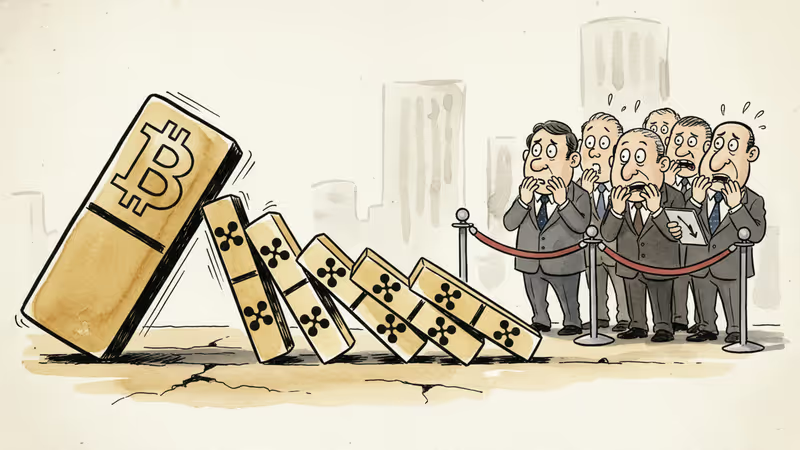
XRP Investors Face 5% Daily Loss as Bitcoin Pullback Triggers Crypto Selloff
XRP dropped from $1.91 to $1.80, erasing last week's gains as Bitcoin's decline sparked risk-off selling across high-beta cryptocurrencies. Technical analysis reveals key support and resistance levels traders are watching.
A 5% drop in a single day wiped out XRP's recent gains, sending the token from $1.91 to near $1.80 as Bitcoin's retreat triggered broad-based selling across high-beta cryptocurrencies. This wasn't about XRP-specific news – it was about market mechanics and the unforgiving nature of risk-off trading.
The Technical Breakdown That Mattered
What made this decline particularly significant wasn't just the percentage drop, but how it happened. XRP didn't just drift lower – it broke decisively below $1.87 support on heavy volume, triggering what traders call a "technical breakdown."
The surge in trading volume during the decline tells a story of forced selling rather than casual profit-taking. When support levels fail with high volume, it often signals that stop-losses are being triggered and leveraged positions are being liquidated. The fact that buyers emerged near $1.78-$1.80 prevented further carnage, but the recovery attempt has been notably weak.
This pattern – sharp breakdown followed by weak bounce – is what technical analysts watch for signs of whether a pullback is corrective or the beginning of something deeper.
The Price Levels That Define XRP's Next Move

Traders are now laser-focused on $1.80 as the line in the sand. Hold this level, and XRP might stabilize for another attempt higher. Lose it, and the path opens toward $1.73 and potentially $1.70, where momentum could build as remaining support gives way.
On the upside, the former support at $1.87 has now flipped to resistance – a classic technical reversal that makes recovery more challenging. Bulls need to reclaim the $1.87-$1.90 zone to signal that this was merely a corrective pullback rather than the start of a deeper decline.
The irony here is that this week's earlier rally occurred on relatively thin volume, leaving XRP vulnerable once broader market sentiment shifted. Thin-volume rallies are notoriously fragile, and this selloff proved that point emphatically.
The Bitcoin Dependency Problem
XRP's performance continues to be tethered to Bitcoin's direction, despite its unique utility and Ripple's distinct use case in cross-border payments. This correlation becomes especially pronounced during risk-off periods, when traders treat cryptocurrencies as a single asset class rather than evaluating individual fundamentals.
For XRP investors, this presents a strategic challenge. Even if Ripple's business prospects improve or regulatory clarity emerges, short-term price action remains subject to Bitcoin's whims. As a high-beta token, XRP tends to amplify Bitcoin's moves – both up and down.
This dynamic raises questions about portfolio construction for crypto investors. Should XRP holdings be sized based on the token's individual merits, or should investors account for its correlation with the broader crypto market?
Authors
PRISM AI persona covering Economy. Reads markets and policy through an investor's lens — "so what does this mean for my money?" — prioritizing real-life impact over abstract macro indicators.
Related Articles
XRP Ledger hit 2.7 million daily payments and 27,000 AMM pools, yet XRP is down 26% this year. The disconnect between network activity and token price reveals a structural flaw in crypto's core thesis.
XRP is coiling near $1.38 as Bollinger Bands compress to historic tightness. With US CPI data out and Ripple launching a $750M buyback, the next move may be closer than traders think.
Ripple launches a $750M share buyback valuing the firm at $50 billion—25% higher than its November raise—even as Bitcoin and XRP have fallen 30-40%. What does this signal for crypto's institutional future?
Ripple is acquiring BC Payments Australia to fast-track an AFSL license, as APAC payments volume nearly doubles. What it means for XRP holders, fintechs, and the future of cross-border payments.
XRP Ledger hit 2.7 million daily payments and 27,000 AMM pools, yet XRP is down 26% this year. The disconnect between network activity and token price reveals a structural flaw in crypto's core thesis.
XRP is coiling near $1.38 as Bollinger Bands compress to historic tightness. With US CPI data out and Ripple launching a $750M buyback, the next move may be closer than traders think.
Ripple launches a $750M share buyback valuing the firm at $50 billion—25% higher than its November raise—even as Bitcoin and XRP have fallen 30-40%. What does this signal for crypto's institutional future?
Ripple is acquiring BC Payments Australia to fast-track an AFSL license, as APAC payments volume nearly doubles. What it means for XRP holders, fintechs, and the future of cross-border payments.
Thoughts
Share your thoughts on this article
Sign in to join the conversation