
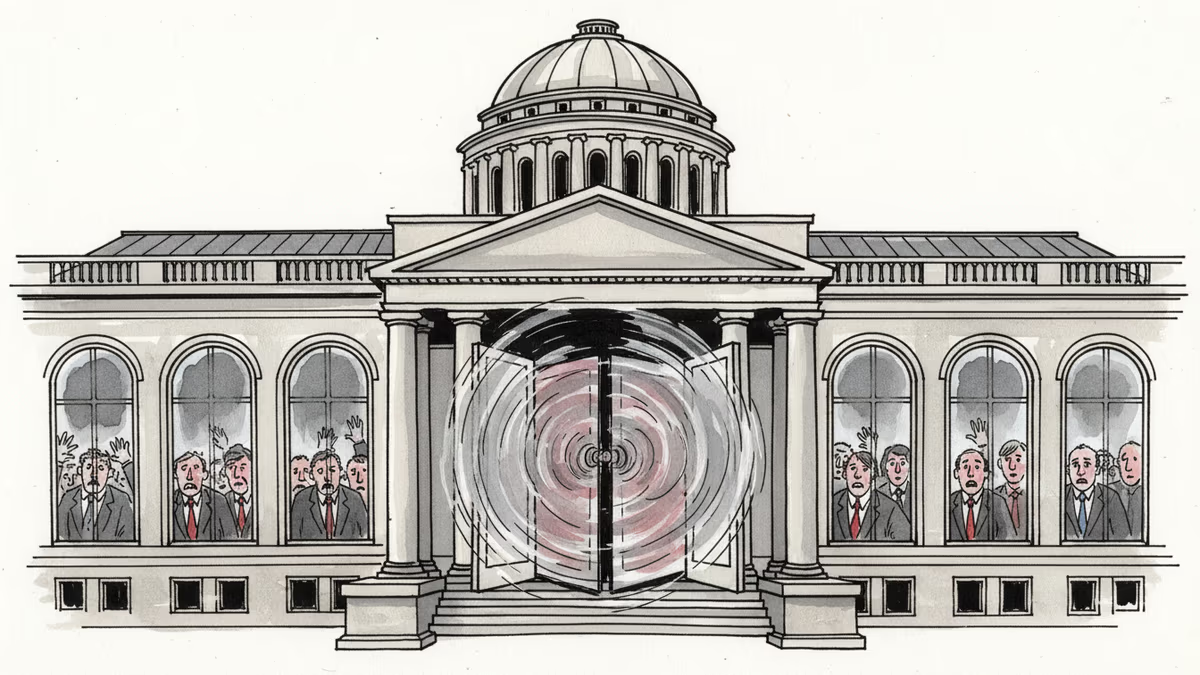
Who's Really Running DHS? The Question Everyone in Washington Is Asking
Months of reporting point to a power vacuum inside the Department of Homeland Security. What happens when the agency guarding America's borders loses its own chain of command?
The reporters have been circling for months. So have the lobbyists, the former officials, and the congressional staffers who speak in careful whispers. Everyone in Washington, it seems, is chasing the same story about the Department of Homeland Security — and nobody can quite pin it down.
That alone tells you something.
A Department Defined by What It Won't Say
DHS is not a subtle agency. It controls the nation's borders, oversees immigration enforcement, manages disaster response, and sits at the center of America's counterterrorism architecture. It employs roughly 260,000 people — more than any other Cabinet-level department except Defense. When something shifts inside DHS, the ripple effects reach every American who has ever stood in a TSA line, applied for a visa, or lived through a hurricane.
Which is why the current fog surrounding the department's internal operations is more than a Beltway curiosity. According to reporting from The Verge's Tina Nguyen, who has been working the story for months alongside what she describes as "every other" journalist on the Washington beat, the details of who is making key decisions — and on whose authority — have proven stubbornly difficult to confirm through official channels.
That opacity is itself a data point. Healthy bureaucracies, whatever their other faults, tend to be legible. They have spokespeople, org charts, and a predictable rhythm of press releases. When a department the size of a small nation-state goes quiet in an unusual way, the silence is usually doing work.
The Smoke-Filled Room, Revisited
Washington's informal power networks have always run alongside its official ones. Policy gets shaped in conversations that never appear in the Federal Register. But there is a meaningful difference between the normal background hum of influence and a situation where even experienced observers cannot reliably identify who holds authority over consequential decisions.
The question of DHS leadership — who is directing enforcement priorities, who is setting the tone on immigration, who has the secretary's ear — matters enormously right now. The department is executing policies that directly affect millions of people: asylum seekers at the southern border, visa holders across the country, communities bracing for federal enforcement actions. The human stakes of bureaucratic confusion are not abstract.

Congressional oversight committees exist precisely for moments like this. Their ability to compel testimony, demand documents, and hold hearings is the constitutional mechanism for making opaque government legible. Whether those mechanisms are functioning as designed is, to put it gently, an open question in the current political environment.
The View From Different Corners
For national security professionals, the concern is less political than operational. A department uncertain about its own command structure is a department that may respond slowly or inconsistently in a crisis. FEMA's troubled response to Hurricane Katrina in 2005 — widely attributed in part to confused lines of authority — remains the cautionary example that never fully leaves the room in these conversations.
For civil liberties advocates, the opacity cuts differently. Enforcement agencies with unclear accountability structures and unclear oversight tend, historically, to expand their activities in ways that are difficult to challenge or even document. The American Civil Liberties Union and similar organizations have long argued that DHS, born in the post-9/11 moment of institutional urgency, was never fully subjected to the democratic scrutiny its powers warrant.
For the communities most directly affected by DHS enforcement — immigrant families, border towns, refugee resettlement organizations — the uncertainty is not an intellectual puzzle. It is a daily reality that shapes decisions about whether to go to work, whether to call the police when a crime occurs, whether to trust that the rules they thought applied yesterday still apply today.
And for those who favor stricter enforcement, the picture is more complicated than it might appear. A department that cannot clearly account for its own decision-making is also a department that may be failing to execute its stated priorities consistently — which serves no one's policy goals, regardless of where those goals sit on the political spectrum.
Why This Moment Matters
DHS was created in 2002, assembling 22 federal agencies into a single department in the largest reorganization of the federal government since the National Security Act of 1947. The logic was integration — that a unified command would prevent the kind of inter-agency communication failures that contributed to the September 11 attacks. More than two decades later, the department is still working through the tensions that come with that forced merger of cultures, missions, and bureaucratic traditions.
Add to that the intense politicization of immigration enforcement over the past decade, the rapid turnover in senior DHS leadership across multiple administrations, and a congressional oversight environment that has become increasingly partisan, and you have a department under unusual strain. The story Nguyen and her colleagues are chasing may be about a specific personnel situation, or it may be about something more structural — a department whose internal coherence is under pressure from multiple directions simultaneously.
The distinction matters, because the remedies are different. A personnel problem can be solved with personnel changes. A structural problem requires something harder: institutional redesign, sustained oversight attention, and a political will to prioritize governance over messaging.
Authors
Related Articles
Anthropic's AI cybersecurity model is reportedly available to the NSA and Commerce Department—but not to CISA, the agency responsible for defending US federal infrastructure. What that gap reveals.
After two months of bitter conflict, Anthropic and the Trump administration may be thawing—thanks to a new cybersecurity AI model. What does it mean when principle meets political pressure?
Florida's AG is investigating OpenAI over a campus shooting, child safety risks, and national security concerns. What it means for AI regulation in America.
Iranian government-backed hackers have escalated from data theft to physically manipulating U.S. water, power, and local government control systems. A joint FBI-NSA-CISA-DOE advisory confirms operational disruption has already occurred.
Anthropic's AI cybersecurity model is reportedly available to the NSA and Commerce Department—but not to CISA, the agency responsible for defending US federal infrastructure. What that gap reveals.
After two months of bitter conflict, Anthropic and the Trump administration may be thawing—thanks to a new cybersecurity AI model. What does it mean when principle meets political pressure?
Florida's AG is investigating OpenAI over a campus shooting, child safety risks, and national security concerns. What it means for AI regulation in America.
Iranian government-backed hackers have escalated from data theft to physically manipulating U.S. water, power, and local government control systems. A joint FBI-NSA-CISA-DOE advisory confirms operational disruption has already occurred.
Thoughts
Share your thoughts on this article
Sign in to join the conversation