
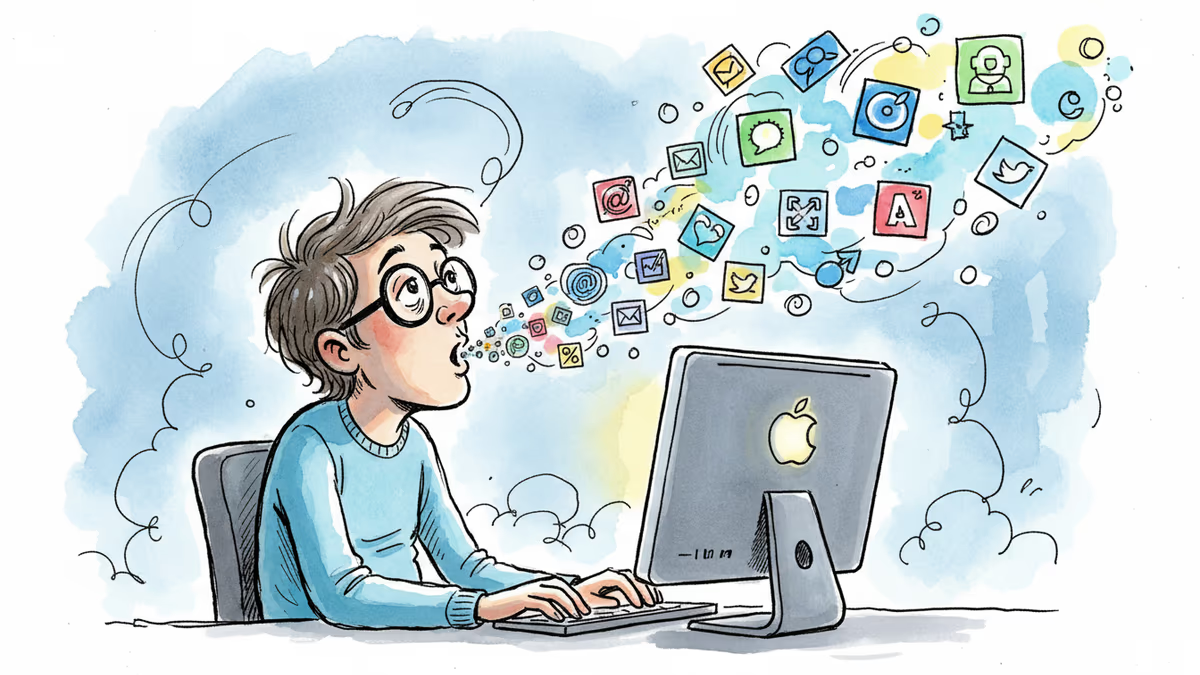
No-Code Just Got Real: Raycast's Glaze Makes App Building Actually Simple
Raycast launches Glaze, a platform that lets Mac users build, share, and discover AI-generated apps without touching code. Is this the tipping point for no-code development?
73% of Developers Say They've Used AI for Coding. Now They Don't Need to Code at All.
Building software with Claude or ChatGPT isn't revolutionary anymore. But you still need to understand terminal commands, deployment processes, and maintenance workflows. Raycast, the launcher app that's become a Mac power-user favorite, thinks it can eliminate even those hurdles.
The company just launched Glaze, a platform that promises to make AI-generated software truly accessible. Users can build, share, and discover apps using what Raycast calls "vibe codes" – natural language descriptions that get turned into working software. It's Mac-only for now, but it might represent the moment no-code development finally lives up to its promise.
Developers vs. Everyone Else: Who Wins?
The core idea is elegantly simple. Instead of wrestling with deployment scripts and dependency management, you describe what you want in plain English. The AI generates the code, and Glaze handles everything else – building, running, even sharing through the Glaze Store.

Developers are split. Some love the rapid prototyping capabilities – one startup founder reported cutting development time by 60% for internal tools. But senior engineers worry about technical debt and long-term maintainability. "It's great until you need to customize something the AI didn't anticipate," one Silicon Valley CTO noted.
For non-developers, though, this could be transformative. Designers, product managers, and students can now turn ideas into working software without learning programming languages or development workflows. The Glaze Store creates a marketplace where anyone can discover and use apps built by others.
The Bigger Picture: Democratization or Commoditization?
What makes Glaze interesting isn't just the technology – it's the timing. We're seeing similar moves across the industry. Microsoft is pushing Power Platform, Google has AppSheet, and countless startups are chasing the "everyone can build software" dream.
But there's a tension here. Lowering barriers to entry doesn't automatically improve software quality. The App Store is already flooded with mediocre apps built by traditional developers. What happens when the barrier to publishing becomes even lower?
The answer might depend on curation and community. Raycast has built a reputation for quality among Mac users. If they can maintain that standard while scaling Glaze, they might avoid the "race to the bottom" that plagues other platforms.
Authors
Related Articles

A major US retailer automated their entire software development lifecycle with AI. Here's what they learned about the future of programming.

Anthropic's Claude AIs collaborated to build a 100,000-line C compiler in just two weeks. Is this the dawn of AI developers or an overhyped experiment?

NTT Data Group unveils plans to automate nearly all IT system development using generative AI by fiscal 2026 to solve Japan's labor shortage. Learn about the 'AI-native' shift.

Lovable's $330M raise from Nvidia and Google at a $6.6B valuation isn't just a funding round. It's a strategic bet on the AI software factory. Here's why.
A major US retailer automated their entire software development lifecycle with AI. Here's what they learned about the future of programming.
Anthropic's Claude AIs collaborated to build a 100,000-line C compiler in just two weeks. Is this the dawn of AI developers or an overhyped experiment?
NTT Data Group unveils plans to automate nearly all IT system development using generative AI by fiscal 2026 to solve Japan's labor shortage. Learn about the 'AI-native' shift.
Lovable's $330M raise from Nvidia and Google at a $6.6B valuation isn't just a funding round. It's a strategic bet on the AI software factory. Here's why.
Thoughts
Share your thoughts on this article
Sign in to join the conversation