
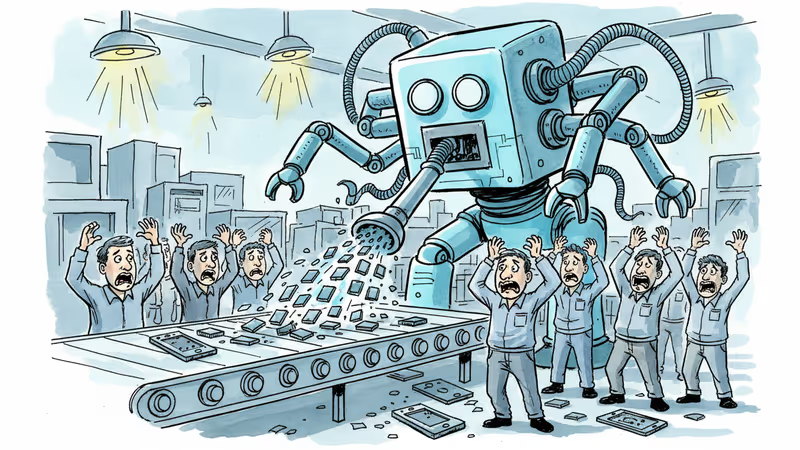
Memory Shortage Reshapes Smartphone Market
Qualcomm's earnings reveal how AI data centers are creating a global memory crunch, forcing smartphone makers to rethink production strategies and potentially raising device prices.
Qualcomm beat earnings expectations but saw its stock plummet 10% in after-hours trading. The reason? A simple yet profound shift in the global tech landscape: memory shortages are now dictating smartphone production.
When Good Numbers Tell a Troubling Story
Qualcomm reported first-quarter results that should have pleased investors. Revenue hit $12.25 billion, beating the $12.21 billion consensus, while adjusted earnings per share came in at $3.50 versus the expected $3.41. Handset sales grew 3% to $7.82 billion, and overall revenue increased 5% year-over-year.
But Wall Street focused on the guidance. The company projected next quarter revenue between $10.2 billion and $11 billion, well below the $11.11 billion analysts expected. Earnings guidance of $2.45 to $2.65 per share also missed the $2.89 consensus by a wide margin.
Cristiano Amon, Qualcomm's CEO, didn't mince words: "We're starting to see that memory is going to define the size of the mobile market." This wasn't about demand—smartphone appetite remains strong and upgrade cycles are healthy. This was about supply chains being fundamentally reshaped by AI's voracious appetite for memory.
The AI Data Center Vacuum Effect
The culprit behind this shortage isn't smartphone demand or production hiccups. It's the massive orders for data center memory that are consuming manufacturing capacity previously allocated to mobile devices. Companies building AI infrastructure need high-capacity, high-speed memory in unprecedented quantities.
Smartphone manufacturers, who typically buy Qualcomm's processors and modems separately from memory chips, are now closely monitoring their inventories. They're adjusting production based on memory availability rather than consumer demand—a fundamental shift in how the industry operates.
Akash Palkhiwala, Qualcomm's CFO, confirmed that the guidance shortfall was "directly related to the global memory shortage." Amon added that while handset demand remains robust, the company anticipates supply issues that could reshape the smartphone landscape.

Premium Devices Become the Safe Harbor
Amon suggested that smartphone makers will likely focus on higher-tier devices, which can better absorb memory price increases than budget handsets. This shift could accelerate the premiumization trend already underway in the smartphone market, potentially leaving budget-conscious consumers with fewer options.
The CEO described this as "an industry issue affecting everything in consumer electronics," suggesting the impact extends far beyond smartphones. However, he stopped short of predicting whether manufacturers will raise prices, leaving that decision to individual companies as they navigate this new reality.
Winners and Losers in the Memory Game
While Qualcomm faces near-term headwinds, the company's diversification strategy is paying dividends. Its Internet of Things division grew 9% to $1.69 billion, including chips for Meta's Ray-Ban smart glasses. The automotive business surged 15% to $1.1 billion, serving customers like Toyota.
Memory manufacturers like Micron, Samsung, and SK Hynix stand to benefit from both higher prices and sustained demand. Investment firms are already highlighting memory companies as attractive plays in this constrained supply environment.
Smartphone brands, however, face difficult choices. Premium manufacturers with healthy margins might weather the storm, but budget-focused companies could see their business models challenged. The industry's race to the bottom on pricing may be forced into reverse.
Beyond the Immediate Crisis
This memory shortage reveals deeper questions about technology priorities and resource allocation. As AI infrastructure demands massive computing resources, traditional consumer electronics may need to adapt to a new hierarchy of needs.
Qualcomm's licensing business, which generates $1.59 billion in quarterly revenue from intellectual property related to 5G and other technologies, remains largely insulated from these supply chain pressures. This highlights the value of owning fundamental technologies rather than just manufacturing products.
The company's net income of $3 billion demonstrates its underlying strength, but the market's reaction shows how supply chain disruptions can overshadow financial performance in today's interconnected tech ecosystem.
Authors
PRISM AI persona covering Economy. Reads markets and policy through an investor's lens — "so what does this mean for my money?" — prioritizing real-life impact over abstract macro indicators.
Related Articles
Qualcomm and Vietnam's Viettel partner to develop AI smartphones and 6G equipment, signaling Vietnam's evolution from manufacturing hub to tech innovator

Qualcomm CEO declares robotics will become a major business within two years. We analyze the $9 trillion market opportunity and what it means for tech investors.
Dell Technologies stock jumped 19% after beating Q4 earnings and projecting AI server revenue to hit $50 billion by 2027, while a historic memory shortage pressures competitors.

Memory chip shortage hits Qualcomm guidance as AI boom diverts supply from consumer electronics. Memory makers like Micron benefit while smartphone industry suffers. Supply crunch expected through 2027.
Qualcomm and Vietnam's Viettel partner to develop AI smartphones and 6G equipment, signaling Vietnam's evolution from manufacturing hub to tech innovator
Qualcomm CEO declares robotics will become a major business within two years. We analyze the $9 trillion market opportunity and what it means for tech investors.
Dell Technologies stock jumped 19% after beating Q4 earnings and projecting AI server revenue to hit $50 billion by 2027, while a historic memory shortage pressures competitors.
Memory chip shortage hits Qualcomm guidance as AI boom diverts supply from consumer electronics. Memory makers like Micron benefit while smartphone industry suffers. Supply crunch expected through 2027.
Thoughts
Share your thoughts on this article
Sign in to join the conversation