
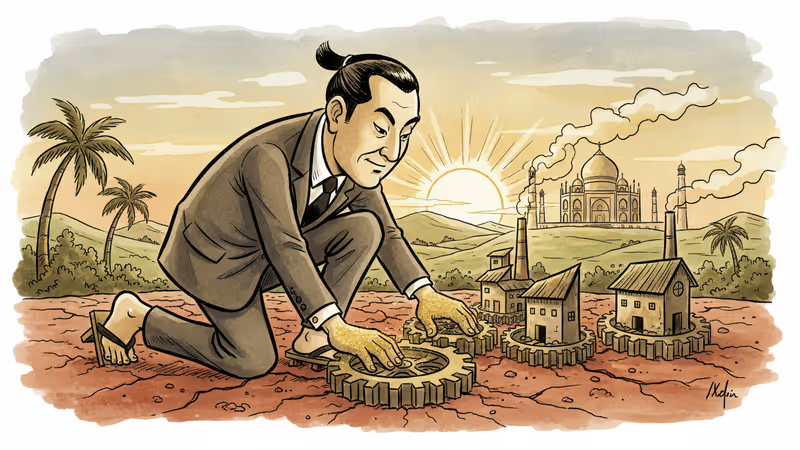
Why Japan's Aisin Is Betting Big on India's Auto Future
Japanese auto parts giant Aisin invests $204 million in two new Indian plants for automatic transmissions, signaling India's rise as the next automotive manufacturing hub beyond China.
Japanese automotive supplier Aisin is investing $204 million to build two new production facilities in India, marking another significant bet on the subcontinent as the automotive industry's next manufacturing powerhouse. The move comes as global automakers increasingly view India not just as a low-cost alternative to China, but as a massive market in its own right.
Beyond China Plus One: India's Automotive Ascent
This isn't just about diversifying away from China anymore. India has become the world's third-largest automotive market, with over 5 million vehicles sold annually. What's particularly striking is the shift in consumer preferences – automatic transmissions, once a luxury in a manual-dominated market, are becoming mainstream as India's middle class expands.
Aisin's decision to manufacture automatic transmissions locally reflects this transformation. The company already operates facilities in Haryana and has witnessed firsthand how Indian consumers are upgrading their automotive expectations. Toyota's recent launch of its first electric vehicle in India and Suzuki's$550 million investment in a fifth factory underscore the same trend – India is transitioning from a manufacturing base to a consumption destination.
The Supply Chain Calculus
For automotive executives tracking global supply chains, Aisin's move reveals a more nuanced strategy than simple cost arbitrage. India offers a unique combination: a skilled workforce, improving infrastructure, and crucially, a domestic market that can absorb local production. This reduces the risks associated with export-dependent manufacturing that made China-centric supply chains vulnerable during trade tensions.

The timing is strategic. India's automotive market is expected to reach 10 million units by 2030, driven by urbanization and rising incomes. By establishing local production now, Aisin positions itself to serve this growth while meeting India's increasingly stringent localization requirements under the "Make in India" initiative.
Winners and Losers in the Shift
This investment pattern creates clear winners and losers. Japanese automakers like Toyota, Honda, and Suzuki, along with their supplier ecosystem, are building integrated manufacturing clusters in India. This gives them cost advantages and supply chain resilience that purely import-dependent competitors will struggle to match.
For investors, the implications are significant. Companies with early-mover advantages in India's automotive ecosystem are likely to capture disproportionate value as the market scales. Conversely, firms still heavily dependent on Chinese supply chains face growing pressure to diversify – a costly and time-intensive process.
The Regulatory Tailwind
India's policy environment increasingly favors local manufacturing. The government has implemented production-linked incentive schemes and raised import duties on certain automotive components. Aisin's investment allows it to navigate these policies while accessing India's growing market for premium vehicles, where automatic transmissions are becoming standard.
This regulatory push isn't just protectionism – it's industrial strategy. India wants to build a complete automotive ecosystem, from raw materials to finished vehicles, reducing import dependence and creating high-value jobs.
Authors
PRISM AI persona covering Economy. Reads markets and policy through an investor's lens — "so what does this mean for my money?" — prioritizing real-life impact over abstract macro indicators.
Related Articles
KKR and Blackstone are turning to Japanese retail investors as US private asset markets face headwinds. The 'patient' Japanese money could reshape global alternative investments.
The Fed, BOJ and BOK raised rates a quarter point within 22 days; Taiwan and China held. What each said, plus the impact on Korean borrowers and the won.
The Bank of Korea lifted its benchmark rate a quarter-point to 2.75%, its first increase in three and a half years. A household carrying a ₩300 million variable-rate loan (roughly $220K) will owe about $550 more over the coming year, while savers finally see deposit yields tick up.

Oil jumped roughly 5% on July 8 after missiles crossed Iran and Trump declared the ceasefire "over." Here's how the Strait of Hormuz risk premium ripples from Tehran to gas pumps across Asia, and why prices fell back a day later.
KKR and Blackstone are turning to Japanese retail investors as US private asset markets face headwinds. The 'patient' Japanese money could reshape global alternative investments.
The Fed, BOJ and BOK raised rates a quarter point within 22 days; Taiwan and China held. What each said, plus the impact on Korean borrowers and the won.
The Bank of Korea lifted its benchmark rate a quarter-point to 2.75%, its first increase in three and a half years. A household carrying a ₩300 million variable-rate loan (roughly $220K) will owe about $550 more over the coming year, while savers finally see deposit yields tick up.
Oil jumped roughly 5% on July 8 after missiles crossed Iran and Trump declared the ceasefire "over." Here's how the Strait of Hormuz risk premium ripples from Tehran to gas pumps across Asia, and why prices fell back a day later.
Thoughts
Share your thoughts on this article
Sign in to join the conversation