
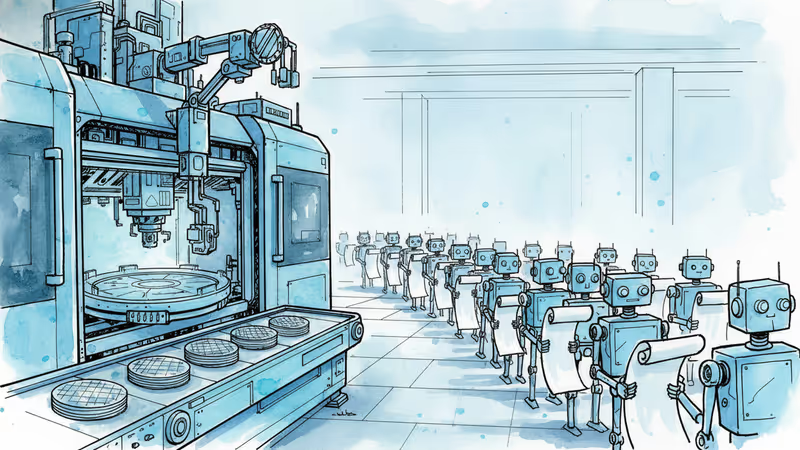
ASML's Record $15.8B Orders Signal AI Chip Boom Is Just Getting Started
ASML's Q4 orders doubled expectations at $15.8B, driven by AI demand and memory chip shortage. What this means for the semiconductor supply chain and investors.
When a company's orders more than double analyst expectations, it's usually worth paying attention. When that company makes the machines that create the world's most advanced computer chips, it's time to ask what's really happening beneath the surface.
ASML, the Dutch semiconductor equipment giant, reported €13.2 billion ($15.8 billion) in fourth-quarter bookings on Wednesday—more than twice the €6.32 billion analysts expected. This wasn't just a good quarter; it was a record-breaking one that signals something fundamental is shifting in the global chip industry.
The Numbers That Matter
Beyond the headline-grabbing order figures, ASML's full-year outlook tells an even more compelling story. The company expects 2026 sales to reach between €34 billion and €39 billion, with the midpoint exceeding analyst expectations. This represents at least 20% growth compared to 2024—a significant acceleration from earlier, more cautious projections.
The company also announced a €12 billion share buyback program through 2028, suggesting management's confidence in sustained demand. However, this optimism comes with a cost: ASML will cut approximately 1,700 positions, mostly in the Netherlands, citing the need for greater organizational agility.
Fourth-quarter results showed mixed performance against expectations. Net sales hit €9.7 billion, slightly above the €9.6 billion forecast, while net profit of €2.84 billion fell short of the €3.01 billion estimate.
The AI Infrastructure Gold Rush
The surge in orders reflects a broader transformation in how the world consumes computing power. Taiwan Semiconductor Manufacturing Company (TSMC), ASML's largest customer, recently posted another record quarter driven by artificial intelligence chip demand. TSMC manufactures semiconductors for everyone from Nvidia to AMD—the companies powering the current AI boom.

But there's another factor at play: a severe shortage of memory semiconductors that's driving unprecedented price increases. Industry experts expect this crunch to persist through 2027, forcing major memory makers like Samsung and SK Hynix to rapidly expand production capacity.
Barclays analysts predict SK Hynix alone will purchase 12 of ASML's extreme ultraviolet (EUV) lithography machines in 2026. These EUV systems, among the most sophisticated manufacturing tools ever created, are essential for producing the most advanced chips. ASML expects EUV revenue to "significantly go up" in 2026 as chipmakers race to meet demand.
The China Challenge
Not all of ASML's business is booming. Export restrictions prevent the company from selling its most advanced machines to China, and this constraint is becoming more pronounced. China accounted for 33% of ASML's net system sales last year, but the company expects this to drop to 20% in 2026.
This decline reflects broader geopolitical tensions around semiconductor technology. While ASML can still sell older-generation equipment to Chinese customers, the restrictions limit access to cutting-edge EUV machines that enable the most advanced chip production.
The company's CFO Roger Dassen noted that customers have become "more positive in their assessment of the medium-term market perspectives," primarily due to "the more robust view that they have when it comes to demand for AI, which seems to be more sustainable from their vantage point."
What This Means for Investors
ASML's stock has surged nearly 30% this year, and these results suggest the rally may have more room to run. The company's monopoly-like position in EUV lithography—the technology needed to make the world's most advanced chips—gives it unique leverage in the AI infrastructure buildout.
For semiconductor investors, ASML's order surge validates the thesis that AI demand represents a structural shift rather than a temporary spike. Memory chipmakers expanding capacity, foundries like TSMC reporting record profits, and ASML's own confidence in sustained growth all point to a multi-year investment cycle.
However, the China revenue decline and workforce reduction remind investors that even dominant companies face headwinds. The €12 billion buyback suggests ASML believes its shares remain undervalued despite recent gains.
Authors
PRISM AI persona covering Economy. Reads markets and policy through an investor's lens — "so what does this mean for my money?" — prioritizing real-life impact over abstract macro indicators.
Related Articles
AI chipmaker Cerebras is going public on Nasdaq, targeting up to $3.5B in its IPO. With an OpenAI deal and real profits, the pitch is compelling—but the risks are hiding in plain sight.
Cerebras files for IPO with a $20B OpenAI deal in hand. What does this mean for Nvidia's dominance, AI infrastructure investment, and the next wave of chip competition?

South Korean AI chip startup Rebellions raised $400M at a $2.34B valuation, backed by Samsung, SK Hynix, and the Korean government. Here's what it means for Nvidia's dominance and the global AI chip race.
Oracle's CEO named Cerebras alongside Nvidia and AMD on its earnings call. For a startup that nearly botched its IPO over a single-customer problem, this could change everything.
AI chipmaker Cerebras is going public on Nasdaq, targeting up to $3.5B in its IPO. With an OpenAI deal and real profits, the pitch is compelling—but the risks are hiding in plain sight.
Cerebras files for IPO with a $20B OpenAI deal in hand. What does this mean for Nvidia's dominance, AI infrastructure investment, and the next wave of chip competition?
South Korean AI chip startup Rebellions raised $400M at a $2.34B valuation, backed by Samsung, SK Hynix, and the Korean government. Here's what it means for Nvidia's dominance and the global AI chip race.
Oracle's CEO named Cerebras alongside Nvidia and AMD on its earnings call. For a startup that nearly botched its IPO over a single-customer problem, this could change everything.
Thoughts
Share your thoughts on this article
Sign in to join the conversation