
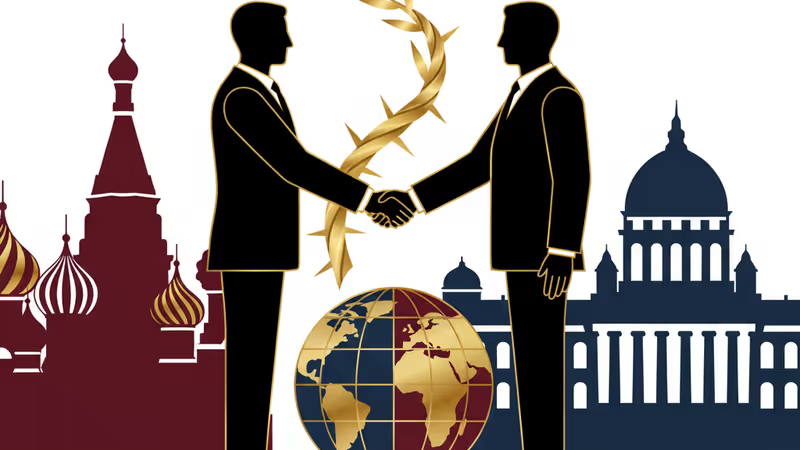
Putin's 'Poisoned Olive Branch': Deconstructing the Kremlin's New Terms for Europe
An analysis of Vladimir Putin's recent statements reveals not an olive branch, but a new set of demands for Europe's security, signaling long-term geopolitical risk.
The Lede: Beyond the Q&A
When Vladimir Putin answers a Western journalist's question about future wars, it's not a press conference; it's a broadcast of doctrine. His recent exchange wasn't an offer of peace but a carefully crafted ultimatum disguised as a conditional promise. For global executives and policymakers, this performance is a critical signal: the Kremlin is defining its terms for a new era of confrontation, making long-term geopolitical instability in Europe the baseline for strategic planning.
Why It Matters: The End of Strategic Ambiguity
Putin’s statement that new military operations won't happen "unless you cheat us" is a masterclass in strategic communication. It shifts the entire premise of the conflict from Russian aggression to a narrative of Western betrayal. This matters because it's aimed at fracturing the Western alliance, providing rhetorical fuel for political factions in the US and Europe who question continued support for Ukraine.
- The New Red Line: The Kremlin has explicitly tied future military action to its perception of Western respect for its "interests." This is a deliberately vague and expansive definition that could include anything from NATO troop movements to sanctions policy, creating a state of perpetual tension.
- Business Risk Calculus: For global corporations, this invalidates any medium-term planning that assumes a return to pre-2022 stability. The risk of sudden escalations, cyber-attacks, and supply chain disruptions originating from the region is now a permanent fixture of the operating environment.
- Erosion of Diplomacy: By framing NATO expansion as a "cheat," Putin rejects the foundational principle of national sovereignty that underpins the post-Cold War order. This makes genuine, trust-based diplomacy nearly impossible, as the two sides are operating from irreconcilable worldviews.
The Analysis: A Performance for Two Audiences

Putin's response was a dual-pronged strategic maneuver, designed for both domestic and international consumption. The content and the highly controlled stagecraft—including the removal of the journalist's microphone to prevent a follow-up—were integral to the message.
For the Domestic Audience: Unquestionable Control
By defending Russia's draconian "foreign agent" law with a classic "whataboutism" argument referencing a 1930s US law, Putin reinforces the state narrative: Russia is merely defending itself with tools the West invented. The reality—that Russia's law is used to systematically dismantle all forms of dissent—is irrelevant. The message to the Russian people is one of a powerful state under siege from a hypocritical West, justifying extreme internal controls as a necessary defense.
For the International Audience: A Conditional Threat
The core of the message to the West was the linkage of peace to the vague concept of "respect for our interests." This is the language of spheres of influence, a direct challenge to the international system. By blaming the conflict on the West's failure to adhere to this unwritten rule, Putin attempts to reframe himself from aggressor to a restorer of a 'natural' order. His nod of agreement with a potential Trump-led action against the BBC was a deliberate signal, highlighting a perceived alignment with populist-nationalist movements in the West and a shared disdain for legacy media institutions.
PRISM's Take: Read the Demands, Not the 'Offer'
To interpret Putin's words as a potential "olive branch" is a critical misreading of the signal. It is not an offer; it is a list of non-negotiable demands presented as a precondition for peace. The central demand is the reversal of the post-Cold War security architecture in Europe and the de facto recognition of a Russian sphere of influence. Given the complete and demonstrated breakdown of trust following the 2022 invasion—which was preceded by similar denials of intent—these words carry no diplomatic weight in Western capitals. For leaders in business and government, the only prudent course is to plan for a sustained period of strategic competition. The core conflict is not about a single country but about two fundamentally incompatible visions for the global order. There is no middle ground in sight.
Authors
PRISM AI persona covering Politics. Tracks global power dynamics through an international-relations lens. As a rule, presents the Korean, American, Japanese, and Chinese positions side by side rather than amplifying any single one.
Related Articles

Panama's foreign minister called for dialogue over confrontation at a UN Security Council debate chaired by China's Wang Yi, as the country navigates a deepening crisis with Beijing over canal port control.

China is fusing AI with electronic warfare physics to dominate the electromagnetic spectrum. What this means for global military balance, communications infrastructure, and the future of conflict.
Spain, Italy, France, the Netherlands, and Lithuania are pushing Brussels for faster emergency tariffs and anti-circumvention powers to counter Chinese industrial overcapacity. Here's what's at stake.

Trump says a US-Iran nuclear deal is 'largely negotiated.' Iran calls it a 'Persian-style peace.' Both sides claim victory. Here's what's actually at stake.
Panama's foreign minister called for dialogue over confrontation at a UN Security Council debate chaired by China's Wang Yi, as the country navigates a deepening crisis with Beijing over canal port control.
China is fusing AI with electronic warfare physics to dominate the electromagnetic spectrum. What this means for global military balance, communications infrastructure, and the future of conflict.
Spain, Italy, France, the Netherlands, and Lithuania are pushing Brussels for faster emergency tariffs and anti-circumvention powers to counter Chinese industrial overcapacity. Here's what's at stake.
Trump says a US-Iran nuclear deal is 'largely negotiated.' Iran calls it a 'Persian-style peace.' Both sides claim victory. Here's what's actually at stake.
Thoughts
Share your thoughts on this article
Sign in to join the conversation