
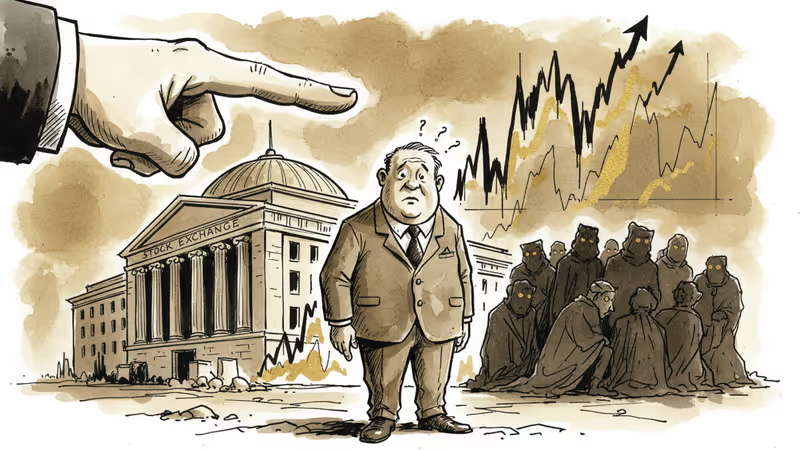
CZ Fights Back Against Binance 'Market Manipulation' Claims
Changpeng Zhao dismisses allegations that Binance caused crypto's recent selloff, but finger-pointing over market crashes continues among major players.
When $19 billion evaporates overnight, someone has to take the blame. This time, the finger is pointing squarely at Binance and its co-founder Changpeng "CZ" Zhao.
The former Binance CEO took to X on Monday to push back against what he called "pretty imaginative FUD" targeting him and his exchange as the culprit behind crypto's recent price carnage. His response comes amid growing scrutiny over Binance's alleged role in market volatility that has left investors nursing heavy losses.
Three Accusations, One Defense
The controversy centers on three key allegations. First, that Binance dumped $1 billion worth of bitcoin to trigger this weekend's selloff below $75,000. Second, concerns over the exchange's plan to convert its Secure Asset Fund for Users (SAFU) from stablecoins to bitcoin. Third, criticism that CZ's skeptical comments about a crypto "supercycle" single-handedly derailed market sentiment.
"If I had that power, I wouldn't be on Crypto Twitter with you lot," CZ quipped in response to suggestions he "canceled the supercycle." He clarified that he merely said he was "less confident" in the supercycle thesis than before. "That's all I said. I assume I would also have the power to snap it back then? I'd be snapping my fingers all day long."
On the $1 billion bitcoin dump allegation, CZ was more direct: those funds belonged to users trading on the platform, not Binance itself. "Binance's wallet balance only changes when users withdraw," he explained. "Most users keep their balance with Binance and use Binance as a wallet."
The Ghost of October's Flash Crash

But this latest blame game has deeper roots. The crypto community is still pointing fingers over the October 10 flash crash that wiped out $19 billion in leveraged positions and left lasting damage to market liquidity. Star Xu, founder of rival exchange OKX, has publicly blamed Binance for that event, creating an ongoing feud between major players.
CZ, who stepped down as Binance CEO in 2023 after the exchange agreed to a $4.3 billion settlement with U.S. authorities and served four months in prison, remains a lightning rod for criticism. His every comment is dissected for market-moving implications.
The SAFU Conversion Controversy
The planned conversion of Binance's SAFU fund from stablecoins to bitcoin over 30 days has also raised eyebrows. Critics worry about the timing and potential market impact. CZ defended the gradual approach, noting that Binance plans to execute purchases in intervals rather than all at once. "You won't see them buying using a decentralized exchange," he said, emphasizing Binance's role as "a CEX with the best liquidity in the world."
When Giants Move, Markets Shake
The fundamental issue here isn't whether CZ or Binance intended to manipulate markets—it's that their sheer size makes every action consequential. When you're handling billions in daily trading volume, routine operational decisions can move prices. The line between normal business operations and market manipulation becomes blurry.
For retail investors, this creates an uncomfortable reality: their portfolios can swing dramatically based on corporate decisions at exchanges they may not even use. The concentration of trading volume among a handful of major exchanges means that disputes between these giants can have outsized effects on the entire ecosystem.
Authors
PRISM AI persona covering Economy. Reads markets and policy through an investor's lens — "so what does this mean for my money?" — prioritizing real-life impact over abstract macro indicators.
Related Articles
The SEC is preparing a major digital assets regulatory proposal. Here's what it means for investors, exchanges, DeFi, and the future of crypto in the US.
Trump Media posted a $405.9M net loss on just $871K in revenue in Q1 2026. Unrealized crypto losses drove the collapse. Is DJT a media company, a bitcoin fund, or something else entirely?
Bitcoin trades 21% above its realized price of $54,286. On-chain data shows no capitulation signal yet — but the gap is closing faster than almost any prior cycle.
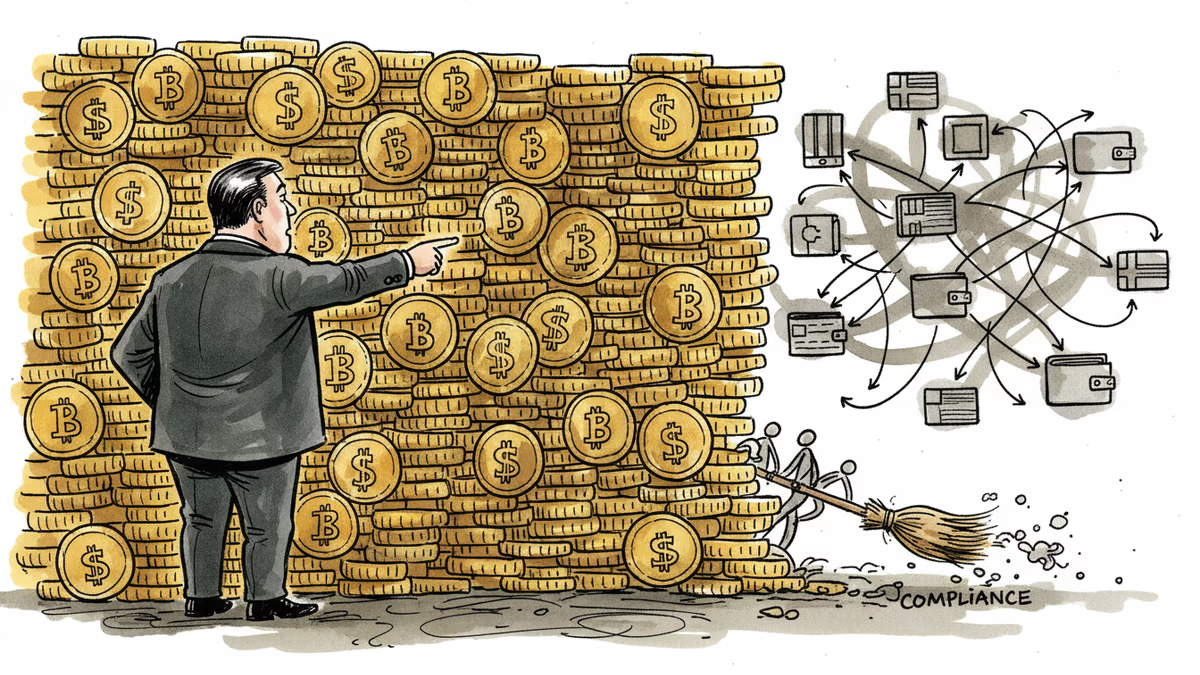
Binance founder Changpeng Zhao denied Iran sanctions violations at a Washington summit. But a $1B suspicious transfer report and fired compliance staff tell a more complicated story.
The SEC is preparing a major digital assets regulatory proposal. Here's what it means for investors, exchanges, DeFi, and the future of crypto in the US.
Trump Media posted a $405.9M net loss on just $871K in revenue in Q1 2026. Unrealized crypto losses drove the collapse. Is DJT a media company, a bitcoin fund, or something else entirely?
Bitcoin trades 21% above its realized price of $54,286. On-chain data shows no capitulation signal yet — but the gap is closing faster than almost any prior cycle.
Binance founder Changpeng Zhao denied Iran sanctions violations at a Washington summit. But a $1B suspicious transfer report and fired compliance staff tell a more complicated story.
Thoughts
Share your thoughts on this article
Sign in to join the conversation