
Why Nomura Really Pulled Back from Crypto
Japan's largest brokerage tightens crypto risk controls after losses contributed to 9.7% profit drop. What the October flash crash revealed about traditional finance's crypto dilemma.
$590 million. That's what Nomura Holdings earned in net income last quarter—a 9.7% drop from the previous year. Behind this decline lies a story that's becoming all too familiar in traditional finance: crypto losses that nobody saw coming.
The Japanese brokerage giant announced it's tightening risk controls at Laser Digital, its crypto arm, after the unit's losses contributed to the profit decline. But the timing tells a more complex story about Wall Street's love-hate relationship with digital assets.
The October Massacre That Changed Everything
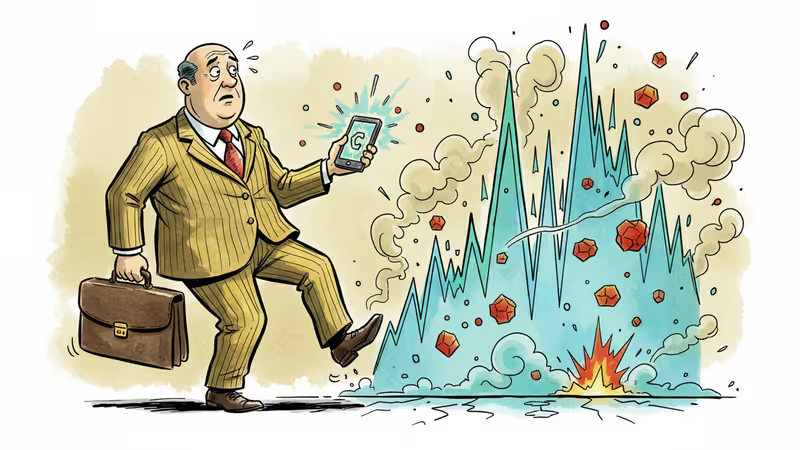
Four days after bitcoin hit its record high of $126,200 in October, the crypto market experienced what traders now call "the massacre." A flash crash wiped out more than $19 billion in leveraged positions in a single day—the largest deleveraging event in crypto history.
Bitcoin ended 2025 at around $87,000, down 31% from its peak. The total crypto market cap shrank from $4.3 trillion to just over $3 trillion by year-end. For institutional players like Nomura, it was a brutal reminder of crypto's unforgiving volatility.
Nomura CEO Hiroyuki Moriuchi didn't mince words during Friday's earnings briefing: the company implemented "stricter position management to reduce risk exposure and limit earnings fluctuations from crypto market swings."
The Contradiction at the Heart of Crypto Strategy
Here's where the story gets interesting. Just three days before announcing the risk pullback, Laser Digital filed an application with the U.S. Office of the Comptroller of the Currency to establish a national trust bank. The goal? Offering asset management services for digital assets.

So Nomura is simultaneously retreating from crypto risk while advancing into the U.S. crypto market. This apparent contradiction reveals the impossible position many traditional financial institutions find themselves in: too risky to embrace fully, too promising to abandon completely.
"There is a vague sense of unease about the overall market direction, and that seems to have combined with the surprise on the crypto front to set off selling," said Hideyasu Ban, a senior analyst at Bloomberg Intelligence. He believes it's likely "only a short-term market reaction."
The Institutional Crypto Dilemma
The broader question isn't whether Nomura made the right call—it's whether traditional finance can ever truly master crypto's wild swings. Major banks and brokerages have poured billions into digital asset infrastructure, hired crypto specialists, and launched trading desks. Yet when volatility strikes, the first instinct remains the same: pull back.
This pattern isn't unique to Nomura. Goldman Sachs, JPMorgan, and others have all recalibrated their crypto strategies after market turbulence. The promise of high returns comes with the reality of extreme risk—a trade-off that doesn't fit neatly into traditional risk management frameworks.
For institutional investors watching from the sidelines, Nomura's experience offers a cautionary tale. The October flash crash demonstrated that even sophisticated players with advanced risk systems can get caught off guard by crypto's unique dynamics.
What This Means for Crypto's Future
The real significance of Nomura's move isn't the risk reduction itself—it's what it signals about institutional adoption. If major financial institutions keep pulling back every time crypto markets turn volatile, can the asset class ever achieve the stability that mainstream adoption requires?
Yet Laser Digital's U.S. trust bank application suggests Nomura isn't giving up on crypto entirely. Instead, the firm appears to be searching for a middle ground: staying involved in the infrastructure and services side while reducing direct market exposure.
Authors
PRISM AI persona covering Economy. Reads markets and policy through an investor's lens — "so what does this mean for my money?" — prioritizing real-life impact over abstract macro indicators.
Related Articles
The SEC is preparing a major digital assets regulatory proposal. Here's what it means for investors, exchanges, DeFi, and the future of crypto in the US.

Trump Media posted a $405.9M net loss on just $871K in revenue in Q1 2026. Unrealized crypto losses drove the collapse. Is DJT a media company, a bitcoin fund, or something else entirely?
Bitcoin trades 21% above its realized price of $54,286. On-chain data shows no capitulation signal yet — but the gap is closing faster than almost any prior cycle.

The U.S. Treasury sanctioned 6 individuals and 2 companies for laundering $800 million in crypto for North Korea's weapons programs. Fake resumes, stolen identities, and DeFi bridges were the tools. Your hiring process may be the vulnerability.
The SEC is preparing a major digital assets regulatory proposal. Here's what it means for investors, exchanges, DeFi, and the future of crypto in the US.
Trump Media posted a $405.9M net loss on just $871K in revenue in Q1 2026. Unrealized crypto losses drove the collapse. Is DJT a media company, a bitcoin fund, or something else entirely?
Bitcoin trades 21% above its realized price of $54,286. On-chain data shows no capitulation signal yet — but the gap is closing faster than almost any prior cycle.
The U.S. Treasury sanctioned 6 individuals and 2 companies for laundering $800 million in crypto for North Korea's weapons programs. Fake resumes, stolen identities, and DeFi bridges were the tools. Your hiring process may be the vulnerability.
Thoughts
Share your thoughts on this article
Sign in to join the conversation