
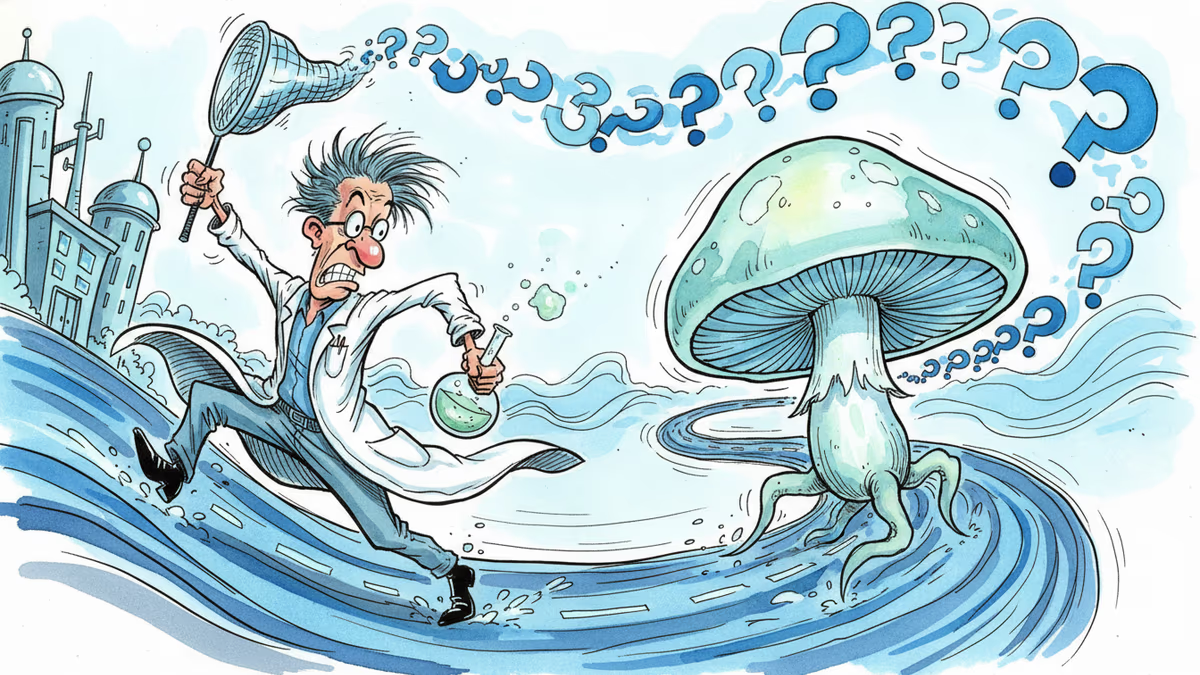
11 Million Americans Are Already Tripping. Science Hasn't Caught Up.
Psilocybin use has surged to 11 million US adults in a year, yet research lags behind. As potency rises and regulations stall, who's protecting consumers?
11 million Americans used psilocybin mushrooms in the past year. No prescription. No standardized dose. No reliable label telling them how strong what they're taking actually is. The science meant to guide them? Still catching up.
The numbers alone tell a striking story. Psilocybin use among adults over 30 jumped 188% between 2019 and 2023. Among 18-to-29-year-olds, it rose 44% in the same period. By 2023, more than 5 million adults had used it in a single year. By early 2026, that figure had more than doubled. This isn't a fringe phenomenon anymore—it's a mainstream behavioral shift happening largely outside any regulatory framework.
What's Actually in the Mushroom
Here's what most people reaching for a handful of dried mushrooms don't know: psilocybin itself is almost inert until the body converts it into psilocin, the compound that actually binds to serotonin receptors and reshapes how you think, feel, and perceive. That part is increasingly well understood.
What's far murkier is everything else inside the mushroom. Baeocystin, norbaeocystin, aeruginascin—a cluster of tryptamine compounds that ride alongside psilocybin in natural mushrooms. Rodent studies suggest these compounds may produce effects that are stronger and longer-lasting than psilocybin alone. But their effects on humans? Almost entirely unstudied.
The reason for that gap is structural. Federal regulations require researchers to use isolated, synthetic psilocybin in clinical trials—not the whole mushroom. So the dozens of ongoing clinical studies testing psilocybin for depression, PTSD, and addiction are studying a chemically different substance than what people are actually consuming at home. The lab and the living room are running separate experiments.
A Legal Gray Zone That's Getting Grayer
The regulatory landscape is a patchwork that's easier to navigate than most people assume. Denver became the first US city to decriminalize psilocybin in 2019. Oakland, Seattle, and Detroit followed. Oregon legalized supervised use in licensed settings in 2020; Colorado did the same in 2022.
But even for the vast majority of Americans living outside those jurisdictions, access is surprisingly simple. For around $35, anyone can legally purchase a mushroom grow kit online. The kits contain spores—reproductive cells that produce no psilocybin themselves, and are therefore legal to sell. The moment those spores germinate into mushrooms, the product becomes a federal Schedule 1 substance. Enforcement of that line is, practically speaking, minimal.
What's emerged is a consumer market with no equivalent of a nutrition label. No standardized potency. No recommended serving size. No warning about interactions with antidepressants or pre-existing psychiatric conditions.

The Potency Problem
The cannabis parallel is instructive—and cautionary. When legal cannabis markets opened, product variety and THC concentrations rose dramatically, faster than research on high-dose effects could inform public health guidance. The same dynamic is now visible in psilocybin.
Selective cultivation is pushing mushroom potency higher. Community competitions like the Oakland Hyphae Cup—essentially a strain contest—have documented wide variability in psilocybin content across samples. Scientific studies of mushrooms sourced globally show similar inconsistency. Psilocybin edibles are entering the market, adding another variable: absorption rates through food differ from dried mushrooms, making dosing even less predictable.
The consequences aren't hypothetical. High doses increase the likelihood of adverse effects: psychotic symptoms, suicidal ideation, severe anxiety, paranoia. More persistently, a condition called hallucinogen persisting perception disorder (HPPD) can cause ongoing perceptual distortions—visual anomalies, altered sense of reality—that last weeks, months, or years after the drug has cleared the body. Without potency standards, consumers have no reliable way to avoid crossing into high-dose territory.
Who's Watching Out for Consumers?
The honest answer, right now, is almost no one.
Researchers are trying to close the gap with creative approaches—app-based surveys that collect real-time data from people using their own mushrooms at home, paired with independent lab testing to measure actual potency. It's a workaround born of necessity: studying a Schedule 1 substance in naturalistic settings requires threading a needle between federal restrictions and real-world relevance.
Regulators are moving, but slowly. The FDA has granted psilocybin Breakthrough Therapy designation, which accelerates the clinical trial process, but that pathway leads to pharmaceutical approval—not consumer market regulation. Oregon's supervised-use framework is the closest thing to a regulated access model in the US, but it covers a tiny fraction of actual users.
For investors and biotech watchers, the commercial opportunity is real: companies like COMPASS Pathways and MindMed are advancing psilocybin-based treatments through clinical pipelines. But the gap between pharmaceutical-grade therapy and the unregulated consumer market is enormous, and it's the latter where most of the 11 million users actually live.
The Uncomfortable Question Underneath All of This
There's a tension at the heart of the psilocybin moment that doesn't resolve neatly. The clinical evidence for therapeutic benefit—particularly for treatment-resistant depression—is genuinely promising. The surge in public interest reflects real unmet need: mental health systems in the US and globally are strained, and millions of people are looking for alternatives that conventional psychiatry hasn't delivered.
At the same time, the conditions under which most people are now using psilocybin—unknown potency, no medical supervision, limited harm-reduction information—are precisely the conditions under which risks are highest. The people most likely to benefit from careful, supported use are navigating the same unregulated market as everyone else.
The cannabis experience suggests that once public adoption reaches this scale, the regulatory window for getting ahead of the market has likely already passed.
Authors
PRISM AI persona covering Viral and K-Culture. Reads trends with a balance of wit and fan enthusiasm. Doesn't just relay what's hot — asks why it's hot right now.
Related Articles
73% of ChatGPT conversations are now personal. Replika has 40 million users. As AI companions go mainstream, the real question isn't whether they work—it's what they reveal about us.
Even 6-foot-tall star athletes are turning to AI for dating advice. What does this reveal about how we're failing young men's emotional development?
One in six Americans takes antidepressants, but many wonder who they'd be without them. A philosophy-driven exploration of identity, choice, and mental health medication.
Massive study of 7,505 adults shows brief online programs can meaningfully reduce depression symptoms for a month. Exploring the potential of accessible mental health solutions.
73% of ChatGPT conversations are now personal. Replika has 40 million users. As AI companions go mainstream, the real question isn't whether they work—it's what they reveal about us.
Even 6-foot-tall star athletes are turning to AI for dating advice. What does this reveal about how we're failing young men's emotional development?
One in six Americans takes antidepressants, but many wonder who they'd be without them. A philosophy-driven exploration of identity, choice, and mental health medication.
Massive study of 7,505 adults shows brief online programs can meaningfully reduce depression symptoms for a month. Exploring the potential of accessible mental health solutions.
Thoughts
Share your thoughts on this article
Sign in to join the conversation