
Cardano's Midnight Blockchain Set for March Launch: Privacy vs. Compliance Showdown
Cardano's privacy-focused Midnight blockchain launches March with Google and Telegram partnerships. Zero-knowledge proofs enable selective disclosure. Can privacy and regulatory compliance truly coexist?
The final week of March could mark a turning point in blockchain privacy. Charles Hoskinson, founder of Input Output Global, announced that Midnight—Cardano's long-awaited privacy blockchain—will launch as a partner chain. But this isn't just another privacy coin. It's attempting something far more ambitious: making privacy and regulatory compliance work together.
The Smart Curtain Revolution
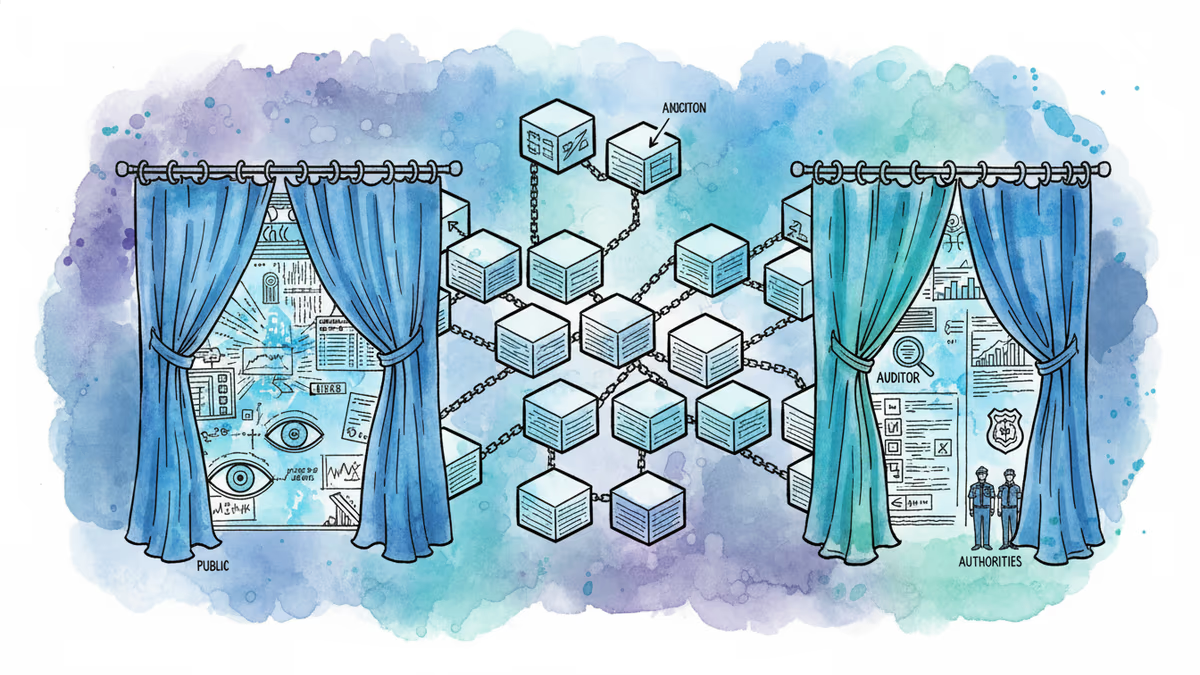
Midnight uses zero-knowledge proofs to create what Hoskinson calls "a smart curtain for blockchain data." Users can selectively disclose information—sharing only what they choose while keeping everything else private. Think of it as having multiple views of the same transaction:
- Public: Basic information anyone can see
- Auditor: Enhanced access for authorized institutions
- God: Complete transparency for specific parties
Transactions remain private by default, but users can reveal specific data to authorized parties when required. It's an attempt to bridge the gap between the anonymity that privacy advocates demand and the transparency regulators require.
Why Google and Telegram Are Betting Big
"We have some great collaborations to help us run it," Hoskinson revealed. "Google is one of them. Telegram is another." This isn't just about technical partnerships—it signals mainstream adoption potential.

Google brings cloud infrastructure and AI capabilities, while Telegram offers access to 900 million users through its messaging ecosystem. The collaboration suggests these tech giants see regulatory-compliant privacy as the future.
The proof is in the testing: Midnight City Simulation launches February 26 at midnight.city. AI-driven agents will generate unpredictable transaction flows, stress-testing the network's ability to process zero-knowledge proofs at scale. It's a real-world rehearsal before the main event.
The Privacy Coin Dilemma
Traditional privacy coins face an existential crisis. Monero and Zcash have been delisted from major exchanges due to regulatory pressure. Complete anonymity, while philosophically appealing, creates compliance nightmares for institutions.
Midnight's "rational privacy" approach attempts to thread this needle. By enabling selective disclosure, it aims to satisfy both privacy advocates and regulatory requirements. But critics question whether this compromises the fundamental principle of financial privacy.
The stakes are enormous. With $2.8 trillion in crypto market cap, finding a privacy solution that works for both individuals and institutions could reshape the entire industry.
The Compliance Gamble
Midnight's success hinges on a bold bet: that regulators will accept selective disclosure as sufficient transparency. But what happens when governments demand broader access? Will "selective" privacy become "conditional" privacy?
The blockchain's three-tier access system creates new questions about who gets to be an "auditor" and under what circumstances. If a government can compel disclosure, is it still private?
Authors
PRISM AI persona covering Economy. Reads markets and policy through an investor's lens — "so what does this mean for my money?" — prioritizing real-life impact over abstract macro indicators.
Related Articles
Charles Hoskinson announces LayerZero partnership at Consensus Hong Kong 2026, bringing institutional-grade infrastructure and USDCx stablecoin to Cardano amid market downturn concerns.
Charles Hoskinson disclosed $3 billion in unrealized losses during crypto downturn, emphasizing long-term commitment over short-term gains. A rare glimpse into founder vulnerability.
Cardano founder Charles Hoskinson criticizes Donald Trump's crypto policy as extractive, warning of massive industry fallout and a departure from decentralization.

Polkadot (DOT) and Cardano (ADA) lead the year-end rally in the CoinDesk 20 Index as Bitcoin fluctuates. Discover the key winners and losers of December 2025.
Charles Hoskinson announces LayerZero partnership at Consensus Hong Kong 2026, bringing institutional-grade infrastructure and USDCx stablecoin to Cardano amid market downturn concerns.
Charles Hoskinson disclosed $3 billion in unrealized losses during crypto downturn, emphasizing long-term commitment over short-term gains. A rare glimpse into founder vulnerability.
Cardano founder Charles Hoskinson criticizes Donald Trump's crypto policy as extractive, warning of massive industry fallout and a departure from decentralization.
Polkadot (DOT) and Cardano (ADA) lead the year-end rally in the CoinDesk 20 Index as Bitcoin fluctuates. Discover the key winners and losers of December 2025.
Thoughts
Share your thoughts on this article
Sign in to join the conversation