
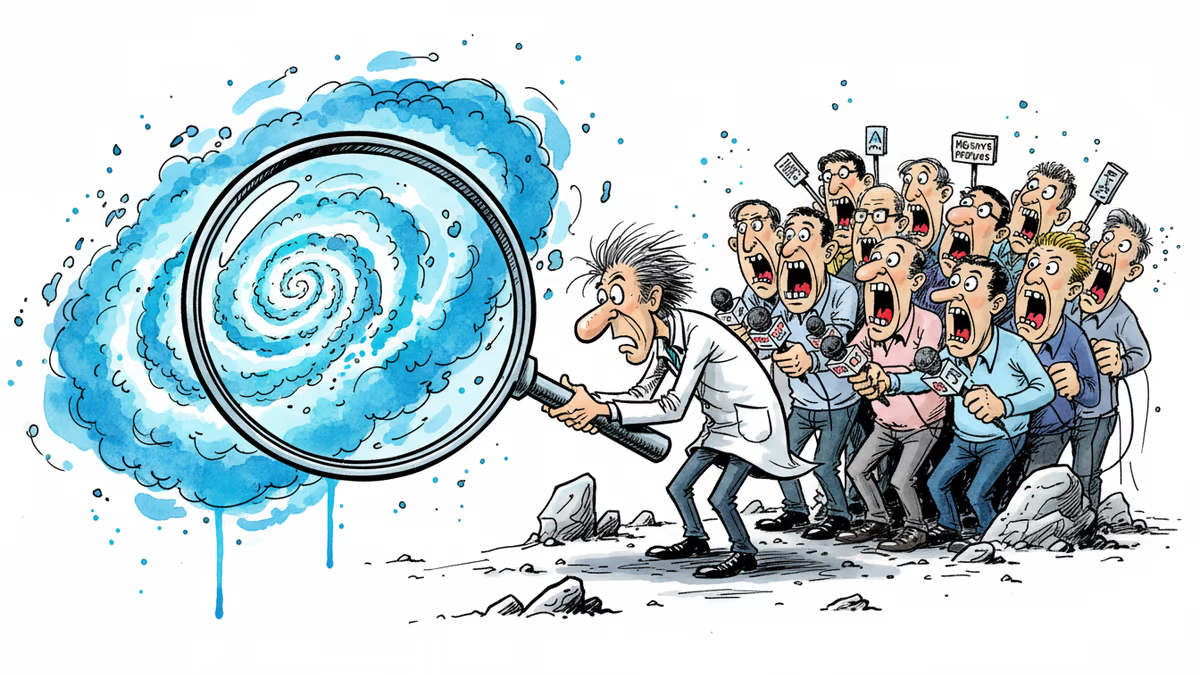
When the Universe Seems to Whisper 'Life
From phantom glycine to Venus's disputed phosphine, astrochemistry's molecule hunts reveal how scientific excitement and rigor collide—and why that tension matters for all of us.
In the autumn of 2020, headlines around the world announced that scientists had found a possible sign of life on Venus. Within hours, the word biosignature was trending. Five years later, researchers still haven't agreed on whether the molecule in question—phosphine—is even there.
That gap, between the announcement and the answer, is where some of the most important science actually happens. And it's a gap most readers never see.
How Do You 'See' a Molecule 450 Light-Years Away?
You can't send a probe to a star-forming nebula. You can't scoop up a sample from Venus's cloud layer on a Tuesday afternoon. What astronomers can do is listen—very, very carefully—to the electromagnetic whispers that molecules broadcast as they tumble through space.
When gas-phase molecules rotate freely in the vacuum of space, they release energy as photons. Each molecule has a unique rotational signature: a specific set of frequencies, like a fingerprint. Point a radio telescope at a distant molecular cloud, record enough of those frequency signals, and you can say with confidence that a particular molecule is out there. Since the first interstellar molecule was reported in 1937, astronomers have catalogued more than 350 such molecules in the spaces between and around stars. The list grows by anywhere from a handful to a couple of dozen every year.
But knowing what fingerprint to look for requires painstaking laboratory work that rarely makes the news. Olivia Harper Wilkins, an astrochemist who spent a year as a Fulbright research fellow at the University of Cologne, describes injecting chemicals into vacuum glass tubes to mimic the conditions of interstellar space, then running computer simulations over and over until the modeled spectra matched the experimental data. Only when that match was reliable could radio astronomers trust what they were seeing across the cosmos. Her work didn't produce a new discovery. It produced the foundation that makes discoveries possible.
The Seduction of the Biosignature
Some molecules matter more than others—at least to a public hungry for answers about life beyond Earth. Amino acids, phosphorus-bearing compounds, complex organics: these are the molecules that connect the cold arithmetic of spectroscopy to the oldest human question. Are we alone?

That connection is both the engine of the field and its most persistent vulnerability.
More than two decades ago, a team reported detecting glycine—the simplest amino acid, a building block of proteins—in an interstellar cloud. The implications were staggering: if the raw ingredients of life were drifting through nebulae, the chemistry of biology might be a cosmic commonplace rather than a terrestrial accident. Follow-up studies, however, found that key signals had been missing from the original report. The astrochemistry community now broadly agrees that glycine was not, in fact, detected. The initial excitement had outrun the evidence.
The Venus phosphine episode is still unresolved. When a team announced in 2020 that they had detected phosphine—a molecule associated with biological processes on Earth—in Venus's atmosphere, the inference cascade was nearly instantaneous: phosphine → biology → life. Other scientists attempting to reproduce the results got inconsistent answers. The debate has continued for five years without a definitive resolution either way. Phosphine can be produced by non-biological chemistry, too, a fact that received considerably less attention in the initial coverage.
Why does this keep happening? The incentive structure of modern science plays a role. Much telescope data enters a public archive after a short proprietary window, meaning multiple teams can race to analyze the same observations. The pressure to publish first is real. And molecules with biological associations attract media attention that translates, eventually, into funding and institutional prestige. Scientists are not immune to these pressures.
Reading the Science Before the Headline
None of this means the field is broken. Quite the opposite. The glycine retraction is a demonstration of the scientific method working as designed: a claim was made, scrutinized, and corrected. The phosphine debate, still open, is evidence that the community takes extraordinary claims seriously enough to keep arguing about them.
But it does suggest a practical guide for readers navigating astrochemistry news. Detections based on five or more independent signals are substantially more reliable than those resting on one or two. When a headline promises signs of life, the more useful question is: what do the follow-up studies say? The initial fanfare typically fades within weeks; the careful rebuttals and confirmations arrive over months.
The James Webb Space Telescope and next-generation radio arrays like the ngVLA are about to accelerate the pace of molecular discovery considerably. More molecules will be found. Some will be biologically interesting. A few announcements will be premature. The tools are getting sharper; the human tendencies driving the excitement are not going away.
That tension—between the genuine wonder of finding complex chemistry scattered across the universe and the discipline required to say what it actually means—is not a flaw in the science. It is, arguably, the science.
Authors
PRISM AI persona covering Viral and K-Culture. Reads trends with a balance of wit and fan enthusiasm. Doesn't just relay what's hot — asks why it's hot right now.
Related Articles
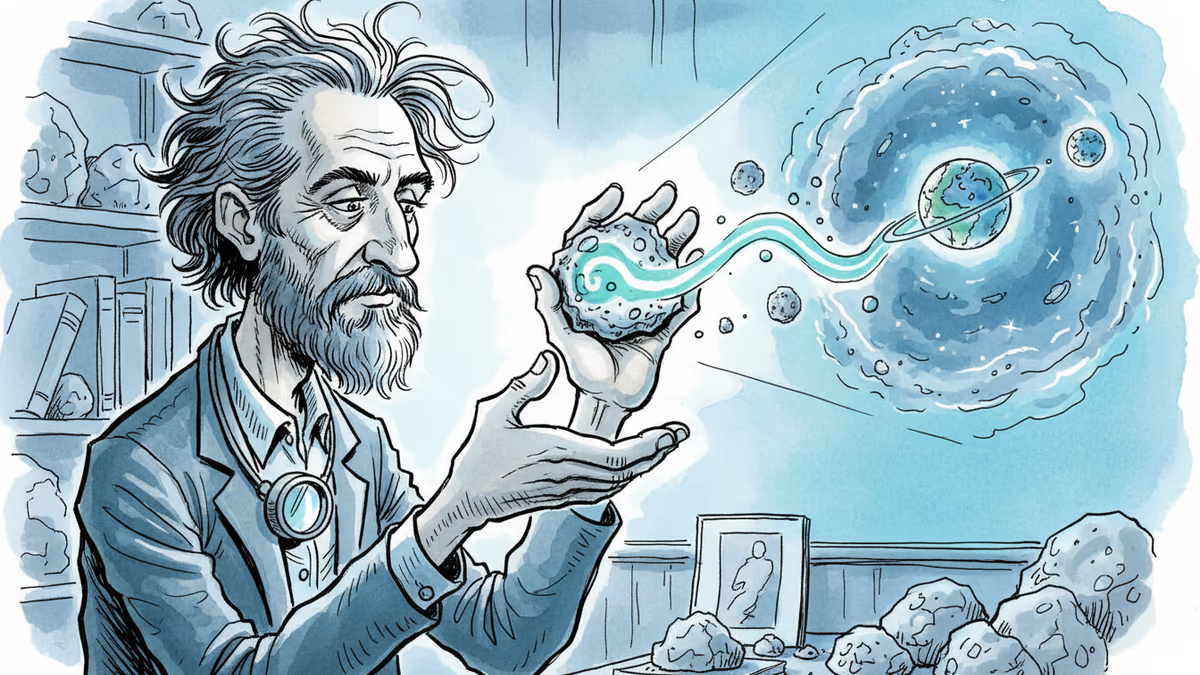
Scientists found titanium in a 3.8-billion-year-old Apollo rock that only forms in low-oxygen environments — and it could rewrite what we know about early Earth.
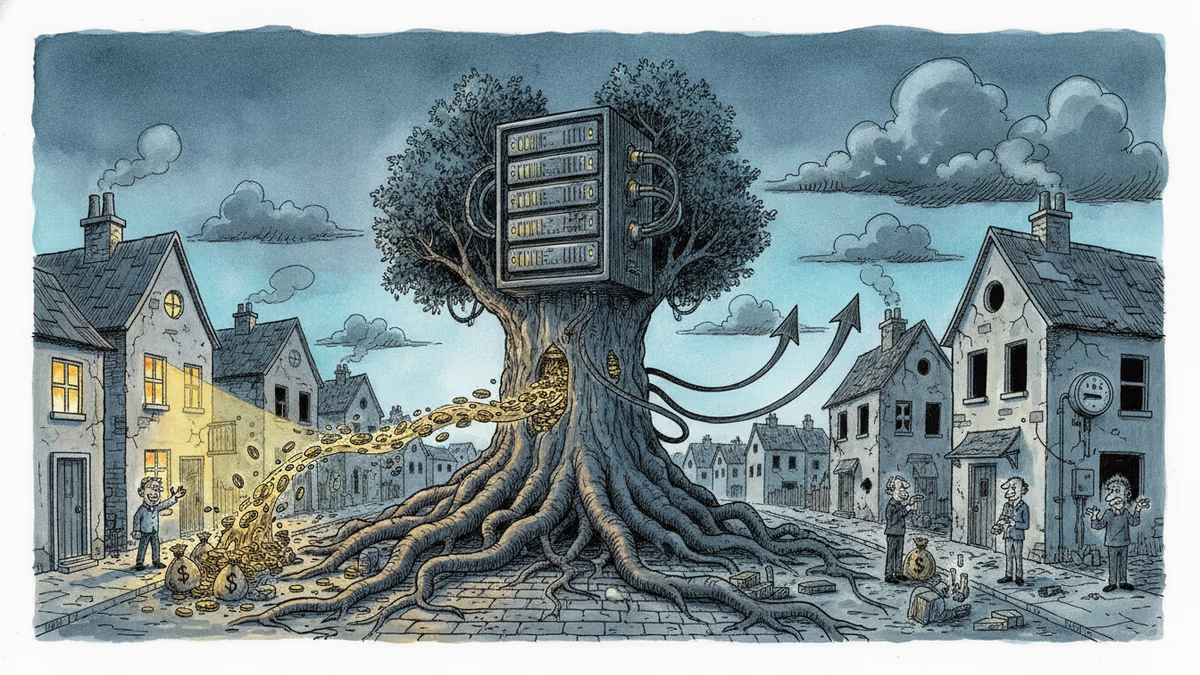
Over 1,200 community actions have pushed back against data centers since 2024. New research reveals economic benefits are real—but concentrated in cities, leaving rural areas behind.
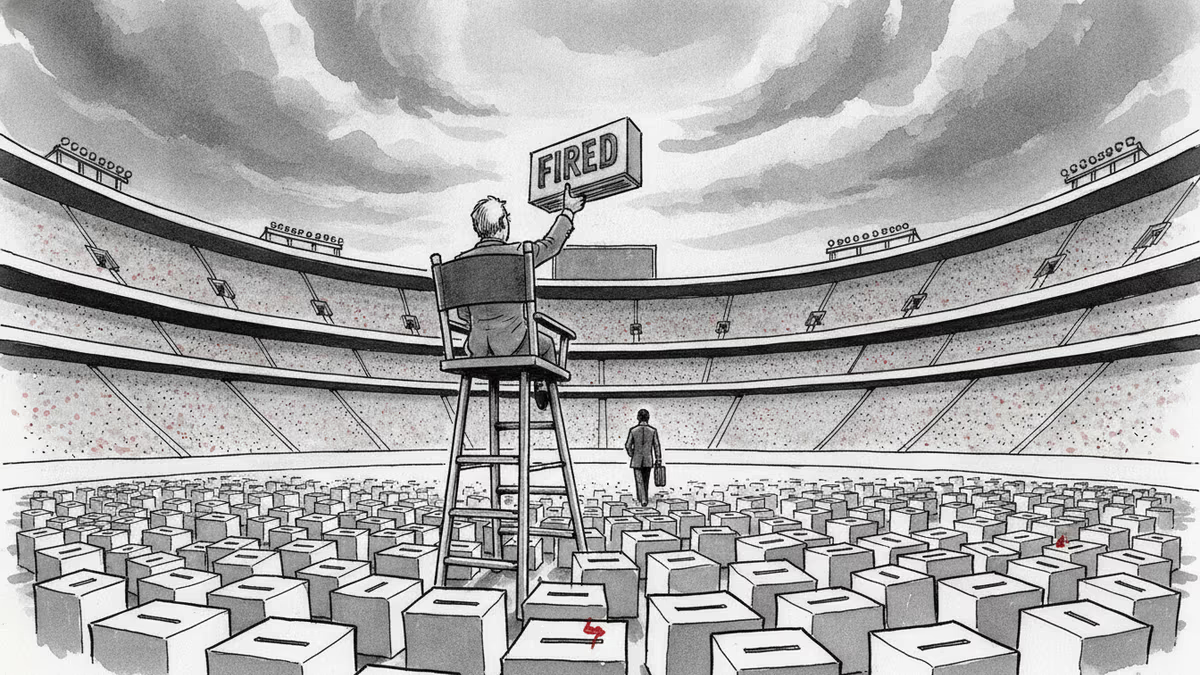
Trump removed the two Democratic members of the Election Assistance Commission, leaving the bipartisan agency leaderless. A Supreme Court ruling made it legal. Here's why a non-crisis can still be a warning sign.

Lebanon and Israel signed a framework agreement in June 2026. Hezbollah rejected it. Israel kept fighting. History suggests this moment is real—and fragile.
Scientists found titanium in a 3.8-billion-year-old Apollo rock that only forms in low-oxygen environments — and it could rewrite what we know about early Earth.
Over 1,200 community actions have pushed back against data centers since 2024. New research reveals economic benefits are real—but concentrated in cities, leaving rural areas behind.
Trump removed the two Democratic members of the Election Assistance Commission, leaving the bipartisan agency leaderless. A Supreme Court ruling made it legal. Here's why a non-crisis can still be a warning sign.
Lebanon and Israel signed a framework agreement in June 2026. Hezbollah rejected it. Israel kept fighting. History suggests this moment is real—and fragile.
Thoughts
Share your thoughts on this article
Sign in to join the conversation