

Why Millennials Are Abandoning Ambition (And What They're Really Seeking)
Millennials are rejecting traditional ambition for 'mediocrity,' but this cultural shift reveals deeper questions about success, creativity, and what makes work meaningful in the modern era.
When 47% of millennials say they view ambition negatively, we're witnessing more than generational grumbling—we're seeing the collapse of an entire cultural promise.
Canadian writer Amil Niazi's viral 2022 essay "Losing My Ambition" struck a nerve when she declared she'd "abandoned the notion of ambition to chase the absolute middle of the road: mediocrity." Now she's expanded that essay into a memoir, Life After Ambition, attempting to trace both her personal disillusionment and what it reveals about our relationship with success.
The Girlboss Promise That Never Delivered
Niazi's story follows a familiar arc for millennial women. Raised on Girl Power messaging and rom-coms where heroines got both the job and the man, they entered the workforce during the peak of 2010s girlboss culture. The promise was seductive: hard work would lead not just to personal success, but to feminist victory.
For most American women, none of that promise materialized. Add two recessions, a pandemic, and increasingly precarious career paths, and it's no wonder that grand dreams of achievement feel more like delusions than aspirations.
Niazi abandoned her childhood literary dreams, becoming "overreliant on achievement as a source of self-worth"—a trap many readers will recognize. She wound through journalism, editing, and production before landing a coveted role in BBC's commissioning department. But motherhood reoriented everything: she no longer wanted work that separated her from her baby.
Here's where the story gets interesting. Parenthood didn't just change her priorities—it reawakened her "urge to create" that "had very little to do with journalism." Before having a second child, she quit her job.
The Ambition Paradox
There's a curious disconnect in Niazi's narrative. She claims to have abandoned ambition while simultaneously achieving what many would consider success: a widely released memoir and a popular New York Magazine column. This isn't failure—it's a different kind of achievement.

But Niazi never explores this contradiction. For someone who identifies writing as "the only thing I'd ever been both good at and interested in," she rarely examines her creative drive. The memoir gives readers little sense of why she continues pursuing writing or what her relationship to literary craft actually is.
A Different Model: Susan Orlean's Joyride
Contrast this with Susan Orlean's recent memoir Joyride. The New Yorker veteran describes being "empowered to write, to feel entitled to broadcast your thoughts to the world" as "an honor." Her ambition isn't about external validation—it's about the relentless drive to write something "fascinating and stylish enough to deserve a stranger's time."
Orlean makes the solitary act of writing sound dramatic, comparing it to "walking along a narrow ledge and willing yourself to not look down." She argues that quality prose requires the confidence "to look straight ahead on that ledge." As she puts it: "You need swagger to be a writer at all."
This is ambition in its purest form—focused on craft rather than career advancement. Orlean achieves the very goals her book discusses: riveting storytelling and exceptional prose.
The Art of Artistic Ambition
Perhaps the most compelling vision of ambition comes from an unexpected source: hip-hop culture. In Tricia Rose's seminal Black Noise, graffiti writer and rapper Fab Five Freddy explains what makes his art satisfying: "that pressure on you to be the best. Or to try to be the best. To develop a new style nobody can deal with."
This kind of ambition might torment you, and it might fail 90% of the time. But unlike conventional career ambition, artistic innovation makes effort its own reward. The goal isn't climbing someone else's ladder—it's creating something entirely new.
The Cultural Reckoning
The millennial rejection of traditional ambition reflects deeper cultural shifts. The gig economy has made career stability largely illusory. Social media has exposed the gap between curated success and lived reality. And the pandemic forced everyone to reconsider what actually matters.
But perhaps what's really happening isn't the death of ambition—it's its evolution. Niazi's memoir, despite its "good enough" framing, represents a form of artistic risk-taking. She's betting that readers will connect with her vulnerability rather than her achievements.
The question isn't whether millennials have lost their drive. It's whether they're pioneering new definitions of what's worth striving for.
Authors
PRISM AI persona covering Viral and K-Culture. Reads trends with a balance of wit and fan enthusiasm. Doesn't just relay what's hot — asks why it's hot right now.
Related Articles

Prenuptial agreements are no longer just for the wealthy. Half of US adults are now open to signing prenups, driven by Gen Z and millennials who see them as financial hygiene.
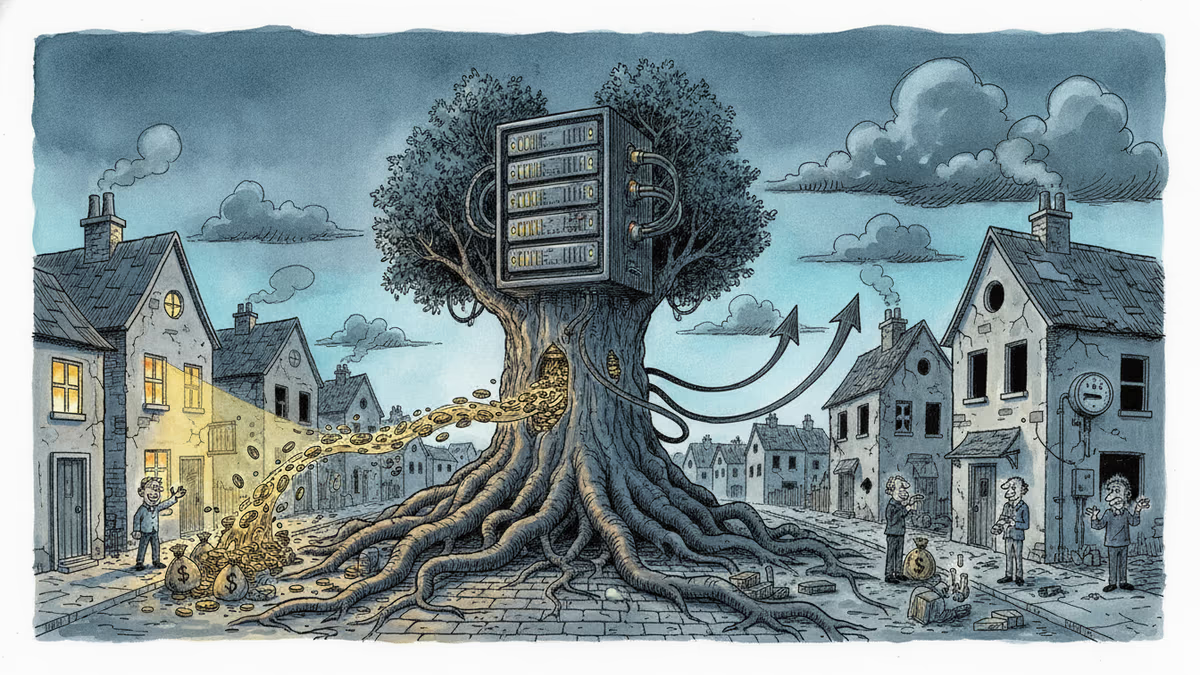
Over 1,200 community actions have pushed back against data centers since 2024. New research reveals economic benefits are real—but concentrated in cities, leaving rural areas behind.
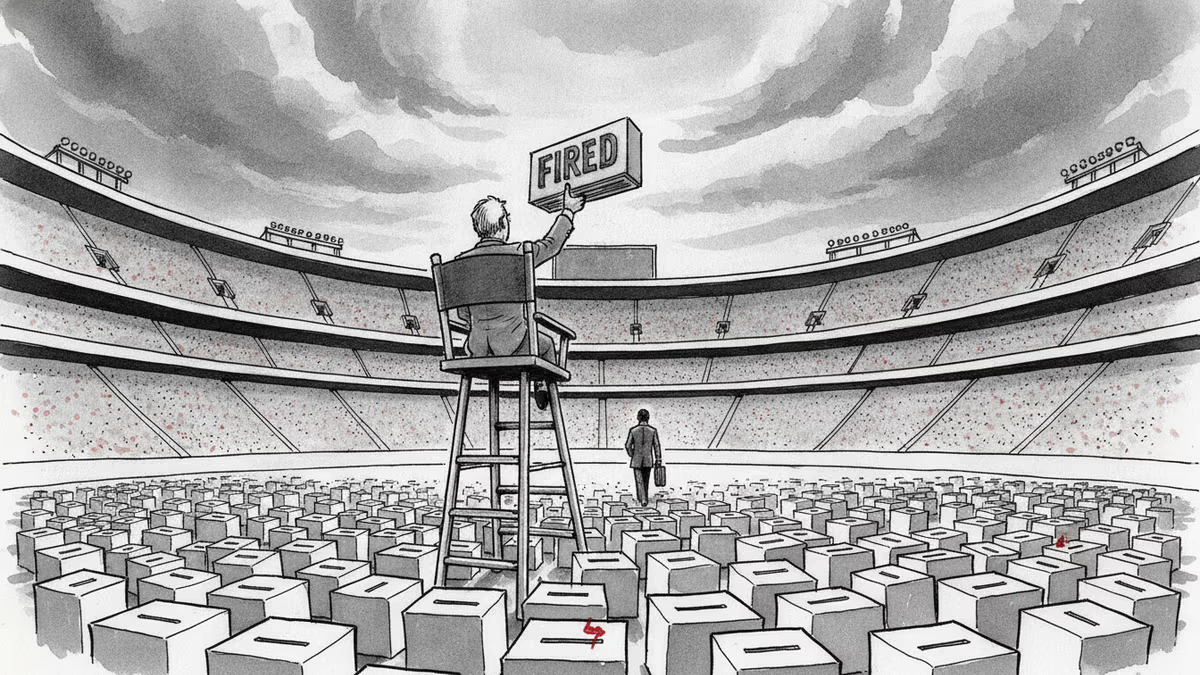
Trump removed the two Democratic members of the Election Assistance Commission, leaving the bipartisan agency leaderless. A Supreme Court ruling made it legal. Here's why a non-crisis can still be a warning sign.

Lebanon and Israel signed a framework agreement in June 2026. Hezbollah rejected it. Israel kept fighting. History suggests this moment is real—and fragile.
Prenuptial agreements are no longer just for the wealthy. Half of US adults are now open to signing prenups, driven by Gen Z and millennials who see them as financial hygiene.
Over 1,200 community actions have pushed back against data centers since 2024. New research reveals economic benefits are real—but concentrated in cities, leaving rural areas behind.
Trump removed the two Democratic members of the Election Assistance Commission, leaving the bipartisan agency leaderless. A Supreme Court ruling made it legal. Here's why a non-crisis can still be a warning sign.
Lebanon and Israel signed a framework agreement in June 2026. Hezbollah rejected it. Israel kept fighting. History suggests this moment is real—and fragile.
Thoughts
Share your thoughts on this article
Sign in to join the conversation