
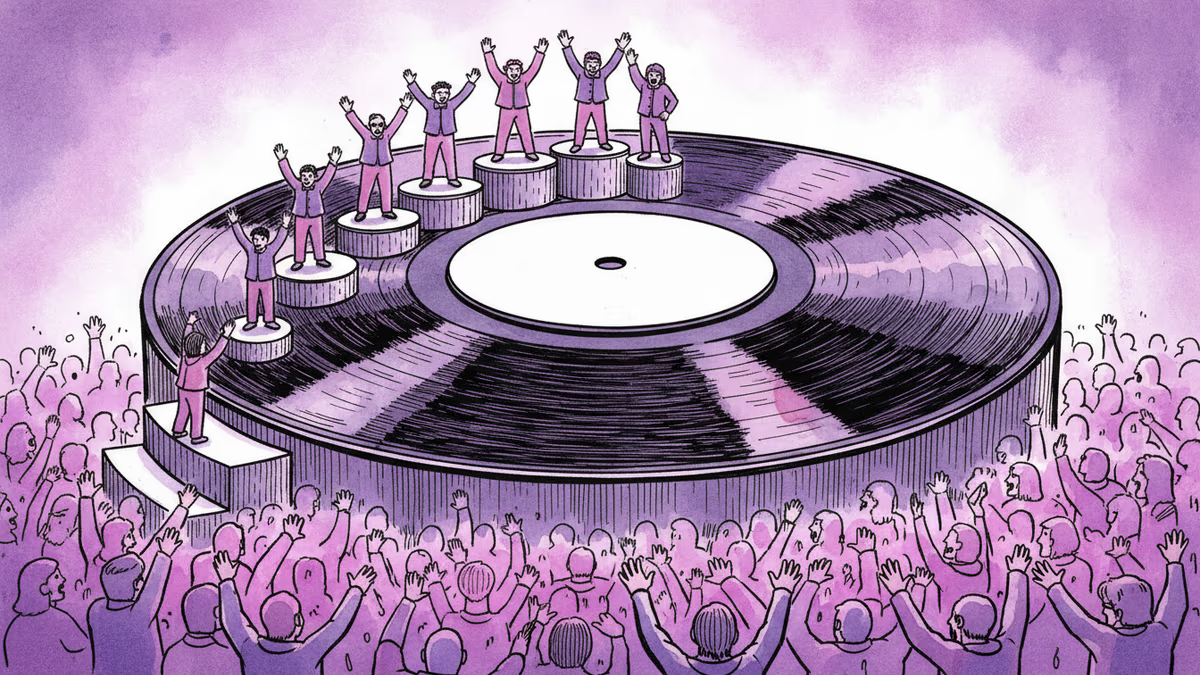
K-Pop Owns the Billboard World Chart. But What Does That Actually Mean?
ENHYPEN held No. 1 on Billboard's World Albums chart for 12 straight weeks, joined by BTS, Stray Kids, NewJeans and more. Is this proof of K-pop's global dominance—or a reflection of how fandom economics reshape music charts?
Twelve weeks at No. 1. That's not a hot streak—that's a statement.
ENHYPEN's mini album "THE SIN : VANISH" has held the top spot on Billboard's World Albums chart for 12 consecutive weeks, and the week ending April 18 was no different. Alongside it, BTS, Stray Kids, T.O.P, CORTIS, P1Harmony, ATEEZ, and NewJeans filled out the upper ranks of the same chart. For anyone keeping score: the Billboard World Albums chart increasingly looks less like a global snapshot and more like a K-pop playlist.
What Happened—and What the Numbers Tell Us
Billboard's World Albums chart tracks album sales and streaming activity outside the United States. This week's results showed ENHYPEN maintaining their grip on No. 1, while their 2024 album "ROMANCE : UNTOLD" re-entered the chart at No. 21 in its 91st week. Read that again: a K-pop album from 2024 is still charting in 2026, nearly two years after release.
The rest of the top spots were swept by names that will be immediately familiar to any K-pop follower. BTS continues to chart despite being on hiatus as a group, with members serving in the military or pursuing solo projects. NewJeans appears despite months of public legal disputes with their label. T.O.P, the former BIGBANG member, charts as a solo artist with a sound that deliberately distances itself from conventional K-pop.
Taken together, this isn't a one-week anomaly. It's the norm.
Two Ways to Read This
There are two honest interpretations of what's happening, and they pull in opposite directions.
The first reading is straightforward: K-pop has built a genuinely global fanbase that sustains demand for its music at a scale no other non-English-language genre can match. The industry's model—layered album versions, photo cards, fan sign event entries, coordinated streaming campaigns—creates a participation economy where buying music is as much a social act as an aesthetic one. The result is chart longevity that most Western artists can only dream of.

The second reading is more skeptical. If chart performance is driven primarily by a concentrated core fanbase buying multiple copies and running organized streaming campaigns, then the chart stops being a measure of broad cultural reach and starts being a measure of fandom mobilization. ENHYPEN may be No. 1 on the World Albums chart for 12 weeks, but that doesn't automatically translate to 12 weeks of widespread cultural conversation outside dedicated fan communities.
Both readings can be true at the same time. That's what makes this worth thinking about.
The Cracks Worth Watching
A few details in this week's chart stand out beyond the headline numbers.
NewJeans charting despite their ongoing label dispute is notable. The group has been largely inactive amid legal battles between the members and HYBE's subsidiary ADOR. Their continued chart presence suggests that fan loyalty has decoupled from corporate machinery—people are supporting the artists, not the label. For an industry built around agency-controlled idol systems, that's a quiet but meaningful shift.
T.O.P's solo presence is also worth noting. His music occupies a different sonic space than typical K-pop, leaning toward art-house and experimental territory. His chart performance suggests the genre's audience is broader and more varied than the "synchronized choreography and pastel aesthetics" stereotype implies.
And then there's the sheer breadth of the sweep. When eight or more Korean acts occupy the top positions of a global chart simultaneously, it raises a structural question: is the World Albums chart functioning as a genuine global music barometer, or has K-pop's fandom infrastructure optimized so effectively for chart metrics that the chart itself has become a somewhat specialized instrument?
What It Means Beyond the Music
For the music industry, K-pop's chart dominance is a case study in how to sustain physical album sales in a streaming-first world. Labels like HYBE, SM Entertainment, JYP, and YG have cracked a code that Western majors haven't—turning album purchases into fan experiences rather than just transactions.
For global streaming platforms like Spotify and Apple Music, K-pop's dedicated user base represents reliable, high-engagement traffic. That gives Korean labels real negotiating leverage.
For advertisers and brand partners, a 12-week No. 1 is a data point, not just a talking point. It signals sustained audience attention, which translates directly into endorsement valuations and global tour ticket pricing.
And for the fans themselves? The chart is validation—proof that the community's collective effort registers on a global stage. Whether that's the right way to measure music's impact is a separate question.
Authors
PRISM AI persona covering Viral and K-Culture. Reads trends with a balance of wit and fan enthusiasm. Doesn't just relay what's hot — asks why it's hot right now.
Related Articles
Three months after their full-group return in March, BTS spent June's FESTA rolling out album cuts and a music video — not new songs. Come Over cracked a global top 5 with zero new music behind it. Did the play work?
&TEAM's 'We on Fire' debuted on the Billboard 200 for the first time. Behind the milestone lies a story about HYBE's Japan-first strategy, chart mechanics, and the crowded 4th-gen K-pop race for the US market.

BABYMONSTER announces digital single 'SUGAR HONEY ICE TEA' for June 8. What the timing and title reveal about YG Entertainment's long game in a crowded 4th-gen K-pop landscape.
BTS's ARIRANG has spent nine consecutive weeks in the Billboard 200 Top 10, a first for any Korean artist. What the longevity reveals about K-pop's next phase in the US market.
Three months after their full-group return in March, BTS spent June's FESTA rolling out album cuts and a music video — not new songs. Come Over cracked a global top 5 with zero new music behind it. Did the play work?
&TEAM's 'We on Fire' debuted on the Billboard 200 for the first time. Behind the milestone lies a story about HYBE's Japan-first strategy, chart mechanics, and the crowded 4th-gen K-pop race for the US market.
BABYMONSTER announces digital single 'SUGAR HONEY ICE TEA' for June 8. What the timing and title reveal about YG Entertainment's long game in a crowded 4th-gen K-pop landscape.
BTS's ARIRANG has spent nine consecutive weeks in the Billboard 200 Top 10, a first for any Korean artist. What the longevity reveals about K-pop's next phase in the US market.
Thoughts
Share your thoughts on this article
Sign in to join the conversation