
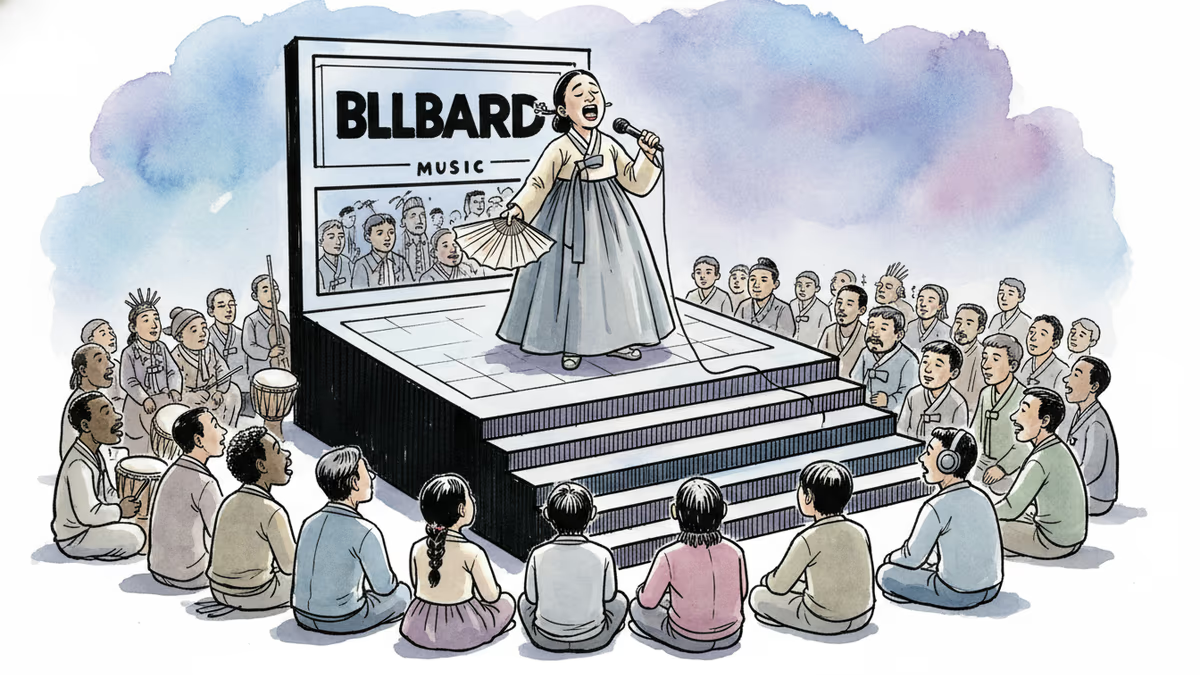
ARIRANG" Stayed on the Billboard 200 Top 10 for 9 Weeks. That Tells You Something.
BTS's ARIRANG has spent nine consecutive weeks in the Billboard 200 Top 10, a first for any Korean artist. What the longevity reveals about K-pop's next phase in the US market.
Nine weeks. That's how long BTS's ARIRANG has sat inside the Billboard 200's Top 10 — longer than any album by a Korean artist in the chart's history. On May 24, it landed at No. 10 in its ninth consecutive week, extending a record BTS had already set the week before. The previous record-holder? Also BTS.
The headline writes itself. But the more interesting story is what this kind of longevity actually measures — and what it doesn't.
What the Chart Actually Counts
The Billboard 200 aggregates streaming, digital downloads, and physical sales into a single weekly ranking. Cracking the Top 10 on release week is largely a function of fan mobilization: pre-orders, coordinated streaming, bulk physical purchases. K-pop fandoms have refined this to a near-science over the past decade.
Staying in the Top 10 for nine weeks is a different animal. It requires what the industry calls the long tail — casual listeners continuing to stream an album well after the initial release surge fades. That's historically been K-pop's structural weakness in the US market. Albums spike, then drop. ARIRANG didn't drop.
What changed? Likely a combination of factors: the album's musical range appears broad enough to pull in listeners beyond the core BTS fanbase; HYBE's Weverse platform has grown sophisticated enough to sustain engagement across multiple weeks; and the album arrived at a moment when the group's full return from mandatory military service carried genuine cultural weight in South Korea and among the diaspora.
The Naming Decision That Wasn't Accidental
The album is called ARIRANG — the name of a centuries-old Korean folk song, untranslated, unmodified. That's a deliberate departure from the trajectory K-pop had been on for most of the 2010s, when English-language hooks, Western producer credits, and globally legible aesthetics were treated as prerequisites for US market penetration.

By the mid-2020s, the calculus shifted. "Authenticity" became one of the dominant currencies in mainstream American pop marketing — see Beyoncé's Cowboy Carter, Kendrick Lamar's GNX, both of which leaned hard into cultural specificity rather than away from it. ARIRANG fits that same register: a title that signals origin rather than accessibility, paired with an album that reportedly integrates traditional Korean musical textures alongside contemporary production.
The irony is that the most overtly Korean album BTS has released may also be their most durable US chart performer. That's not a coincidence — it's a market signal.
Where ARIRANG Sits in the Current Landscape
During the nine weeksARIRANG held Top 10 position, it shared the upper reaches of the Billboard 200 with Kendrick Lamar, Sabrina Carpenter, and Beyoncé. The company it kept matters: these are artists with mainstream US listener bases, not just dedicated fandoms.
Within K-pop itself, the gap is stark. BLACKPINK has been in a fragmented solo cycle; aespa, SEVENTEEN, and STRAY KIDS have all charted on the Billboard 200 but haven't approached this kind of sustained Top 10 presence. Fourth-generation groups have built enormous global fanbases, but the transition from single-track streaming consumption to album-unit staying power in the US hasn't fully materialized yet. ARIRANG's run highlights that gap rather than closing it.
For HYBE as a publicly traded company, the timing is significant. The label has faced investor scrutiny over its post-BTS pipeline, and the group's full-unit return was always going to be the clearest near-term answer to questions about revenue sustainability. Nine weeks in the Top 10 is a strong answer.
What This Doesn't Settle
Three explanations for ARIRANG's longevity are in circulation, and they're not mutually exclusive: BTS's individual brand equity, accumulated over more than a decade; HYBE's increasingly engineered fan engagement infrastructure; and the album's own musical quality drawing in non-fandom listeners.
Disentangling those three is genuinely difficult from the outside. If the longevity is primarily a function of HYBE's platform mechanics, it tells us something about the industrialization of chart performance. If it's primarily the album itself pulling in casual listeners, it tells us something more interesting about where K-pop's ceiling actually is.
The record also raises a question about what comes next for other Korean artists. If the "authenticity" play — leaning into Korean cultural specificity rather than softening it for Western audiences — is what drove ARIRANG's staying power, that's a replicable strategy. But it's also one that depends heavily on the artist having enough pre-existing US recognition to make the cultural specificity legible rather than simply unfamiliar.
This content is AI-generated based on source articles. While we strive for accuracy, errors may occur. We recommend verifying with the original source.
Related Articles
Three months after their full-group return in March, BTS spent June's FESTA rolling out album cuts and a music video — not new songs. Come Over cracked a global top 5 with zero new music behind it. Did the play work?
PRISM Trend Pipeline caught LE SSERAFIM's YouTube KR trending peak. Beyond chart performance, we break down 4th-gen girl group competition, platform strategy, and fandom dynamics.
&TEAM's 'We on Fire' debuted on the Billboard 200 for the first time. Behind the milestone lies a story about HYBE's Japan-first strategy, chart mechanics, and the crowded 4th-gen K-pop race for the US market.

BABYMONSTER announces digital single 'SUGAR HONEY ICE TEA' for June 8. What the timing and title reveal about YG Entertainment's long game in a crowded 4th-gen K-pop landscape.
Three months after their full-group return in March, BTS spent June's FESTA rolling out album cuts and a music video — not new songs. Come Over cracked a global top 5 with zero new music behind it. Did the play work?
PRISM Trend Pipeline caught LE SSERAFIM's YouTube KR trending peak. Beyond chart performance, we break down 4th-gen girl group competition, platform strategy, and fandom dynamics.
&TEAM's 'We on Fire' debuted on the Billboard 200 for the first time. Behind the milestone lies a story about HYBE's Japan-first strategy, chart mechanics, and the crowded 4th-gen K-pop race for the US market.
BABYMONSTER announces digital single 'SUGAR HONEY ICE TEA' for June 8. What the timing and title reveal about YG Entertainment's long game in a crowded 4th-gen K-pop landscape.
Thoughts
Share your thoughts on this article
Sign in to join the conversation