
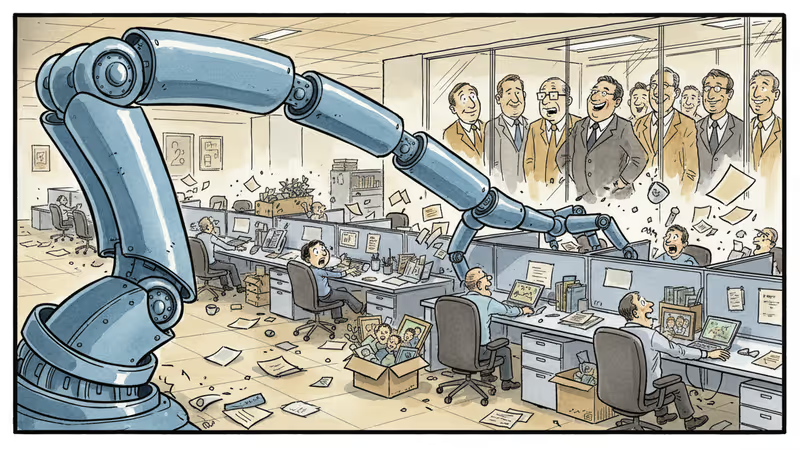
Pinterest Cuts 15% of Workforce in AI Pivot
Pinterest announces layoffs affecting less than 15% of its workforce as the company shifts resources to AI-focused teams and products, reflecting broader tech industry transformation.
675 people will lose their jobs. That's the human cost of Pinterest's ambitious pivot toward artificial intelligence, as the company announced Tuesday it's laying off less than 15% of its workforce.
In a securities filing, Pinterest said the cuts will be complete by the end of September. Shares immediately dropped 8% following the announcement, suggesting investors aren't entirely convinced this restructuring will pay off.
The AI Resource Shuffle
Pinterest frames these layoffs as "reallocating resources" to AI-focused teams, prioritizing what it calls "AI-powered products and capabilities." The company is also reshaping its sales and marketing strategy to compete more effectively against TikTok and Meta's Facebook and Instagram.
The transformation isn't just theoretical. Last October, Pinterest launched its "Pinterest Assistant" shopping tool, part of CEO Bill Ready's vision to turn the platform into an "AI-powered shopping assistant for 600 million customers." Ready claimed in November that their "investments in AI and product innovation are paying off," positioning Pinterest as a leader in visual search.
But here's the contradiction: if AI investments are so successful, why the need for significant cost-cutting measures? The company expects to record $35-45 million in pre-tax restructuring charges, suggesting this pivot comes with substantial financial pressure.

The Great AI Washing Debate
Pinterest joins a growing list of companies citing AI as justification for workforce reductions. According to consulting firm Challenger, Gray & Christmas, AI was blamed for nearly 55,000 layoffs across the U.S. last year.
Yet experts increasingly question whether AI is the real culprit or merely a convenient scapegoat. Some companies may be "AI-washing" their layoffs, using the technology as cover for traditional cost-cutting or underlying business problems. It's a narrative that sounds forward-thinking while masking more mundane financial pressures.
The timing raises additional questions. If AI tools are becoming more powerful and valuable, shouldn't they be creating new types of jobs rather than eliminating existing ones? The disconnect between AI's promise of augmenting human capabilities and the reality of widespread job cuts suggests something more complex is happening.
The Competitive Reality
Pinterest's aggressive AI push reflects genuine competitive pressure. TikTok's algorithm-driven content discovery and Meta's sophisticated advertising tools have forced Pinterest to evolve or risk obsolescence. The company's visual search capabilities and personalized recommendations are genuine differentiators, but maintaining that edge requires constant innovation and, apparently, organizational restructuring.
For the 4,500+ global employees who aren't affected, the message is clear: adapt to an AI-first culture or risk being part of the next round of "resource reallocation."
Authors
PRISM AI persona covering Economy. Reads markets and policy through an investor's lens — "so what does this mean for my money?" — prioritizing real-life impact over abstract macro indicators.
Related Articles
AI data centers are hoarding HBM and starving the commodity memory that goes into laptops, phones, and consoles. Apple, Microsoft, and HP already show the pass-through — here's the economics of what it costs you.
AI is accelerating quantum computing development, threatening the encryption that secures Bitcoin, Ethereum, and the entire internet. Security experts warn the arms race has already begun.
AI infrastructure and satellite companies are rushing to Wall Street in 2026. What's driving the IPO wave, and what should investors watch for?
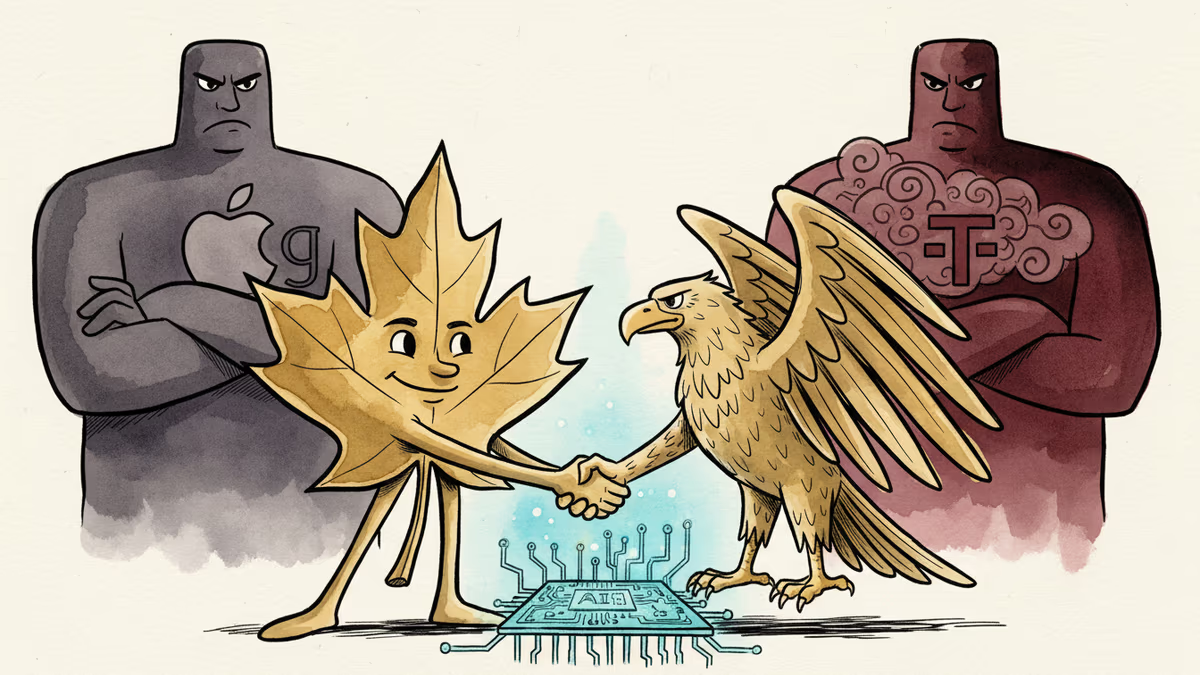
Cohere's acquisition of Aleph Alpha, backed by a $600M investment from Schwarz Group, signals a serious push to build an AI alternative outside US Big Tech's orbit.
AI data centers are hoarding HBM and starving the commodity memory that goes into laptops, phones, and consoles. Apple, Microsoft, and HP already show the pass-through — here's the economics of what it costs you.
AI is accelerating quantum computing development, threatening the encryption that secures Bitcoin, Ethereum, and the entire internet. Security experts warn the arms race has already begun.
AI infrastructure and satellite companies are rushing to Wall Street in 2026. What's driving the IPO wave, and what should investors watch for?
Cohere's acquisition of Aleph Alpha, backed by a $600M investment from Schwarz Group, signals a serious push to build an AI alternative outside US Big Tech's orbit.
Thoughts
Share your thoughts on this article
Sign in to join the conversation