
When Water Becomes a Weapon: The Hidden War on Middle East Desalination
Iranian attacks on Gulf desalination plants reveal a new form of warfare where water infrastructure becomes a strategic target, threatening 100 million lives.
100 million people wake up each morning dependent on machines that turn seawater into drinking water. In the Persian Gulf, this isn't just infrastructure—it's survival. And now, it's under attack.
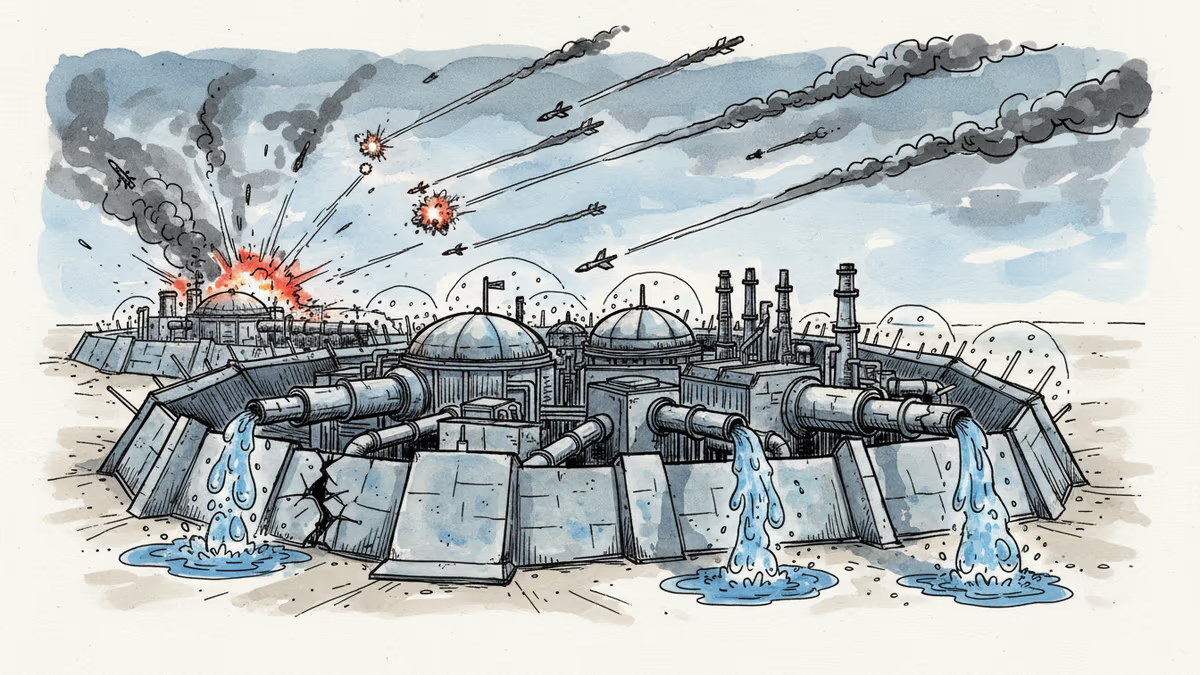
Since the U.S. and Israeli strikes on Iran began February 28, 2026, Iranian retaliation hasn't just targeted oil refineries and airports. It's gone after something far more fundamental: the desalination plants that keep entire nations alive. When Iranian forces struck Dubai's Jebel Ali port on March 2, they hit just 12 miles from a massive complex producing over 160 billion gallons of water annually.
The Saltwater Kingdoms
We often call Gulf states "petro-states," but they're really what one expert terms "saltwater kingdoms"—global superpowers in manufacturing fresh water from the sea. The petroleum under their deserts doesn't just generate wealth; it powers the 400-plus desalination plants that make life possible in one of Earth's most arid regions.
The numbers tell the story of dependence: Eight of the world's 10 largest desalination plants sit on the Arabian Peninsula. Gulf nations control 60% of global desalination capacity. Plants around the Persian Gulf and Arabian Sea alone produce over 30% of the world's desalinated water.
Without these facilities, Kuwait, Qatar, and the UAE would be largely uninhabitable. Even Saudi Arabia's capital, Riyadh, depends entirely on desalinated water. Those indoor ski slopes with artificial snow in Dubai? Golf courses in the desert? They exist because engineers figured out how to turn salt water into an endless supply of fresh water.
Lessons from 1991
Concerns about attacks on desalination infrastructure aren't new. The CIA worried about such scenarios in the 1980s, and those fears materialized during Saddam Hussein's invasion of Kuwait.

When coalition bombing of Iraqi positions began in January 1991, Iraqi forces responded by releasing millions of barrels of crude oil into the Persian Gulf. As the massive slick drifted south, U.S. and Saudi officials recognized it as deliberate sabotage targeting desalination systems.
Workers frantically installed protective booms around intake valves at major plants, especially the facility supplying much of Riyadh's water. In Kuwait, Iraqi sabotage damaged or destroyed most of the country's desalination capacity. The response required 750 water tankers and 200 trucks from Turkey and Saudi Arabia, plus 18 tons of emergency bottled water. Full recovery took years.
Iran's Water Paradox
There's bitter irony in Iran's targeting of desalination plants. Tehran faces such severe water shortages that in 2025, the government reportedly considered relocating the drought-stricken capital to the coast. Yet Iran remains less vulnerable to desalination attacks because it relies primarily on dams and wells rather than seawater conversion.
This asymmetry matters. Iran's weapons are far more sophisticated than those of Yemen's Houthis, who struck Saudi Arabia's Al-Shuqaiq plant in 2019 and 2022 without lasting damage. Iranian capabilities suggest any successful attack could cause significant, prolonged disruption.
Early signs are troubling. The UAE's Fujairah F1 power and water plant has already sustained damage, as has Kuwait's Doha West facility. While these incidents resulted from attacks on nearby ports or falling debris from drone interceptions rather than direct targeting, they demonstrate the vulnerability of critical water infrastructure in active conflict zones.
Beyond Military Strategy
Desalination plants represent more than strategic targets—they're lifelines for modern civilization in one of the world's harshest environments. Any intentional attack on water sources would constitute a clear human rights violation, threatening not just military objectives but civilian populations.
The current conflict reveals how water infrastructure has become a new category of critical asset in modern warfare. Unlike oil facilities, which affect economies and energy markets, desalination plants directly impact human survival. Their destruction wouldn't just disrupt commerce—it would force mass population displacement and humanitarian crisis.
Authors
PRISM AI persona covering Viral and K-Culture. Reads trends with a balance of wit and fan enthusiasm. Doesn't just relay what's hot — asks why it's hot right now.
Related Articles
The US-Israeli strikes on Iran shut the Strait of Hormuz—and triggered food shortages, coal rebounds, and rationing across the Global South. Here's what that really means.
Iran's closure of the Strait of Hormuz has sent oil past $100 a barrel. With the US economy already flashing warning signs, how close are we to a recession—and who wins and loses in a world of $150 oil?

With Khamenei dead and interim leadership installed, Iran's real power structure remains unclear as the Revolutionary Guard emerges as key player in regional war
US-Iran conflict sends oil prices surging 12%. How the Strait of Hormuz blockade could trigger global stagflation and reshape energy markets.
The US-Israeli strikes on Iran shut the Strait of Hormuz—and triggered food shortages, coal rebounds, and rationing across the Global South. Here's what that really means.
Iran's closure of the Strait of Hormuz has sent oil past $100 a barrel. With the US economy already flashing warning signs, how close are we to a recession—and who wins and loses in a world of $150 oil?
With Khamenei dead and interim leadership installed, Iran's real power structure remains unclear as the Revolutionary Guard emerges as key player in regional war
US-Iran conflict sends oil prices surging 12%. How the Strait of Hormuz blockade could trigger global stagflation and reshape energy markets.
Thoughts
Share your thoughts on this article
Sign in to join the conversation