
Mars Is Hiding an Older River Delta—Underground
NASA's Perseverance rover has detected a buried ancient river delta beneath Jezero Crater's surface. The discovery opens new possibilities in the search for signs of ancient Martian life.
The Map Had a Second Layer All Along
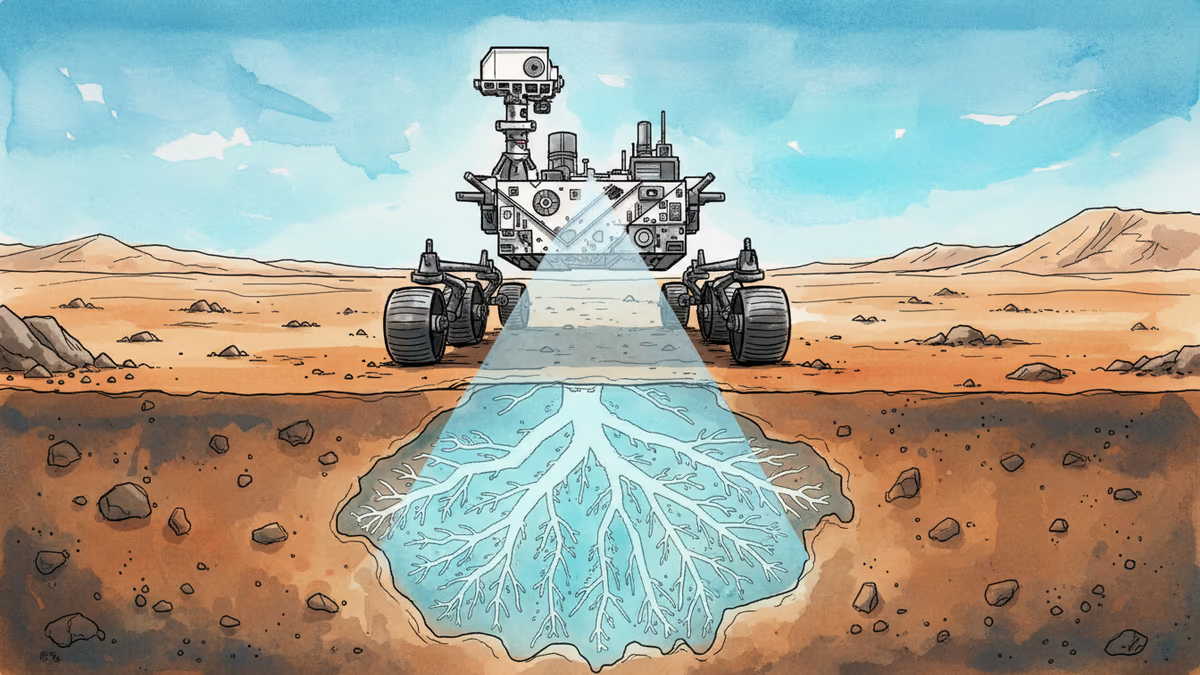
Scientists spent four years studying the wrong delta. Not wrong, exactly—but incomplete. When NASA's Perseverance rover touched down in Jezero Crater in February 2021, researchers zeroed in on the crater's Western Delta: a sweeping, fan-shaped formation carved by an ancient river billions of years ago. It was the obvious place to look for signs of life. Then Perseverance's ground-penetrating radar found something no one had seen coming—a second, older river delta buried tens of meters beneath the first.
The instrument responsible is called RIMFAX (Radar Imager for Mars Subsurface Experiment). Every 10 centimeters the rover travels, it fires radar pulses into the ground. When those waves hit boundaries between rock, sediment, or ice layers, they bounce back. Scientists read the timing and intensity of those reflections to reconstruct a vertical cross-section of the Martian crust—essentially an ultrasound of the planet's underground. What they found beneath the visible delta was a geological record that predates it, from an era when Mars may have been warmer, wetter, and potentially more hospitable to life.
Emily L. Cardarelli, an astrobiologist at UCLA who led the team interpreting the RIMFAX data, didn't mince words: "I think it's a promising place to look for signs of biosignatures at depth. Microbial life could have potentially developed in those types of environments."
Why a Buried Delta Changes the Calculus
Deltas matter in astrobiology for a specific reason. Where rivers empty into lakes, organic material concentrates and sediment piles up quickly—conditions that favor both the survival of microbial life and the preservation of its traces long after it's gone. On Earth, ancient delta deposits have yielded microfossils billions of years old. Mars, scientists believe, had a similar window of habitability early in its history.
The surface Western Delta has already delivered results. Perseverance has collected dozens of rock samples containing organic molecules—the chemical building blocks associated with life, though not proof of it. Those samples are waiting for a future retrieval mission to bring them to Earth, currently planned for the early 2030s through the joint NASA-ESA Mars Sample Return (MSR) program, though the mission has faced repeated delays due to budget pressures and technical complexity.

The newly detected buried delta is older than all of that. It represents a chapter of Martian history that hasn't been directly sampled yet—and may contain a more pristine record of the planet's early conditions. The catch, of course, is that Perseverance can't drill tens of meters into the ground. RIMFAX can see the structure; it cannot touch it.
The Gap Between Discovery and Proof
There's a meaningful distance between "promising place" and "evidence of life," and it's worth being clear about where this discovery sits. RIMFAX maps geology. It tells scientists that layers exist and how they're structured. It doesn't tell them what's in those layers. Confirming whether biosignatures are actually present would require physical access—drilling, sampling, analysis—that no current Mars mission is equipped to do at that depth.
That gap is partly what makes the Mars Sample Return mission so consequential, and its delays so frustrating to the scientific community. The $11 billion estimated cost of MSR has drawn scrutiny from lawmakers and budget reviewers. Meanwhile, SpaceX has floated timelines for crewed Mars missions in the 2030s, raising a different possibility: that humans, not robots, might eventually be the ones to investigate what RIMFAX has outlined underground.
For the space industry, the discovery is a reminder that Mars exploration is still in its reconnaissance phase. Every radar scan, every sample tube, every atmospheric reading is building a map that future missions—robotic or human—will use to decide where to go and what to dig for. The buried delta just got added to that map.
What This Means for the Search Itself
The broader implication isn't just about one crater or one delta. If a second, older geological feature was hiding beneath a site scientists had already deemed scientifically significant, it raises a question about methodology: how much of Mars's most interesting history is buried, and how much of our current exploration is only skimming the surface—literally?
For investors and space industry observers, the near-term commercial angle is limited. This is fundamental science, not a product launch. But the long arc matters: the more precisely scientists can identify high-value targets on Mars, the more efficiently future missions—including commercial ones—can be designed. Data like this shapes mission architecture years before a rocket leaves the ground.
For the general public, the story is simpler and older than any of that. Humans have wondered whether we're alone for as long as we've been able to wonder. A buried river delta on a cold, dead planet is one more place where the answer might be waiting.
Authors
Related Articles
NASA's Artemis III has been redesigned as an Earth-orbit mission. SpaceX and Blue Origin say their landers won't be ready until late 2027. What does this mean for the future of lunar exploration?

Artemis II splashed down successfully in the Pacific, marking humanity's first crewed deep space mission in over 50 years. But the harder question isn't whether we can go back — it's why we should.

NASA's Orion capsule splashed down safely after humanity's first crewed lunar voyage in 54 years. The mission succeeded. Now the harder questions begin.

Artemis II's four astronauts are returning to Earth Friday night. The splashdown off Southern California isn't the anticlimax it sounds—it's the most technically perilous moment of the entire lunar journey.
NASA's Artemis III has been redesigned as an Earth-orbit mission. SpaceX and Blue Origin say their landers won't be ready until late 2027. What does this mean for the future of lunar exploration?
Artemis II splashed down successfully in the Pacific, marking humanity's first crewed deep space mission in over 50 years. But the harder question isn't whether we can go back — it's why we should.
NASA's Orion capsule splashed down safely after humanity's first crewed lunar voyage in 54 years. The mission succeeded. Now the harder questions begin.
Artemis II's four astronauts are returning to Earth Friday night. The splashdown off Southern California isn't the anticlimax it sounds—it's the most technically perilous moment of the entire lunar journey.
Thoughts
Share your thoughts on this article
Sign in to join the conversation