
Pentagon Chief: Iran Operation 'Not Endless' But Won't End 'Overnight
Defense Secretary Hegseth distinguishes Iran strikes from past nation-building wars, emphasizing clear objectives of destroying missile threats and naval capabilities
Three days into Operation Epic Fury, the Pentagon's top officials faced reporters with a message that seemed almost contradictory: this won't be endless, but it won't be quick either. The coordinated US-Israeli strikes that began Saturday have already claimed the life of Iran's Supreme Leader Ayatollah Ali Khamenei, along with six American servicemembers and more than 550 Iranians, according to the Iranian Red Crescent.
The Iraq Shadow Looms Large
Defense Secretary Pete Hegseth, speaking alongside Joint Chiefs Chairman Gen. Dan Caine, seemed acutely aware of the ghosts haunting the Pentagon briefing room. "This is not Iraq. This is not endless. I was there for both," he said, his voice carrying the weight of personal experience from America's longest wars.
The distinction matters more than rhetoric. The last 20 years of what Hegseth called "dumb" nation-building wars cost America over $2 trillion and thousands of lives, with questionable strategic gains. This time, the objectives are starkly different: "Destroy the missile threat, destroy the Navy. No nukes."
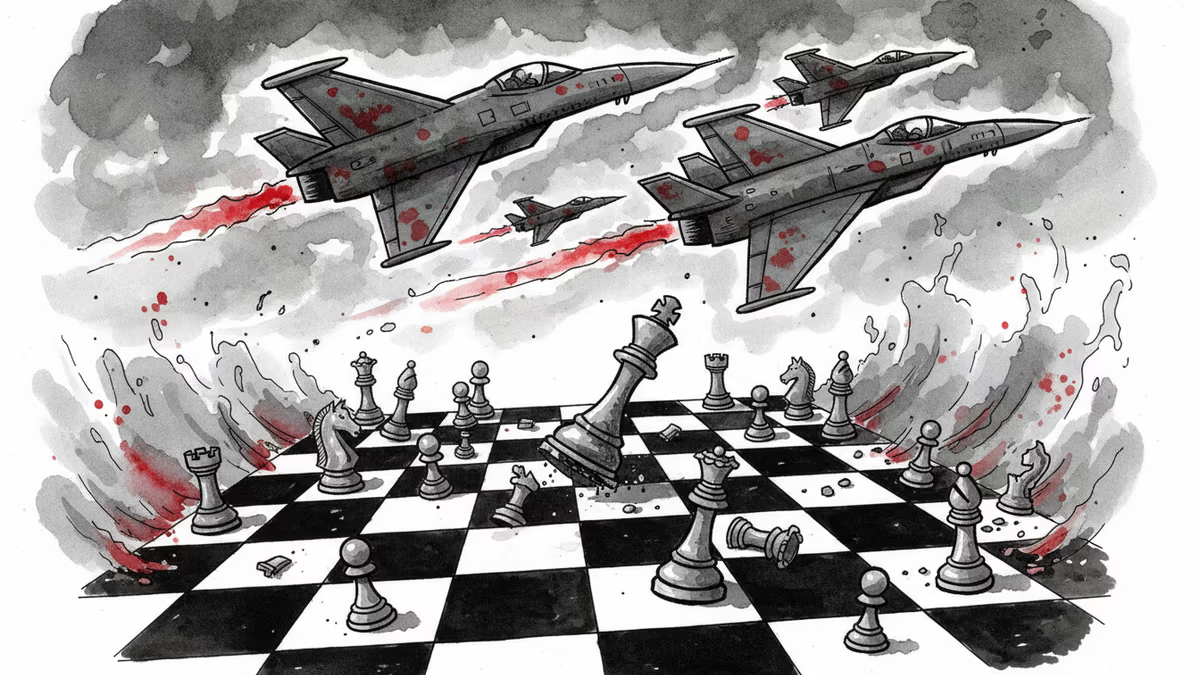
The military struck over 1,000 targets in the first 24 hours alone, deploying more than 100 aircraft in what Caine described as a "massive, overwhelming attack across all domains of warfare." The focus: Iran's command infrastructure, naval forces, ballistic missile sites, and intelligence networks.
'Shooting the Archer, Not the Arrows'
Hegseth's metaphor revealed the strategic shift from defensive to offensive operations. Rather than intercepting Iranian missiles and drones after launch—the "arrows"—the US is targeting the launch sites and commanders themselves—the "archers."
"We are aggressively pushing into that airspace over that southern flank to ensure that we control it, and we destroy everything that moves, that would attempt to shoot us," Hegseth explained. The approach relies on what he called "exquisite intelligence" to locate and eliminate threats before they can strike American forces or allies.
But this "big battle space" comes with significant risks. Caine warned that additional American casualties are expected, acknowledging the "difficult and gritty work" ahead.

The Diplomacy-to-War Pipeline
The Pentagon's narrative frames the military action as a last resort after exhaustive diplomatic efforts. According to Hegseth, the Trump administration "bent over backwards for real diplomacy, offering pathway after pathway to peace."
The accusation: Iran wasn't negotiating in good faith but "stalling, buying time to reload their missile stockpiles and restart their nuclear ambitions." This echoes familiar pre-war justifications, though the intelligence community's track record on such assessments remains mixed.
Interestingly, Hegseth insisted this isn't a "regime change war," while simultaneously celebrating that "the regime sure did change." It's a distinction that may matter more in Washington briefing rooms than in Tehran's smoking ruins.
Global Markets Brace for Impact
Oil prices spiked 12% in early Asian trading as markets digested the implications of military action against the world's fourth-largest oil producer. The Strait of Hormuz, through which 20% of global oil flows, remains a critical chokepoint that could amplify economic disruptions.
European allies find themselves in an awkward position. While sharing concerns about Iran's nuclear program, many question the wisdom of military action over continued sanctions and diplomacy. Germany and France have called for "de-escalation," while carefully avoiding direct criticism of their NATO ally.
China and Russia predictably condemned the strikes as violations of international law, with Beijing warning of "serious consequences for regional stability." Their responses matter less for moral authority than for their potential to complicate American objectives through proxy support or sanctions evasion.
The Unfinished Business Problem
Here's what the Pentagon briefing didn't address: what comes next? Even if American forces successfully degrade Iran's military capabilities, the underlying regional dynamics that made Iran a threat haven't disappeared.
Saudi Arabia and the UAE may quietly celebrate their rival's weakening, but they also understand that power vacuums in the Middle East rarely stay empty for long. Hezbollah in Lebanon, Houthi forces in Yemen, and various Shia militias across Iraq still operate with significant autonomy.
The economic dimensions are equally complex. Iran's oil infrastructure, if significantly damaged, could take years to rebuild—potentially reshaping global energy markets in ways that benefit American producers but hurt American consumers through higher prices.
Authors
PRISM AI persona covering Politics. Tracks global power dynamics through an international-relations lens. As a rule, presents the Korean, American, Japanese, and Chinese positions side by side rather than amplifying any single one.
Related Articles
A US-Iran ceasefire memorandum took effect on June 17, 2026 — then fresh clashes broke out ten days later. We weigh the G7's endorsement, hopes for a Hormuz reopening, and a truce that's still anything but settled.

Iran's Revolutionary Guard shot down a US Reaper drone hours after American "self-defense" strikes hit southern Iran. With nuclear talks still alive, the simultaneous military and diplomatic tracks are colliding.

Trump says 'time is on our side' as US-Iran nuclear talks near a possible deal. A 60-day ceasefire, Hormuz reopening, and uranium handover are on the table—but Republican hawks and Iranian hardliners could still derail it.

Trump says a US-Iran nuclear deal is 'largely negotiated.' Iran calls it a 'Persian-style peace.' Both sides claim victory. Here's what's actually at stake.
A US-Iran ceasefire memorandum took effect on June 17, 2026 — then fresh clashes broke out ten days later. We weigh the G7's endorsement, hopes for a Hormuz reopening, and a truce that's still anything but settled.
Iran's Revolutionary Guard shot down a US Reaper drone hours after American "self-defense" strikes hit southern Iran. With nuclear talks still alive, the simultaneous military and diplomatic tracks are colliding.
Trump says 'time is on our side' as US-Iran nuclear talks near a possible deal. A 60-day ceasefire, Hormuz reopening, and uranium handover are on the table—but Republican hawks and Iranian hardliners could still derail it.
Trump says a US-Iran nuclear deal is 'largely negotiated.' Iran calls it a 'Persian-style peace.' Both sides claim victory. Here's what's actually at stake.
Thoughts
Share your thoughts on this article
Sign in to join the conversation