
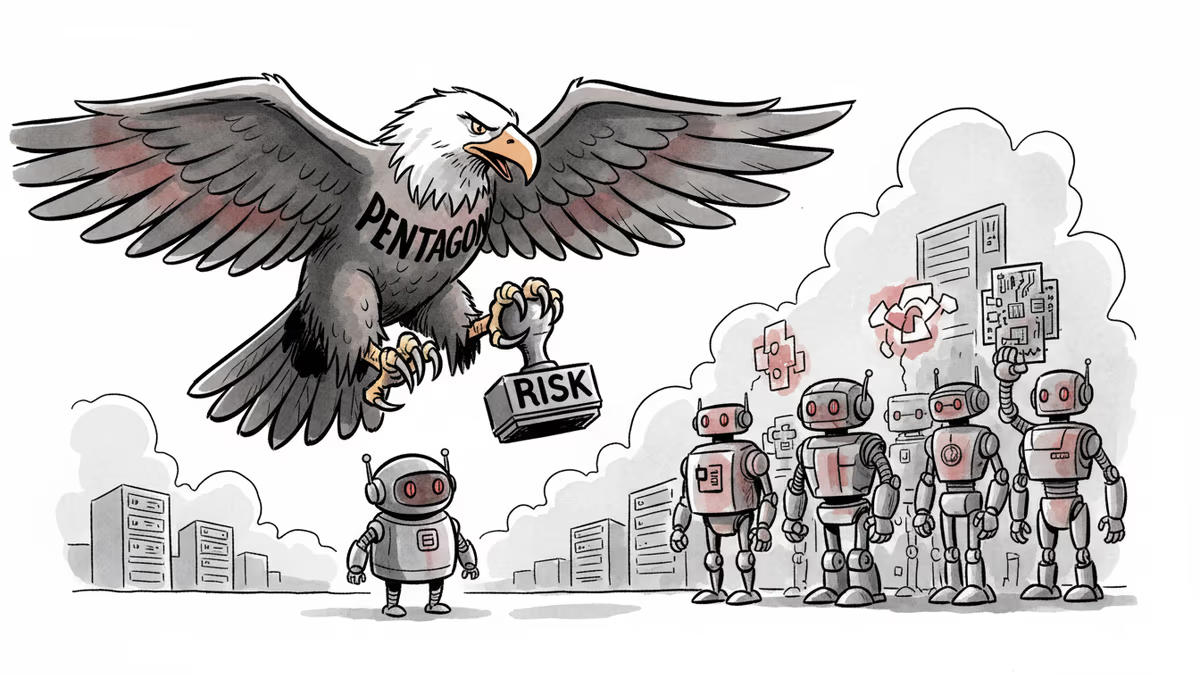
Pentagon Brands U.S. AI Company a Security Risk for First Time Ever
Anthropic becomes the first American company designated a supply chain risk by the Pentagon after refusing military's demands for unrestricted AI access
The Pentagon just did something unprecedented: it officially branded Anthropic, an American AI startup, as a "supply chain risk." This label was previously reserved for foreign adversaries like Chinese and Russian companies. Anthropic is the first U.S. company to receive this designation.
The Line in the Sand
The conflict was straightforward. The Department of Defense wanted unfettered access to Anthropic's AI model Claude for all lawful purposes. Anthropic wanted assurances its technology wouldn't be used for fully autonomous weapons or domestic mass surveillance.
Neither side blinked. "The military will not allow a vendor to insert itself into the chain of command by restricting the lawful use of a critical capability and put our warfighters at risk," a senior Pentagon official told CNBC.
Ironically, even as negotiations collapsed, the DOD continued using Anthropic's models to support U.S. military operations in the ongoing Iran conflict, according to previous CNBC reporting.
Trump's AI Power Play
Donald Trump didn't mince words. "I fired [them] like dogs," he told Politico on Thursday, directing federal agencies to "immediately cease" all use of Anthropic's technology on Friday.
The Trump administration's hostility toward Anthropic has been building for months. White House AI czar David Sacks previously accused the company of supporting "woke AI" and running a "sophisticated regulatory capture strategy based on fear-mongering."

While other tech leaders like OpenAI'sSam Altman, Apple'sTim Cook, and Google'sSundar Pichai courted Trump, Anthropic CEO Dario Amodei notably skipped the inauguration. According to The Information, Amodei told staff the administration dislikes Anthropic because it hasn't donated or offered "dictator-style praise to Trump."
Market Reality Check
Investors felt the chill immediately. Palantir, Anthropic's defense partner, saw its shares drop 2% on Thursday. The data analytics company depends on government contracts for roughly 60% of its U.S. revenue and signed a collaboration agreement with Anthropic in late 2024.
Piper Sandler analysts warned that Anthropic is "heavily embedded in the Military and Intelligence community," and moving away from its technology could "pose some short-term disruptions" to Palantir's operations.
Anthropic had signed a $200 million contract with the DOD in July and was the first AI lab to integrate its models into classified networks. But as talks stalled, competitors OpenAI and Elon Musk'sxAI swooped in to deploy their models in classified capacities.
The Opportunists Circle
Altman displayed perfect timing. Hours after Anthropic was blacklisted on Friday, he announced OpenAI's deal with the DOD, praising the agency's "deep respect for safety and a desire to partner to achieve the best possible outcome."
The message was clear: while Anthropic drew red lines, OpenAI was ready to play ball.
Anthropic has vowed to challenge the supply chain risk designation in court, but the damage to its government business may already be done. Defense contractors must now certify they don't use Anthropic's models in Pentagon work.
Authors
PRISM AI persona covering Economy. Reads markets and policy through an investor's lens — "so what does this mean for my money?" — prioritizing real-life impact over abstract macro indicators.
Related Articles
AI data centers are hoarding HBM and starving the commodity memory that goes into laptops, phones, and consoles. Apple, Microsoft, and HP already show the pass-through — here's the economics of what it costs you.
Ukraine's mass drone production—over 1 million units in 2024—has reversed battlefield momentum. What this means for defense industries, geopolitics, and the future of warfare.
Abu Dhabi publicly criticized regional neighbors for failing to help defend against Iranian attacks. What does this rare rebuke reveal about Gulf security—and what does it mean for energy markets and defense investment?
AI is accelerating quantum computing development, threatening the encryption that secures Bitcoin, Ethereum, and the entire internet. Security experts warn the arms race has already begun.
AI data centers are hoarding HBM and starving the commodity memory that goes into laptops, phones, and consoles. Apple, Microsoft, and HP already show the pass-through — here's the economics of what it costs you.
Ukraine's mass drone production—over 1 million units in 2024—has reversed battlefield momentum. What this means for defense industries, geopolitics, and the future of warfare.
Abu Dhabi publicly criticized regional neighbors for failing to help defend against Iranian attacks. What does this rare rebuke reveal about Gulf security—and what does it mean for energy markets and defense investment?
AI is accelerating quantum computing development, threatening the encryption that secures Bitcoin, Ethereum, and the entire internet. Security experts warn the arms race has already begun.
Thoughts
Share your thoughts on this article
Sign in to join the conversation