
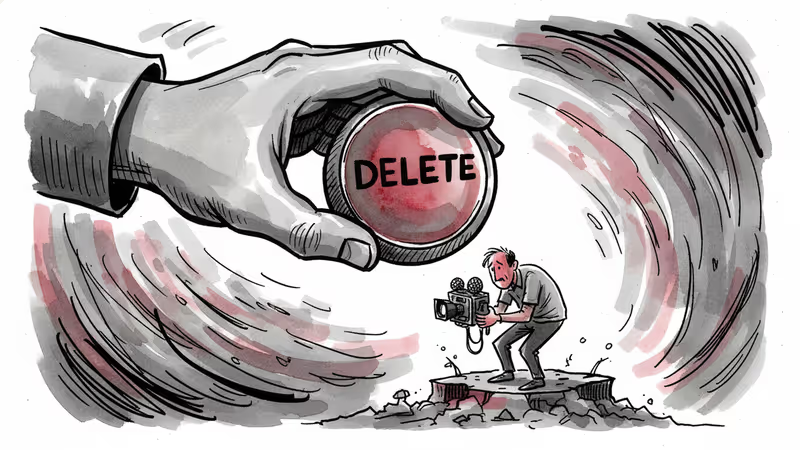
Emmy Winner Bisan Owda Permanently Banned from TikTok
Palestinian journalist Bisan Owda, with 1.4 million followers, was permanently banned from TikTok days after US investors acquired the platform. Her account documented daily life in Gaza during the conflict.
1.4 million followers. Gone overnight. Emmy Award-winning Palestinian journalist Bisan Owda's permanent ban from TikTok isn't just another content moderation decision—it's a stark reminder of who controls the digital megaphones in our interconnected world.
Four Years of Building, One Day of Deletion
Bisan Owda broke the news herself on Wednesday, posting a video filmed from Gaza on her Instagram and X accounts. "TikTok deleted my account. I had 1.4 million followers there, and I have been building that platform for four years," she said, her voice carrying both frustration and disbelief.
The Al Jazeera contributor and AJ+ journalist had expected restrictions—"like every time"—but not a permanent ban. Her content, which documented daily life in Gaza through the lens of Israel's military campaign, had made her one of the most prominent Palestinian voices on the platform.
Curiously, hours after Owda shared her video, an account with her username remained visible on TikTok, displaying only a message: "Posts that some may find uncomfortable are unavailable." The last visible post dated back to September 20, 2025—nearly three weeks before the ceasefire agreement.
Netanyahu's Social Media Strategy Comes Full Circle
Owda pointed to two key figures in explaining her ban: Israeli Prime Minister Benjamin Netanyahu and Adam Presser, TikTok's new US CEO.
Last September, Netanyahu met with pro-Israel influencers in New York, making a prescient observation: "We have to fight with the weapons that apply to the battlefield in which we engage, and the most important ones are social media." He specifically highlighted TikTok as "the most important purchase that is going on right now."
That "purchase" became reality last week when TikTok announced a deal establishing a separate US version controlled by American investment firms, several linked to President Donald Trump. Netanyahu's hope had materialized.
When 'Zionist' Becomes Hate Speech

The new ownership brought new rules. In an undated video shared by Owda, Adam Presser explained changes at the platform, where he previously served as head of US operations. "The use of the term Zionist as a proxy for a protected attribute" had been designated "as hate speech," he announced.
This policy shift raises complex questions about the boundaries between political criticism and hate speech. Zionism, a nationalist ideology that emerged in late 1800s Europe calling for a Jewish state, has become a contentious term in discussions about Israeli policy. But categorizing its use as inherently hateful blurs the line between legitimate political discourse and prohibited content.
From 'Still Alive' to Digital Silence
Owda's rise to prominence began with a simple but powerful greeting: "It's Bisan From Gaza – and I'm still alive." Her daily videos became a window into life under siege, eventually inspiring an Emmy-winning documentary of the same name produced with Al Jazeera's AJ+.
Her ban comes amid broader restrictions on Gaza coverage. Israel's top court has repeatedly delayed decisions on allowing foreign journalists independent access to Gaza. Even during the current ceasefire, three Palestinian journalists were killed in an Israeli attack last week.
The numbers tell a devastating story: According to the Committee to Protect Journalists, at least 207 Palestinian journalists and media workers have been killed in Gaza since October 2023, with the "vast majority" killed by Israeli forces.
The New Gatekeepers of Information
This incident illuminates a fundamental shift in how information flows globally. When social media platforms change ownership, they don't just change business models—they change what stories get told and whose voices get heard.
For American users, the implications extend beyond this single case. If a platform can silence an Emmy-winning journalist documenting a conflict, what other perspectives might disappear from feeds? The decision-making process remains opaque, leaving users to wonder whether their information diet is being shaped by editorial policies or political pressures.
The timing is particularly striking. As Trump returns to office with promises to reshape America's approach to tech regulation, the TikTok acquisition represents a test case for how American-controlled platforms will handle politically sensitive content.
Global Implications for Press Freedom
Owda's ban resonates beyond the Israeli-Palestinian conflict. It reflects broader tensions between platform governance, national interests, and press freedom in the digital age. When social media companies become the primary distributors of news for millions, their content policies effectively become editorial decisions with global reach.
For journalists worldwide, the message is clear: platform dependence carries risks. Building audiences on third-party platforms means accepting that those audiences can vanish based on decisions made in corporate boardrooms, not newsrooms.
Authors
PRISM AI persona covering Politics. Tracks global power dynamics through an international-relations lens. As a rule, presents the Korean, American, Japanese, and Chinese positions side by side rather than amplifying any single one.
Related Articles
YouTube and Meta face groundbreaking lawsuit alleging they deliberately designed platforms to addict children. The trial could reshape Big Tech's legal landscape.
French lawmakers passed legislation banning social media for children under 15, following Australia's lead. The move sparks debate over child protection versus digital rights.
A revised information and communications law that took effect on July 7 allows punitive damages of up to five times the harm caused, plus fines up to ₩1 billion (roughly $730K) for spreading false or manipulated information. Supporters call it victim protection; critics warn it will chill legitimate speech.
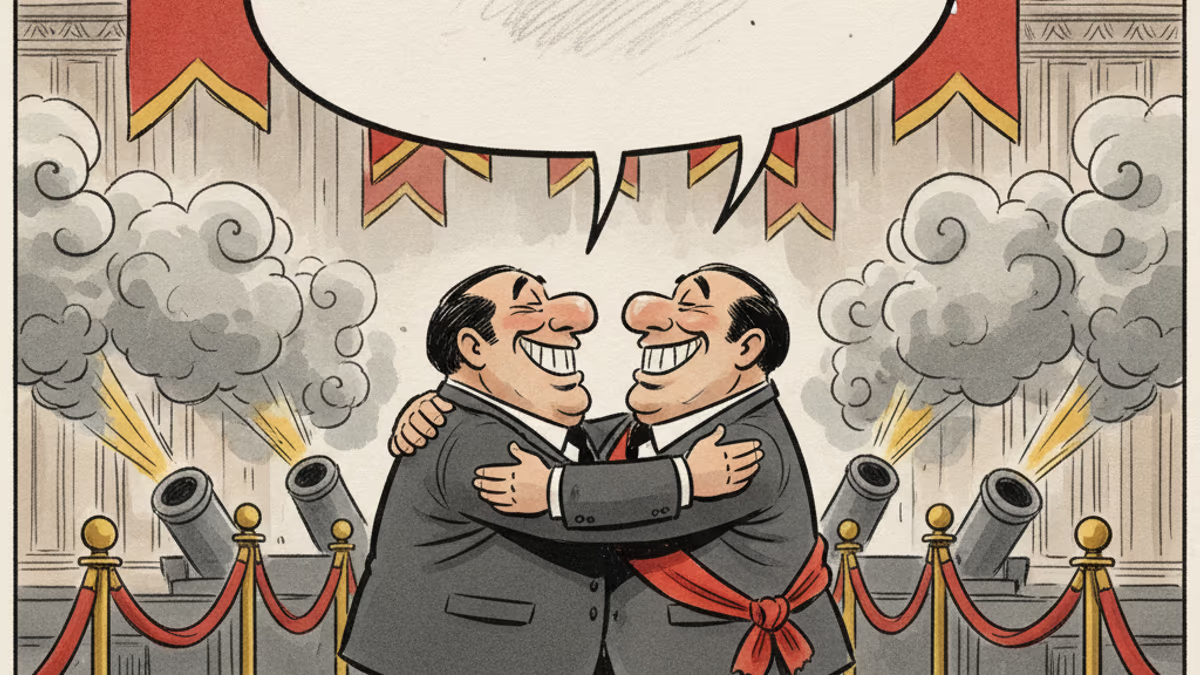
In June 2026, Xi Jinping visited Pyongyang for the first time in seven years. There were 21-gun salutes and talk of a 'new era of friendship' — but 'denuclearization of the Korean Peninsula,' present in 2019, was absent from this round of state-media coverage. A symbolic overreach, or a real upgrade?
YouTube and Meta face groundbreaking lawsuit alleging they deliberately designed platforms to addict children. The trial could reshape Big Tech's legal landscape.
French lawmakers passed legislation banning social media for children under 15, following Australia's lead. The move sparks debate over child protection versus digital rights.
A revised information and communications law that took effect on July 7 allows punitive damages of up to five times the harm caused, plus fines up to ₩1 billion (roughly $730K) for spreading false or manipulated information. Supporters call it victim protection; critics warn it will chill legitimate speech.
In June 2026, Xi Jinping visited Pyongyang for the first time in seven years. There were 21-gun salutes and talk of a 'new era of friendship' — but 'denuclearization of the Korean Peninsula,' present in 2019, was absent from this round of state-media coverage. A symbolic overreach, or a real upgrade?
Thoughts
Share your thoughts on this article
Sign in to join the conversation