

When Your Own Employees Ask: Are We the Baddies?
Palantir CEO Alex Karp finally responded to weeks of internal pressure about ICE contracts, but his hour-long video raised more questions than answers
The Question That Wouldn't Go Away
For weeks, Palantir's internal Slack channels buzzed with uncomfortable questions. "What exactly is ICE doing with our products?" "Are we helping round up asylum seekers who've done nothing wrong?" The questions multiplied after federal agents shot and killed Minneapolis nurse Alex Pretti last month.
CEO Alex Karp finally responded on Friday. Sort of.
Instead of a town hall or direct answers, employees received a nearly hour-long pre-recorded video conversation that felt more like a philosophy lecture than corporate transparency.
The Art of Not Answering
For the first 40 minutes, Karp avoided the ICE questions entirely. Instead, he waxed philosophical about Palantir's role in "building and maintaining Western power"—a favorite topic from his public interviews and recent book.
When he finally addressed immigration enforcement, Karp offered political cover rather than technical details. He cited Barack Obama's 2014 statement that America is both "a nation of immigrants" and "a nation of laws," arguing that Palantir maintains consistent policies regardless of which president is in office.
Employees wanting specifics? They could sign NDAs for one-on-one briefings. Transparency through secrecy—a distinctly Palantir approach.
What Employees Really Want to Know

The internal Slack conversations reveal the depth of employee concern. "Can Palantir put any pressure on ICE at all?" wrote one worker. "I've read stories of folks rounded up who were seeking asylum with no order to leave the country, no criminal record, and consistently check in with authorities. Literally no reason to be rounded up. Surely we aren't helping to do that?"
According to an internal wiki updated January 24, Palantir recently completed a six-month pilot helping ICE identify potential targets and track self-deportations. The company is now beginning a new pilot with US Citizenship and Immigration Services to help identify "fraudulent benefit submissions."
Since December, the Trump administration has used fraud allegations to justify ICE presence in cities like Minneapolis.
The Silicon Valley Reckoning
Karp acknowledged the internal tension: "There is no history of Palantir where we're 100 percent popular. There is a history of Palantir where we're unpopular and we do better internally. And yeah, we're behind the curve internally."
This isn't just a Palantir problem. Google withdrew from the Pentagon's drone AI project in 2018 after employee protests. Microsoft faced internal rebellion over military contracts. Amazon paused, then resumed, selling facial recognition technology to police.
But Palantir is different. Founded explicitly to serve government and defense clients, the company has never shied away from controversial contracts. What's new is the scale of internal dissent.
The NDA Solution
Offering NDAs to concerned employees reveals Palantir's fundamental tension. The company built its reputation on helping government agencies see patterns in data—but it can't let its own employees see the patterns in its business.
Courtney Bowman, Palantir's global director of privacy and civil liberties engineering, promised the video was "a step forward, not a completion" of leadership's discussions with staff. But what good is a step forward if you can't see where you're going?
Authors
Related Articles

Palantir has become the tech backbone of Trump's immigration enforcement. Former employees are calling it a 'descent into fascism.' What happens when the people who build surveillance tools start asking uncomfortable questions?

ICE agents have been deployed to 14 US airports, officially to fill TSA staffing gaps during the government shutdown. But the line between security assistance and immigration enforcement is blurring fast.
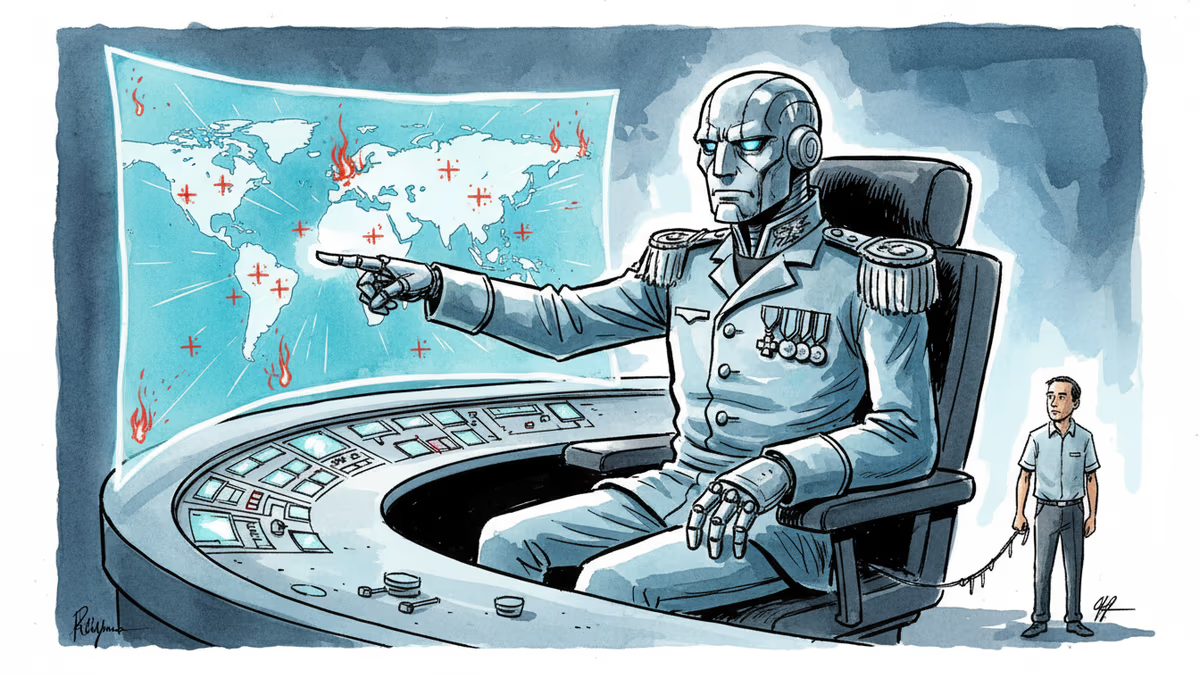
Anthropic's Claude AI is embedded in US military operations—from the capture of Maduro to the Iran war. A Pentagon dispute is exposing what "responsible AI" actually means in wartime.

ICE and CBP have paid hundreds of millions to Palantir, Microsoft, Amazon, and Google for immigration enforcement technology. Where's the line between innovation and surveillance?
Palantir has become the tech backbone of Trump's immigration enforcement. Former employees are calling it a 'descent into fascism.' What happens when the people who build surveillance tools start asking uncomfortable questions?
ICE agents have been deployed to 14 US airports, officially to fill TSA staffing gaps during the government shutdown. But the line between security assistance and immigration enforcement is blurring fast.
Anthropic's Claude AI is embedded in US military operations—from the capture of Maduro to the Iran war. A Pentagon dispute is exposing what "responsible AI" actually means in wartime.
ICE and CBP have paid hundreds of millions to Palantir, Microsoft, Amazon, and Google for immigration enforcement technology. Where's the line between innovation and surveillance?
Thoughts
Share your thoughts on this article
Sign in to join the conversation