
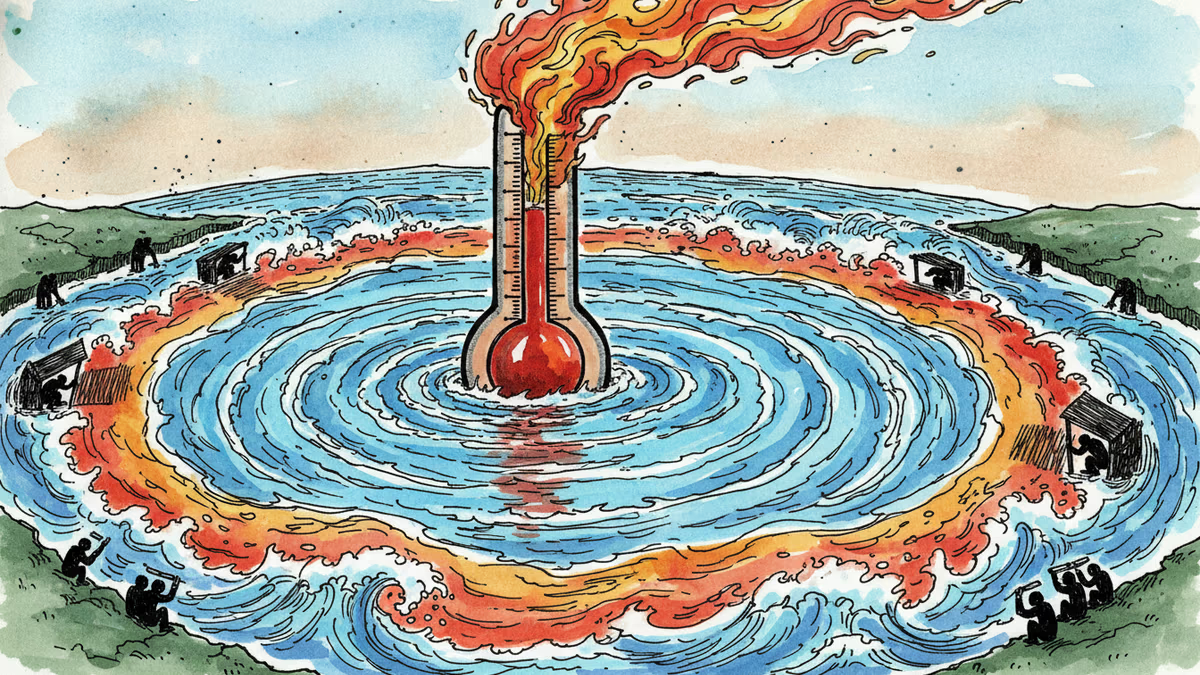
When the Pacific Boils, the Climate Doesn't Cool Back Down
Scientists warn a coming super El Niño could trigger lasting "climate regime shifts" — not just extreme weather, but permanent changes to rainfall, drought, and ocean systems worldwide.
The last time the tropical Pacific ran this hot, it helped make 2024 the warmest year in recorded human history.
Now scientists are watching the same ocean heat engine rev up again — and this time, some of them think the world may not cool back down afterward.
Projections suggest the tropical Pacific is drifting toward another strong El Niño within the next 12 to 18 months. But a study published in December 2025 in Nature Communications reframes what that actually means. Strong El Niños, the research argues, aren't just passing weather events. They can push parts of the Earth's climate system into entirely new states — states that persist long after the Pacific cools.
How El Niño Moves the World
To understand the stakes, it helps to understand the mechanism.
The tropical Pacific is Earth's largest heat reservoir. The Western Pacific Warm Pool — a stretch of ocean between Australia and Indonesia — spans an area four times the size of the continental United States and holds the warmest ocean water on the planet. Normally, trade winds push that heat westward and keep it pooled there. But periodically, the winds shift, and the stored heat surges eastward across the equatorial Pacific. That's El Niño.
When that heat vents into the atmosphere, it reshapes weather patterns across the globe. Some regions get drenched — think flooding in Peru or California. Others bake: drought and wildfires in Australia, East Africa, and the Amazon. The 2015 El Niño helped push Earth's average annual temperature permanently past 1 degree Celsius above pre-industrial levels. The 2024 El Niño helped deliver the hottest year in human history.
Climate scientist James Hansen has said that even a moderately strong El Niño in the next 12 to 18 months could push the global average temperature to around 1.7 degrees Celsius above pre-industrial levels — and that he doubts the world will meaningfully cool back below 1.5 degrees once that event fades.
That 1.5-degree figure isn't arbitrary. It's the threshold enshrined in the Paris Agreement and scientific literature as the point where climate impacts shift from serious to potentially irreversible. Below it, coral reefs are damaged but can recover. Above it, the math changes.

The "Super El Niño" Problem
The Nature Communications study draws a sharper distinction than most climate reporting does. There are El Niños, and then there are super El Niños — defined as events where sea surface temperature anomalies in the tropical Pacific exceed two standard deviations above normal. This isn't a matter of degree. It's a different category of event.
Only three super El Niños have been recorded: 1982–83, 1997–98, and 2015–16. All three triggered what the researchers call "climate regime shifts" — abrupt, lasting changes to regional ocean temperatures, rainfall patterns, and drought cycles. Marine heat waves destroyed coral reefs and caused mass die-offs across the food chain, from starfish to seabirds to marine mammals. Those impacts didn't fade with the El Niño. Some persisted for years. Some may reshape regional patterns for decades.
Jong-Seong Kug, a climate researcher at Seoul National University and co-author of the study, identifies the key "regime-shift hotspots" in the oceans: the central North Pacific, the southeastern Indian Ocean, the southwestern Pacific, and the Gulf of Mexico. On land, the signals show up in East Africa, the Maritime Continent around Indonesia and Papua New Guinea, the Amazon, central southern Asia, and western Greenland.
The mechanism on land is particularly sobering. Super El Niños reshape regional precipitation through what scientists call teleconnections — long-distance atmospheric links that alter soil moisture thousands of miles from the Pacific. When soil moisture stays below normal for several consecutive years, crops face repeated heat and water stress across multiple growing seasons. A single bad harvest becomes a structural food security problem.
"Super El Niño may not just cause a one-time extreme event," Kug wrote. "It can shift the background climate conditions that people and ecosystems rely on."
The Adaptation Gap Is Widening
Here's the problem that sits beneath the climate science: human societies were built for a climate that may no longer exist.
City water systems, agricultural calendars, flood infrastructure, insurance models — all of it was designed around historical climate patterns. When the baseline shifts, the engineering assumptions underneath everything shift with it. That's not a future scenario. It's already happening. California reservoirs now swing between empty and overflowing within the same decade. Coral reefs from the Great Barrier Reef to the Caribbean have bleached beyond recovery. Wildfire seasons have expanded so dramatically that "fire season" is becoming a misnomer — in some regions, it's simply the new year-round condition.
The UN Environment Programme's2025 Adaptation Gap Report quantifies how far behind the world has fallen. International public adaptation finance actually fell slightly in 2023, to $26 billion. The estimated need for developing countries alone is $310 billion to $365 billion per year by 2035. Current global efforts amount to less than a tenth of that.
The UNEP's conclusion is blunt: incremental, reactive adaptation is no longer sufficient. Water systems, cities, agriculture, and infrastructure need to be redesigned for a climate that hasn't arrived yet — one with sharper swings between floods and droughts, longer fire seasons, and sustained extreme heat that doesn't break at night.
Kug frames the underlying dynamic as a vicious cycle: global warming amplifies the impacts of super El Niños, and super El Niños push the climate system into states that are more prone to further shifts. Each event doesn't just add to the damage — it potentially lowers the threshold for the next one.
This content is AI-generated based on source articles. While we strive for accuracy, errors may occur. We recommend verifying with the original source.
Related Articles
A massive heat reservoir beneath the Pacific has forecasters talking about a 'super El Niño' in 2026. But ocean scientists say the outcome remains genuinely uncertain—and that's exactly why some regions need to act now.
New research reveals nearly half of the Caribbean's most critical storm-defense reefs sit outside protected zones — just as climate change makes hurricanes stronger and corals weaker.
Twelve hours after tourists photographed the South Sawyer Glacier, a landslide triggered the second-tallest tsunami in recorded history. The signals were there. The monitoring system wasn't.
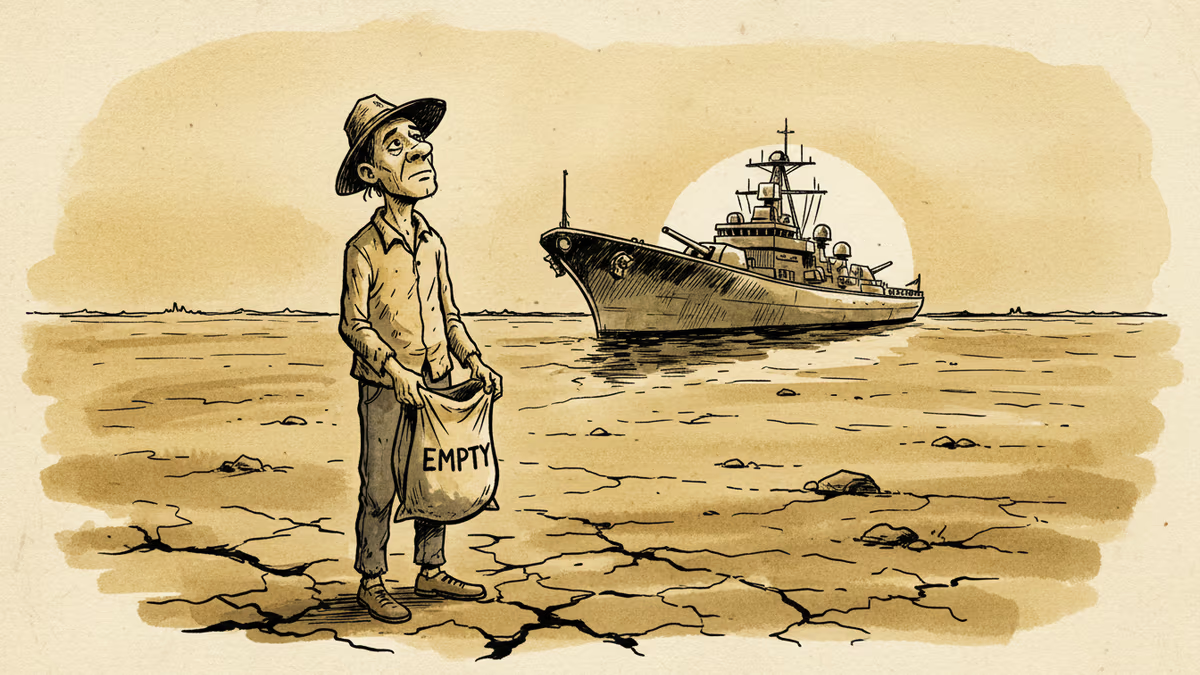
The Strait of Hormuz closure didn't just cut oil. It's strangling the world's fertilizer supply—and that means food prices are coming for everyone, everywhere.
A massive heat reservoir beneath the Pacific has forecasters talking about a 'super El Niño' in 2026. But ocean scientists say the outcome remains genuinely uncertain—and that's exactly why some regions need to act now.
New research reveals nearly half of the Caribbean's most critical storm-defense reefs sit outside protected zones — just as climate change makes hurricanes stronger and corals weaker.
Twelve hours after tourists photographed the South Sawyer Glacier, a landslide triggered the second-tallest tsunami in recorded history. The signals were there. The monitoring system wasn't.
The Strait of Hormuz closure didn't just cut oil. It's strangling the world's fertilizer supply—and that means food prices are coming for everyone, everywhere.
Thoughts
Share your thoughts on this article
Sign in to join the conversation