
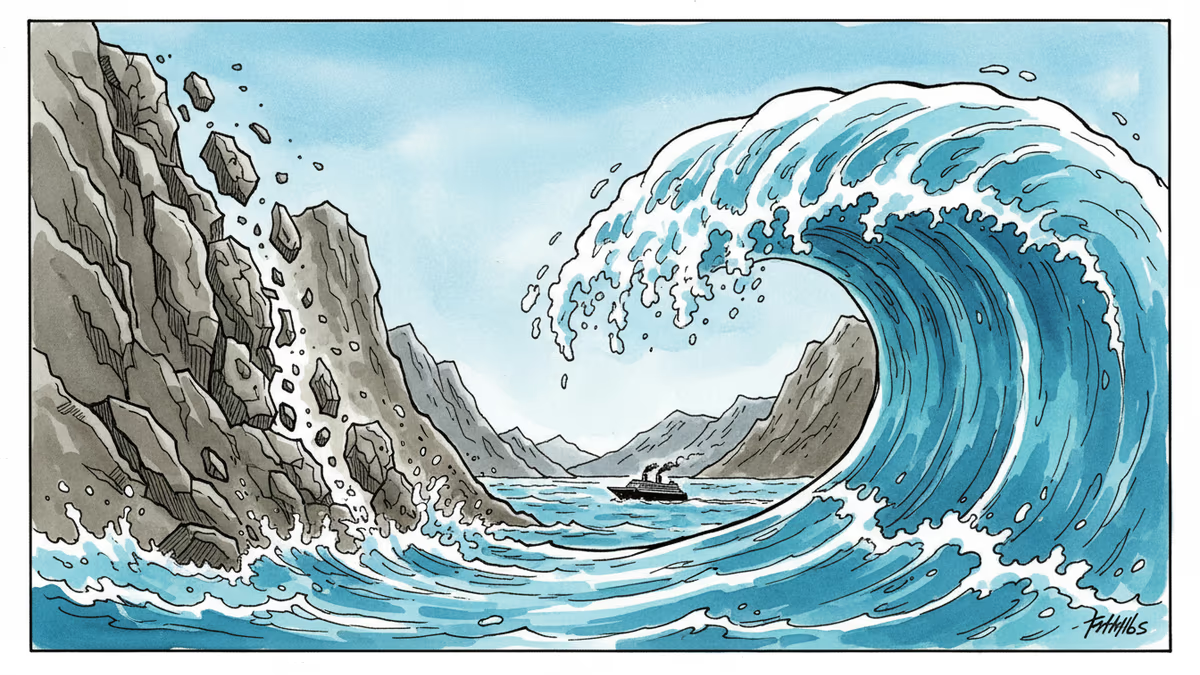
The Mountain Was Already Talking. Nobody Was Listening.
Twelve hours after tourists photographed the South Sawyer Glacier, a landslide triggered the second-tallest tsunami in recorded history. The signals were there. The monitoring system wasn't.
Twelve hours earlier, they were taking selfies.
On the evening of August 9, 2025, passengers aboard the Hanse Explorer photographed the South Sawyer Glacier and motored back down Tracy Arm fjord in southeastern Alaska. By 5 a.m. the next morning, the mountain beside that same glacier had collapsed into the water below, unleashing the second-tallest tsunami ever recorded. The wave surged 481 meters (1,580 feet) up the opposite fjord wall — higher than the top floor of Taipei 101. The force stripped the rock walls bare.
No ships were in the fjord. The margin was twelve hours.
A Pattern Nobody Named Until Now
Researchers at the Alaska Earthquake Center, including Alaska's state seismologist, have published findings that go well beyond the Tracy Arm event itself. What they describe is a pattern — one that's been quietly building across the Arctic for years.
Large landslides are increasingly occurring at the precise terminus of retreating glaciers. The mechanics aren't fully understood yet, but the hypothesis is stark: when glaciers that have buttressed mountain slopes for millennia disappear, the rock loses structural support and becomes unstable. Add heavier precipitation — rainwater seeping into cracks, raising hydraulic pressure — and the mountain edges toward failure.
In the two months before the Tracy Arm slide, the glacier below the collapse zone retreated more than a third of a mile. Heavy rain had been falling for days. And in the days immediately preceding the landslide, thousands of small seismic tremors were emanating from the slope. Then came the tell: a continuous "hum" of seismic energy — what scientists call seismic tremor — in the hours before the collapse.
This same convergence of conditions is playing out from Alaska to Greenland to Norway. The Tracy Arm event wasn't an anomaly. It was a case study.

The Warning That Could Have Existed
Here's what makes this story more than a disaster retrospective: the researchers argue that a tiered alert system — had one existed — could have flagged the danger at least a day in advance.
The weather conditions and rapid glacier retreat in early August were enough for a yellow alert: elevated hazard in a general area. Hours before the slide, the exponential spike in seismic events and the onset of seismic tremor warranted an orange alert, with a recommendation to keep vessels out of the fjord. And once the landslide began, existing seismic networks could have characterized the event within two minutes — enough time for a red alert that might have given ships farther down the fjord a 10-minute warning window.
NOAA's tsunami warning program has spent decades building exactly this kind of rapid-dissemination infrastructure for ocean-generated tsunamis. The gap is specific: no equivalent system exists for landslide-generated tsunamis in the U.S. The seismic data that revealed Tracy Arm's warning signs was collected incidentally, as a byproduct of routine earthquake monitoring — not because anyone was watching that slope.
Building a dedicated system would require coordination across state and federal agencies, expanded sensor networks, and new communication channels. The researchers are candid: it won't be fail-proof. But the alternative — no warning at all — is the current reality.
Living With the Risk, Not Hiding From It
Some cruise lines quietly began rerouting away from Tracy Arm after the event. It's an understandable response, but the researchers push back on avoidance as a long-term strategy. The forces that make Arctic fjords dangerous — glacial retreat, steep terrain, dynamic geology — are the same forces that make them extraordinary. People will keep going.
The more instructive analogy is avalanche warning systems. They haven't eliminated backcountry skiing deaths, but they've enabled far more people to make informed decisions in high-risk terrain. Volcanic unrest alerts haven't emptied the towns near active calderas, but they've given communities a framework for knowing when to act.
The question the Tracy Arm researchers are really asking isn't whether these places should be closed off. It's whether the people who visit them — and the companies that take them there — deserve better information than they currently have.
On August 9, 2025, tourists passed through a landscape that was, in measurable, recordable ways, on the edge of catastrophe. They didn't know. There was no system to tell them.
This content is AI-generated based on source articles. While we strive for accuracy, errors may occur. We recommend verifying with the original source.
Related Articles
A massive heat reservoir beneath the Pacific has forecasters talking about a 'super El Niño' in 2026. But ocean scientists say the outcome remains genuinely uncertain—and that's exactly why some regions need to act now.
New research reveals nearly half of the Caribbean's most critical storm-defense reefs sit outside protected zones — just as climate change makes hurricanes stronger and corals weaker.
Scientists warn a coming super El Niño could trigger lasting "climate regime shifts" — not just extreme weather, but permanent changes to rainfall, drought, and ocean systems worldwide.
California's Salton Sea is shrinking, releasing toxic dust that stunts children's lung growth more than living near a busy freeway. A seven-year study reveals the human cost of water policy decisions.
A massive heat reservoir beneath the Pacific has forecasters talking about a 'super El Niño' in 2026. But ocean scientists say the outcome remains genuinely uncertain—and that's exactly why some regions need to act now.
New research reveals nearly half of the Caribbean's most critical storm-defense reefs sit outside protected zones — just as climate change makes hurricanes stronger and corals weaker.
Scientists warn a coming super El Niño could trigger lasting "climate regime shifts" — not just extreme weather, but permanent changes to rainfall, drought, and ocean systems worldwide.
California's Salton Sea is shrinking, releasing toxic dust that stunts children's lung growth more than living near a busy freeway. A seven-year study reveals the human cost of water policy decisions.
Thoughts
Share your thoughts on this article
Sign in to join the conversation