
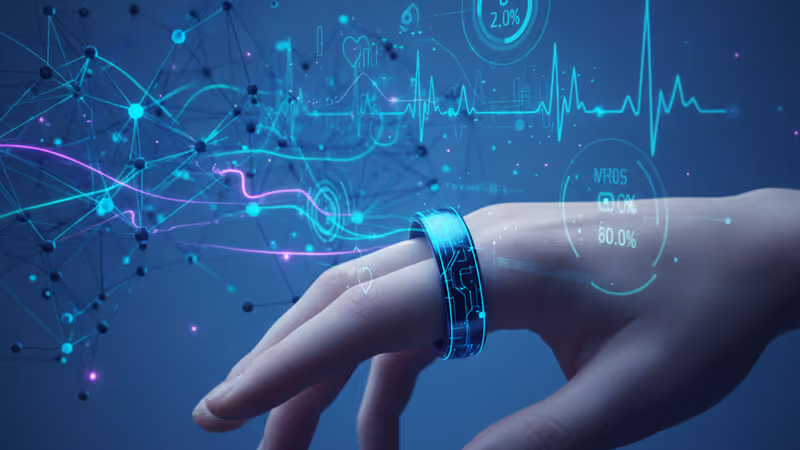
Oura Ultrahuman Patent Lawsuit 2026: A New Era of Smart Ring Competition
Analyzing the Oura Ultrahuman patent lawsuit 2026 results. Learn how ITC import bans are forcing smart ring competitors to innovate through software and services.
The smart ring market's landscape has shifted dramatically. Following a pivotal legal battle, the number of health-tracking rings available in the U.S. has notably shrunk since October 21, 2025. This change stems from a victory by Oura at the U.S. International Trade Commission (ITC), which effectively banned imports from major competitors Ultrahuman and RingConn.
The 178 Patent: Why Oura Ultrahuman Patent Lawsuit 2026 Matters
According to WIRED, the ITC ruled that Ultrahuman and RingConn infringed on Oura’s178 patent, which covers a specific hardware architecture—a layered arrangement housing internal electrical components. Critics argue this description is broad enough to encompass nearly any modern smart ring, yet it’s been a powerful weapon for Oura to maintain its market lead.
Oura isn’t just playing defense. The company recently filed complaints against Samsung regarding the Galaxy Ring, as well as Reebok and Zepp Health. While licensing agreements were reached with some, like RingConn later on, the legal pressure remains immense. Meanwhile, Oura is expanding its footprint by building a manufacturing facility in Texas to serve major clients like the U.S. Department of Defense.

Ultrahuman’s Software Pivot: Innovation Over Lawsuits
Facing hardware import bans, Ultrahuman is leaning heavily into software, which falls outside the ITC's jurisdiction. At this week’s CES, the company announced its 'Blood Vision' service would now be free for all users, checking 20 biomarkers without a subscription. This stands in stark contrast to Oura’s$6 monthly fee.
The company also introduced 'PowerPlugs,' an app store that lets users customize which metrics to track. It's a strategic move to address a growing problem: as rings track more data, battery life drops. By letting users choose their features, Ultrahuman aims to offer better efficiency than Oura, whose battery performance has reportedly slipped in the past year.
Authors
Related Articles

Xreal's Project Aura debuted at Google I/O with OLED displays, hand tracking, and an IPO on the horizon. The industry has burned billions for a decade. So why does it feel like something has actually shifted?
Google is rebranding the Fitbit app as Google Health on May 19, launching an AI Health Coach powered by Gemini. What does this mean for your data, your doctor, and Apple?
Two ex-Apple engineers built an AI puck that only listens when you press it. At $179, Button is a deliberate bet that dedicated AI hardware beats the Swiss Army knife approach of smartphones.
University of Illinois researchers combined frying and microwave heating to reduce oil absorption in french fries — without sacrificing crunch. Here's the science, and what it could mean for the food industry.
Xreal's Project Aura debuted at Google I/O with OLED displays, hand tracking, and an IPO on the horizon. The industry has burned billions for a decade. So why does it feel like something has actually shifted?
Google is rebranding the Fitbit app as Google Health on May 19, launching an AI Health Coach powered by Gemini. What does this mean for your data, your doctor, and Apple?
Two ex-Apple engineers built an AI puck that only listens when you press it. At $179, Button is a deliberate bet that dedicated AI hardware beats the Swiss Army knife approach of smartphones.
University of Illinois researchers combined frying and microwave heating to reduce oil absorption in french fries — without sacrificing crunch. Here's the science, and what it could mean for the food industry.
Thoughts
Share your thoughts on this article
Sign in to join the conversation