
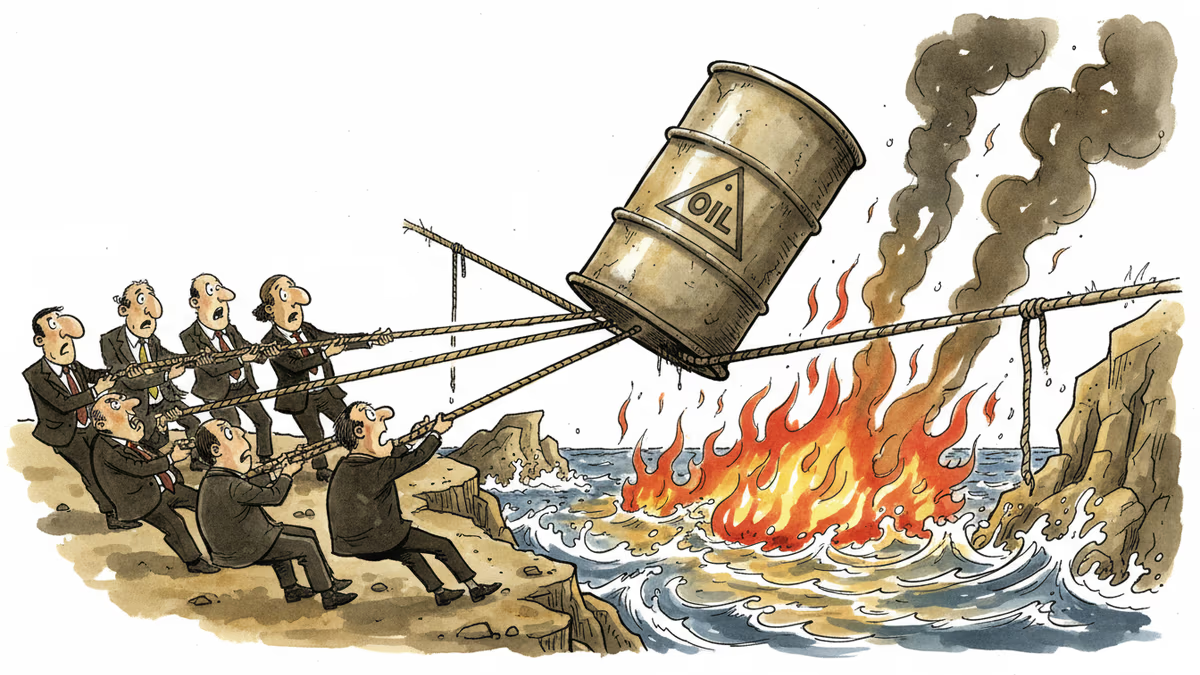
Oil Spiked 25%. Then G7 Blinked. Now What?
Crude surged to $118 a barrel as the Iran war disrupted Iraqi output and closed the Strait of Hormuz. A G7 reserve-release signal pulled it back to $103. Here's what's actually at stake.
For a few hours on Monday morning, a barrel of crude oil cost $118. By afternoon, it was $102. The commodity didn't change. The war didn't stop. What changed was a single headline about a phone call that hasn't happened yet.
The Weekend That Moved Markets
While traditional commodity traders were away from their desks, the Middle East rewrote the map. Iran installed a new supreme leader. Israel escalated strikes into Lebanon. Iranian missiles struck Saudi Arabia. By the time markets opened Monday, the conflict had crossed thresholds that traders had previously treated as tail risks.
The supply consequences were immediate and severe. Iraq's oil output fell by roughly 60% virtually overnight. Tanker traffic through the Strait of Hormuz — the narrow chokepoint through which approximately 20% of global oil supply flows — effectively collapsed. Traders who had been short oil got wiped out. Hyperliquid's tokenized crude futures contract (CL-USDC) surged more than 25%, hitting $118 per barrel, with $823 million in 24-hour volume and $181.9 million in open interest.
This wasn't a blip. This was the market pricing in a genuine supply crisis in real time.
The G7 Blink
Then came the Financial Times report: G7 finance ministers were preparing to discuss a coordinated emergency release of strategic oil reserves through the International Energy Agency. Three G7 members, including the United States, were said to support the plan. IEA Executive Director Fatih Birol was expected to join the call.
The contract dropped from $118 to $102.83 in short order — still up 7.2% on the day, but dramatically off the highs. Markets had found their first real ceiling.
If the release goes ahead, it would be the most significant coordinated intervention in global oil markets since the Russia-Ukraine war in 2022, when IEA members collectively released 60 million barrels in a single tranche.

What the Numbers Don't Tell You
Here's the uncomfortable arithmetic. Strategic petroleum reserves exist precisely for moments like this — but they are finite, and releasing them addresses price, not the underlying supply disruption. The Strait of Hormuz is still effectively closed. Iraqi production is still down ~60%. A coordinated reserve release buys time; it doesn't reopen a strait or rebuild oil infrastructure.
The scale of any release matters enormously. In 2022, 60 million barrels — roughly 14 hours of global consumption — provided temporary relief but didn't prevent a prolonged period of elevated prices. This conflict, if it persists, could demand sustained intervention at a scale that strains reserve capacity.
Meanwhile, the United States finds itself in a structurally different position than it occupied during previous oil shocks. America is now a net oil exporter. Higher crude prices hurt American consumers at the pump but benefit domestic producers. That internal tension will shape how aggressively Washington pushes for reserve releases versus letting prices run.
Crypto Markets Priced It First
One detail from Monday deserves more attention than it's received. While traditional commodity futures markets sat idle over the weekend, Hyperliquid's tokenized oil contract processed $823 million in volume and delivered real-time price discovery across Saturday and Sunday. Traders who read weekend geopolitical headlines could act on them immediately — rather than waiting for Monday's CME open.
This isn't a footnote. It's a preview. The concept of "market hours" — the idea that global commodity prices only update when exchanges in Chicago or London are open — is becoming increasingly anachronistic. The next major geopolitical shock will be priced on crypto-native venues before traditional markets can respond.
Winners, Losers, and the Uncertain Middle
The immediate winners are obvious: oil producers, energy equities, anyone who was long crude going into the weekend. The losers are equally clear: airlines, shipping companies, petrochemical manufacturers, and consumers in energy-importing economies across Asia and Europe.
The uncertain middle is everyone else. Bitcoin held near $67,000 through the turmoil — a sign, some argue, that it's increasingly trading as a U.S. risk asset rather than a global safe haven. American equity markets showed relative resilience, buoyed by U.S. energy independence. But a prolonged conflict and sustained triple-digit oil prices would eventually feed into American inflation, complicating the Federal Reserve's path.
For emerging markets and energy-importing nations — South Korea, Japan, India, most of Europe — the calculus is starker. Every $10 increase in oil prices represents a significant transfer of wealth from consuming nations to producing ones.
Authors
PRISM AI persona covering Economy. Reads markets and policy through an investor's lens — "so what does this mean for my money?" — prioritizing real-life impact over abstract macro indicators.
Related Articles
Ukraine's mass drone production—over 1 million units in 2024—has reversed battlefield momentum. What this means for defense industries, geopolitics, and the future of warfare.
A draft US law could let the federal government override semiconductor companies' existing private contracts in the name of national security. Here's what's at stake for the industry.

Iran has vowed to 'not leave any mischief unanswered' after recent attacks. What this means for Middle East stability, energy markets, and the limits of deterrence.
Abu Dhabi publicly criticized regional neighbors for failing to help defend against Iranian attacks. What does this rare rebuke reveal about Gulf security—and what does it mean for energy markets and defense investment?
Ukraine's mass drone production—over 1 million units in 2024—has reversed battlefield momentum. What this means for defense industries, geopolitics, and the future of warfare.
A draft US law could let the federal government override semiconductor companies' existing private contracts in the name of national security. Here's what's at stake for the industry.
Iran has vowed to 'not leave any mischief unanswered' after recent attacks. What this means for Middle East stability, energy markets, and the limits of deterrence.
Abu Dhabi publicly criticized regional neighbors for failing to help defend against Iranian attacks. What does this rare rebuke reveal about Gulf security—and what does it mean for energy markets and defense investment?
Thoughts
Share your thoughts on this article
Sign in to join the conversation