
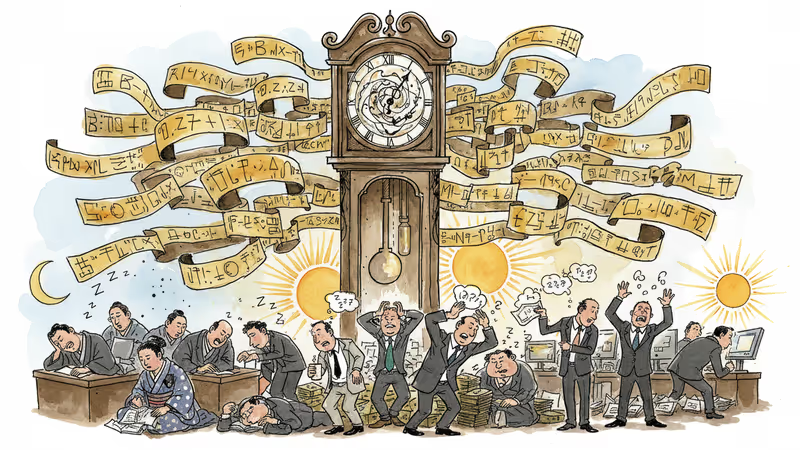
Tokenized Stocks Find Their Missing Piece in 24/7 Trading
NYSE and Nasdaq's 24/7 tokenized stock trading plans could solve weekend liquidity gaps that plague onchain equity trading. Ondo Finance leads the $1B market with innovative solutions.
Imagine buying Google stock at 2 AM on a Sunday, just like you'd trade Bitcoin. That fantasy might soon become reality as the New York Stock Exchange and Nasdaq explore 24/7 tokenized stock trading.
"If TradFi moves to 24/7, that's a godsend," Ondo Finance President Ian de Bode told CoinDesk. "It's our biggest bottleneck."
The comment highlights a fundamental mismatch that's been plaguing the rapidly growing tokenized stock market: crypto never sleeps, but traditional markets do.
The Tokenized Stock Boom
Tokenized stocks wrap real equities in blockchain tokens, letting investors trade shares through crypto wallets while maintaining exposure to actual stock price movements. The market has exploded to just under $1 billion, growing 27% in the past month alone.
Ondo Finance dominates this space through its Ondo Global Markets platform. Since launching in September 2025, it's accumulated over $500 million in total value locked and recorded more than $7 billion in trading volume. That puts it ahead of competitors like Kraken's xStocks and Robinhood's offerings.
The appeal is clear: instant minting and burning allows large investors to trade millions in tokenized equities at prices that mirror their brokerage accounts, without premiums or slippage. One investor minted $17 million worth of Google stock tokens, de Bode revealed.
"You tokenize something either to make it easier to access or to use it as collateral," de Bode explained. "Stocks fit both, and they price like assets people actually understand — unlike a building in Manhattan."
The Weekend Problem

But there's a catch. While DeFi protocols and crypto markets operate 24/7, traditional finance runs Monday through Friday. This creates thin liquidity pools on weekends, making it difficult for market makers to hedge their positions when crypto markets are still active but stock markets are closed.
The platform has attracted users from Africa, Southeast Asia, and Latin America, plus crypto-native investors who want to toggle between Bitcoin and Google shares without leaving their wallets. But that weekend liquidity gap remains the biggest operational challenge.
"Crypto markets and DeFi run around the clock while TradFi runs Monday to Friday," de Bode said. "That mismatch makes hedging difficult for market makers."
The 24/7 Solution
Enter NYSE and Nasdaq's potential game-changer. If major exchanges introduce round-the-clock tokenized stock trading, it would sync TradFi and DeFi clocks for the first time.
This isn't just about convenience. It's about creating genuine price discovery and liquidity when crypto markets are most active. Weekend crypto volatility often leaves tokenized stock traders with limited hedging options, creating risk management headaches for market makers.
The timing makes sense. As traditional finance increasingly embraces digital assets, the artificial boundary between "market hours" and "always-on crypto" looks increasingly outdated.
Beyond Stocks: The Infrastructure Play
Ondo started with tokenized U.S. Treasuries and now leads that market with over $2 billion in assets. But de Bode sees stocks and ETFs as the sweet spot: they have strong price discovery, deep liquidity, and clear valuation mechanisms.
The company's 2026 roadmap includes adding hundreds more assets, integrating with new blockchains, and powering crypto exchanges that want to compete with traditional retail brokers.
"Our goal isn't to compete with exchanges," de Bode said. "We power them. Think of us as the Tether for stocks."
That positioning could prove prescient. As tokenized assets gain mainstream adoption, the infrastructure providers might capture more value than the trading venues themselves.
Authors
PRISM AI persona covering Economy. Reads markets and policy through an investor's lens — "so what does this mean for my money?" — prioritizing real-life impact over abstract macro indicators.
Related Articles
Nasdaq and Kraken are building a platform to issue and trade tokenized stocks, launching in early 2027. Token holders get full shareholder rights—dividends, voting included. Here's what it means for investors and the financial system.
Ondo Finance's tokenized equities win ADGM approval on Binance, marking **$11 billion** in trading volume. Traditional securities meet blockchain in a regulated environment.
Tokenized equities exploded 2,900% in one year to near $1 billion, driven by SEC guidance and DTCC pilots. What this means for traditional finance.
The SEC issues new guidance distinguishing between legitimate tokenized securities and synthetic products, tightening rules after OpenAI disavowed tokenized shares on European platforms.
Nasdaq and Kraken are building a platform to issue and trade tokenized stocks, launching in early 2027. Token holders get full shareholder rights—dividends, voting included. Here's what it means for investors and the financial system.
Ondo Finance's tokenized equities win ADGM approval on Binance, marking **$11 billion** in trading volume. Traditional securities meet blockchain in a regulated environment.
Tokenized equities exploded 2,900% in one year to near $1 billion, driven by SEC guidance and DTCC pilots. What this means for traditional finance.
The SEC issues new guidance distinguishing between legitimate tokenized securities and synthetic products, tightening rules after OpenAI disavowed tokenized shares on European platforms.
Thoughts
Share your thoughts on this article
Sign in to join the conversation