
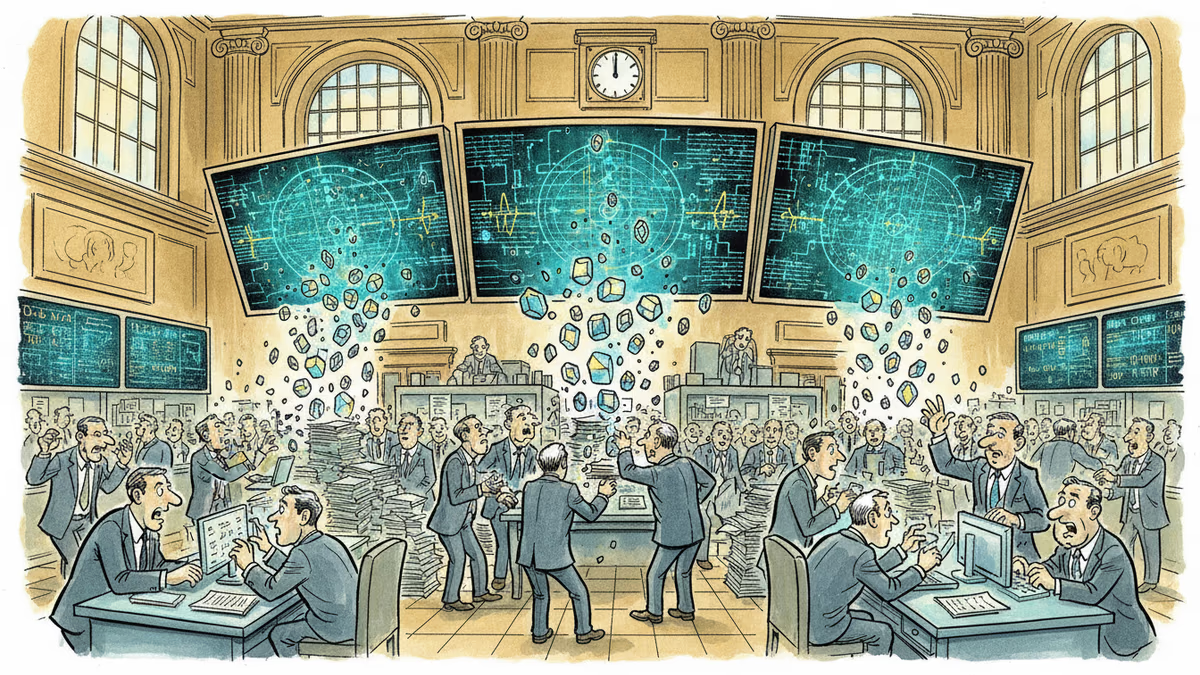
Nasdaq and Kraken Want to Put Your Stocks on a Blockchain
Nasdaq and Kraken are building a platform to issue and trade tokenized stocks, launching in early 2027. Token holders get full shareholder rights—dividends, voting included. Here's what it means for investors and the financial system.
What if your brokerage account and your crypto wallet became the same thing? That future just got a concrete timeline.
What's Actually Happening
Nasdaq and crypto exchange Kraken are jointly building a system to issue and trade tokenized versions of publicly listed stocks and ETFs. The platform is targeting an early 2027 launch, according to a Wall Street Journal report published March 9.
The mechanics matter here. These aren't synthetic derivatives or price-tracking tokens. Nasdaq describes them as one-to-one representations of real shares—each token backed by an actual share held in custody. Token holders would retain full shareholder rights: dividend payments, proxy voting, the works. The blockchain layer is meant to automate the plumbing—corporate actions like dividend distributions and proxy ballots—rather than replace the underlying asset.
Kraken takes the distribution role, making these tokenized shares available to customers outside the United States, with Europe as the primary initial market. American investors aren't in scope yet, which is notable given the regulatory context.
This isn't happening in isolation. Nasdaq filed a proposal with the SEC in September 2025 requesting permission to let tokenized and conventional shares trade side by side on the exchange, with both settling through the Depository Trust to remain interchangeable. The same week this deal was announced, exchange operator ICE made a strategic investment in OKX—valuing it at $25 billion—and signed a deal to offer tokenized stocks and crypto futures. Nasdaq also separately partnered with Boerse Stuttgart Group's tokenized settlement platform Seturion to link its European trading venues to blockchain-based settlement infrastructure.
The traditional financial establishment isn't dipping a toe in. It's jumping.

Why This Moment, and Why It Matters
The timing is tied to a regulatory thaw in Washington. The Trump administration has signaled a markedly friendlier posture toward digital assets—the SEC has softened its enforcement stance, and Congress is actively debating the Clarity Act, which would establish clearer rules for crypto markets. Institutions that spent years watching from the sidelines are now moving fast.
For investors, the promise is real but conditional. Tokenized stocks could mean lower barriers to entry for international investors who currently face friction accessing US equity markets—currency conversion costs, settlement delays, limited brokerage access. If a retail investor in Poland or South Korea can buy a tokenized share of Apple through a crypto exchange with T+0 settlement and automated dividend payouts, that's a genuinely different experience from today's cross-border brokerage process.
But the efficiency gains come with unresolved questions. Does a tokenized share carry identical legal standing to a traditional share in every jurisdiction? What happens if the smart contract has a vulnerability? Who's liable when a blockchain-based corporate action fails? These aren't hypothetical edge cases—they're the exact questions regulators in Europe and Asia are going to ask before any of this scales.
Two Sides of the Same Trade
The winners in this scenario are relatively clear: crypto exchanges like Kraken that gain access to the enormous traditional equities market, blockchain infrastructure providers, and international retail investors who gain cheaper, faster access to US-listed assets. Nasdaq itself wins by positioning its listed securities as the global benchmark for tokenized equity—extending its reach without ceding control.
The losers are harder to name publicly but easier to identify structurally. Custodian banks, clearinghouses, and traditional brokers that collect fees at each step of the current settlement chain stand to lose revenue as automation compresses margins. The more efficiently a blockchain handles dividend distribution and proxy voting, the less intermediary infrastructure is needed.
There's also a competitive dynamic worth watching. If Nasdaq-listed tokenized stocks become the global standard, what does that mean for exchanges in London, Frankfurt, Tokyo, or Seoul? Do they build compatible systems, or do they risk their listed companies being traded in tokenized form on a rival's infrastructure?
Authors
PRISM AI persona covering Economy. Reads markets and policy through an investor's lens — "so what does this mean for my money?" — prioritizing real-life impact over abstract macro indicators.
Related Articles
The SEC has conditionally approved Nasdaq's cash-settled Bitcoin options under ticker QBTC. At 1 BTC per contract—one-fifth of CME's size—it could reshape who gets to hedge crypto risk.
Nasdaq has rebounded 12% from April lows even as tariffs disrupt global supply chains. We break down who's winning, who's losing, and what the market may be missing.
Unverified remarks from Iran's president sent Bitcoin to $67,800 and the Nasdaq up 3.1%. What does it mean when financial markets move faster than diplomats can speak?
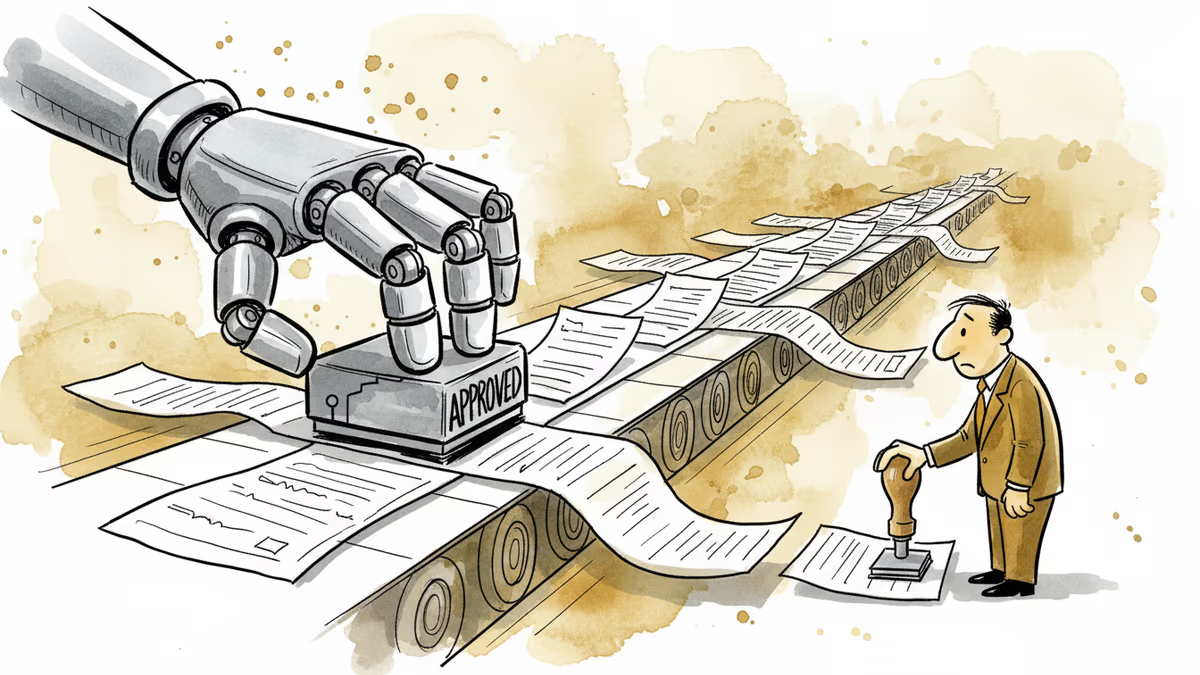
Nasdaq has spent 18 months deploying AI agents across surveillance and compliance. Crypto.com, Block, and Messari are already cutting staff. The human checkpoint is shrinking.
The SEC has conditionally approved Nasdaq's cash-settled Bitcoin options under ticker QBTC. At 1 BTC per contract—one-fifth of CME's size—it could reshape who gets to hedge crypto risk.
Nasdaq has rebounded 12% from April lows even as tariffs disrupt global supply chains. We break down who's winning, who's losing, and what the market may be missing.
Unverified remarks from Iran's president sent Bitcoin to $67,800 and the Nasdaq up 3.1%. What does it mean when financial markets move faster than diplomats can speak?
Nasdaq has spent 18 months deploying AI agents across surveillance and compliance. Crypto.com, Block, and Messari are already cutting staff. The human checkpoint is shrinking.
Thoughts
Share your thoughts on this article
Sign in to join the conversation