
Nvidia Gave Up China's AI Market. Huawei Took It.
Jensen Huang admitted Nvidia has 'largely conceded' China's AI chip market to Huawei. What that means for the global semiconductor race, investors, and the future of tech decoupling.
Nvidia just reported its best quarter ever. Then its CEO told the world he's given up on one of the biggest markets on earth.
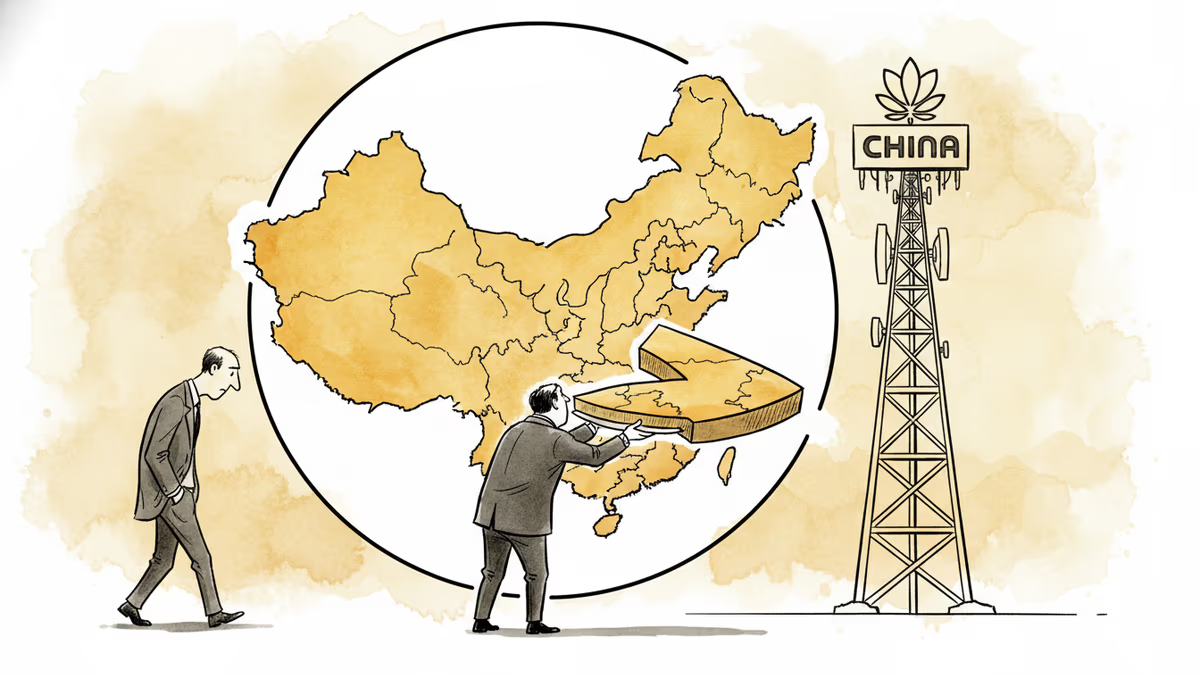
Jensen Huang dropped the line almost matter-of-factly during a CNBC interview: "We've really largely conceded that market to them." Them being Huawei. The market being China's AI chip industry — a space that once generated at least one-fifth of Nvidia's data center revenue.
The timing is worth sitting with. Nvidia's quarterly revenue surged 85% year-over-year to $81.62 billion, blowing past every estimate. The company announced an $80 billion share buyback and raised its dividend. By every conventional measure, this was a triumph. And yet Huang used the moment to publicly acknowledge a structural retreat that has no clear end date.
How the Shutdown Happened
The story starts with Washington, not Silicon Valley. Export restrictions on advanced AI chips to China have tightened progressively — first under Biden, then accelerated under Trump. In April, the Trump administration told Nvidia it would need a license to export chips to China and several other countries. That effectively shut the door.
Huang told investors to "expect nothing" on China approvals. When Trump visited Beijing last week, Huang was added to the delegation at the last minute, briefly raising hopes that H200 chip sales might be back on the table. They weren't. A U.S. trade representative confirmed that chip export controls weren't part of the talks at all.
Some Chinese companies — Alibaba, Tencent, ByteDance, and JD.com — reportedly received Commerce Department approval to purchase H200 chips. But whether that signals a thaw or a narrow carve-out remains unclear. Huang's own guidance to investors was unambiguous: plan for zero.

Huawei's Moment
Nature abhors a vacuum, and so does a $1 trillion+ AI infrastructure market. Huawei stepped in.
Huang's description of his competitor was notably candid: "Huawei is very, very strong. They had a record year, they'll likely, very likely, have an extraordinary year coming up, and their local ecosystem of chip companies are doing quite well — because we've evacuated that market."
That last phrase — because we've evacuated — is the key admission. Huawei's Ascend AI chips are closing the performance gap with Nvidia's H100. Domestic Chinese chip firms like Cambricon and Moore Threads are scaling. An ecosystem that was once dependent on Nvidia is now being deliberately rewired around homegrown alternatives. U.S. export controls, designed to slow China's AI progress, may have compressed the timeline for Chinese semiconductor self-sufficiency instead.
What This Means for Investors — and Everyone Else
For Nvidia shareholders, the near-term picture is still bright. The company's growth engine is running on U.S., European, and Southeast Asian demand, plus the insatiable appetite of hyperscalers like Microsoft, Google, and Amazon for AI infrastructure. Huang outlined what he calls the AI industry's "five-layer cake" — energy, chips, infrastructure, models, and applications — and said the idea of Nvidia becoming "many times larger" is "not out of the question."
But the China gap is a real ceiling. A market that once contributed 20%+ of data center revenue is now effectively zero. And the longer the shutdown persists, the more entrenched Huawei's position becomes. Winning back Chinese customers in five years won't look like winning them back today — the switching costs will be higher, the loyalty to domestic suppliers deeper.
For policymakers, the calculus is harder. The export controls were designed to deny China access to cutting-edge AI hardware. They succeeded in that narrow sense. But they also created the conditions for Huawei to become China's dominant AI chip supplier — a company that, by Huang's own assessment, is now on a record growth trajectory. The policy achieved its stated goal and may have accelerated its unintended consequence simultaneously.
For the broader tech industry, the Nvidia-China story is a preview of a world where the global semiconductor supply chain splits into two distinct lanes — one aligned with Washington, one with Beijing. Companies, investors, and governments will increasingly have to decide which lane they're in.
This content is AI-generated based on source articles. While we strive for accuracy, errors may occur. We recommend verifying with the original source.
Related Articles

Nvidia posted 85% revenue growth and a $80B buyback. Its stock still dropped — for the fourth straight post-earnings quarter. Here's what that tells us about where AI investing stands right now.
Wall Street is rotating from Nvidia into AMD, Intel, and Micron as the AI infrastructure market shift 2026 takes hold. Discover why CPUs and memory are the new gold.

Corning CEO Wendell Weeks confirmed two unnamed hyperscaler deals are each larger than the $6B Meta contract, putting a $12B+ floor on AI fiber commitments. Here's what that means for investors.
AI chipmaker Cerebras is going public on Nasdaq, targeting up to $3.5B in its IPO. With an OpenAI deal and real profits, the pitch is compelling—but the risks are hiding in plain sight.
Nvidia posted 85% revenue growth and a $80B buyback. Its stock still dropped — for the fourth straight post-earnings quarter. Here's what that tells us about where AI investing stands right now.
Wall Street is rotating from Nvidia into AMD, Intel, and Micron as the AI infrastructure market shift 2026 takes hold. Discover why CPUs and memory are the new gold.
Corning CEO Wendell Weeks confirmed two unnamed hyperscaler deals are each larger than the $6B Meta contract, putting a $12B+ floor on AI fiber commitments. Here's what that means for investors.
AI chipmaker Cerebras is going public on Nasdaq, targeting up to $3.5B in its IPO. With an OpenAI deal and real profits, the pitch is compelling—but the risks are hiding in plain sight.
Thoughts
Share your thoughts on this article
Sign in to join the conversation