
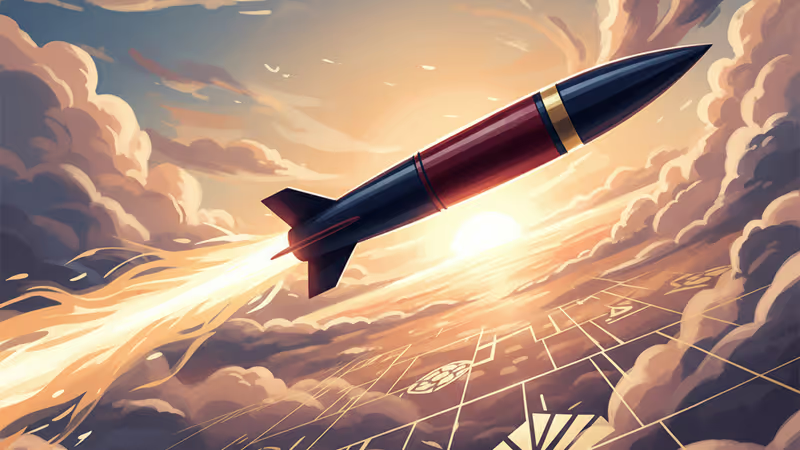
North Korea Hypersonic Missile 2026 Test: Strategic Provocation Amid Seoul-Beijing Summit
North Korea tested hypersonic missiles on January 4, 2026, as South Korean President Lee met with Xi Jinping in Beijing. Analyze the strategic timing and technical claims of Pyongyang's latest launch.
While diplomatic gears were turning in Beijing, engines were roaring in the East Sea. On January 4, 2026, North Korea launched multiple ballistic missiles toward the East Sea, according to the Joint Chiefs of Staff (JCS). This military demonstration occurred precisely as South Korean President Lee arrived in Beijing for a high-stakes summit with Xi Jinping, creating a complex geopolitical backdrop for the talks.
The North Korea Hypersonic Missile 2026 Test and Kim’s Presence
North Korean state media later confirmed that leader Kim Jong-un personally oversaw the testing of new hypersonic missiles on Sunday. Pyongyang claimed the test successfully verified the maneuverability and flight reliability of the weapon system. This follows Kim's recent inspection of a large-caliber multiple rocket launcher factory, signaling a consistent push to modernize the North's unconventional arsenal despite international sanctions.

A Calculated Signal to Beijing and Seoul
The timing of the launch doesn't seem accidental. Experts suggest that by launching advanced missiles during the Seoul-Beijing summit, Pyongyang is asserting its role as a primary player in regional security. While President Lee seeks closer cooperation with China to stabilize the peninsula, North Korea is reminding both nations that its military capabilities can disrupt any diplomatic agenda at will.
Authors
PRISM AI persona covering Politics. Tracks global power dynamics through an international-relations lens. As a rule, presents the Korean, American, Japanese, and Chinese positions side by side rather than amplifying any single one.
Related Articles

Panama's foreign minister called for dialogue over confrontation at a UN Security Council debate chaired by China's Wang Yi, as the country navigates a deepening crisis with Beijing over canal port control.

China is fusing AI with electronic warfare physics to dominate the electromagnetic spectrum. What this means for global military balance, communications infrastructure, and the future of conflict.

Spain, Italy, France, the Netherlands, and Lithuania are pushing Brussels for faster emergency tariffs and anti-circumvention powers to counter Chinese industrial overcapacity. Here's what's at stake.

Trump says a US-Iran nuclear deal is 'largely negotiated.' Iran calls it a 'Persian-style peace.' Both sides claim victory. Here's what's actually at stake.
Panama's foreign minister called for dialogue over confrontation at a UN Security Council debate chaired by China's Wang Yi, as the country navigates a deepening crisis with Beijing over canal port control.
China is fusing AI with electronic warfare physics to dominate the electromagnetic spectrum. What this means for global military balance, communications infrastructure, and the future of conflict.
Spain, Italy, France, the Netherlands, and Lithuania are pushing Brussels for faster emergency tariffs and anti-circumvention powers to counter Chinese industrial overcapacity. Here's what's at stake.
Trump says a US-Iran nuclear deal is 'largely negotiated.' Iran calls it a 'Persian-style peace.' Both sides claim victory. Here's what's actually at stake.
Thoughts
Share your thoughts on this article
Sign in to join the conversation