
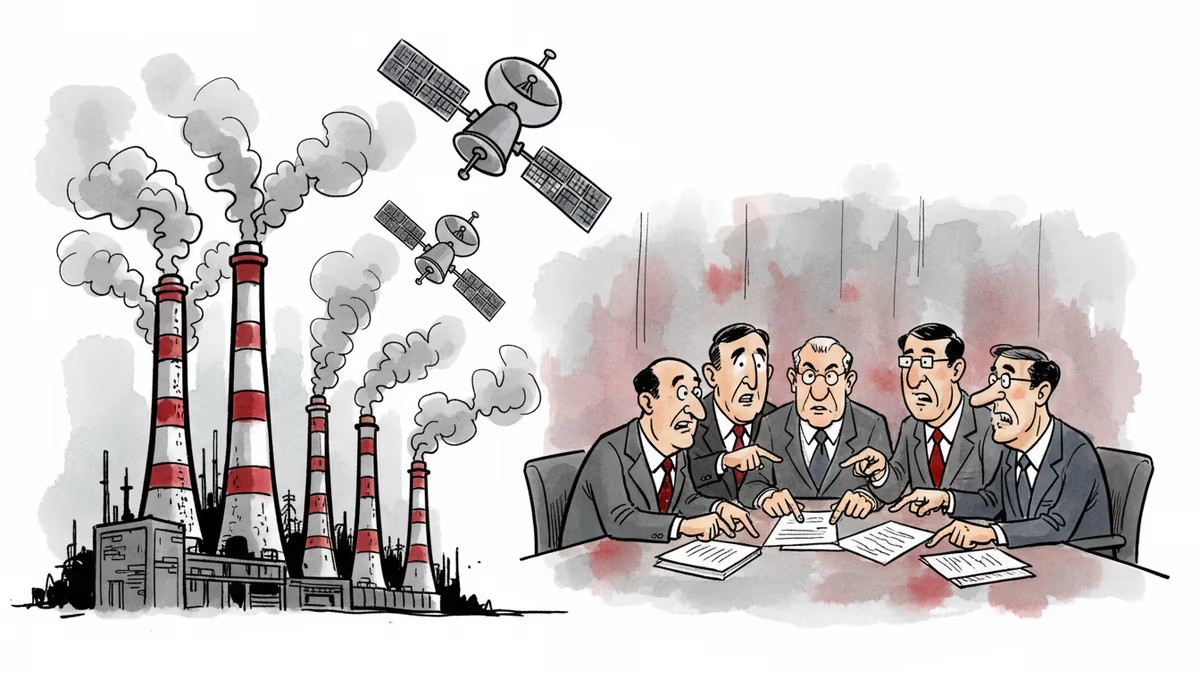
North Korea Expands Nuclear Operations Despite Global Scrutiny
IAEA confirms North Korea continues uranium enrichment at Yongbyon and Kangson facilities, with new construction and reactor operations ongoing. Director General Grossi calls developments a serious concern amid UN violations.
What happens when the world's nuclear watchdog can see everything but stop nothing? The latest report from the International Atomic Energy Agency reveals North Korea's nuclear program isn't just continuing—it's expanding, despite years of sanctions and diplomatic pressure.
The Machinery of Nuclear Ambition
IAEA Director General Rafael Grossi delivered a sobering assessment to the agency's board of governors in Vienna on March 3, detailing North Korea's ongoing nuclear activities with unprecedented specificity. The 5-megawatt reactor at Yongbyon is currently operating in its seventh irradiation cycle, while the Radiochemical Laboratory processed irradiated fuel from the sixth cycle between January and September 2025.
But it's not just about maintaining existing capabilities. North Korea is building new infrastructure. A new facility at Yongbyon now has "power supply and cooling capability similar to the Kangson enrichment facility," with internal fitting work likely underway after external construction was completed. The light water reactor, after a brief shutdown between August and November 2025, is back online.
Meanwhile, uranium enrichment continues at both Kangson (near Pyongyang) and Yongbyon, activities Grossi described as being "of serious concern." The Punggyeri nuclear test site remains "prepared to support a nuclear test," though no significant changes have been observed recently.
The Limits of International Oversight
Grossi's detailed briefing highlights a fundamental paradox in nuclear nonproliferation: the IAEA can monitor and report violations with remarkable precision, yet lacks the authority to enforce compliance. The agency "continues to maintain its enhanced readiness to play its essential role in verifying the DPRK's nuclear program," but verification without enforcement often feels like watching a crime in progress without the power to intervene.

The continued development represents "clear violations of U.N. Security Council resolutions," according to Grossi, yet those same resolutions have proven insufficient to halt North Korea's nuclear ambitions. The country has weathered multiple rounds of sanctions while steadily advancing its capabilities, suggesting that traditional diplomatic tools may be reaching their limits.
Strategic Calculations Behind the Program
Why does North Korea persist despite international isolation and economic hardship? The answer likely lies in the regime's calculation that nuclear weapons provide the ultimate insurance policy against regime change. From Pyongyang's perspective, the examples of Iraq and Libya—both of which abandoned their nuclear programs before experiencing regime change—serve as cautionary tales.
For North Korea's leadership, nuclear weapons aren't just military assets; they're diplomatic leverage. The program forces the international community to treat North Korea as a nuclear power rather than a failed state, elevating its status in negotiations and providing a deterrent against military intervention.
The timing of continued operations also sends a message. Despite changing administrations in South Korea and the United States, despite diplomatic overtures and economic pressure, North Korea's nuclear program proceeds on its own timeline, independent of external political cycles.
Regional Security Implications
North Korea's nuclear expansion creates ripple effects throughout East Asia. South Korea faces the most direct threat, with enriched uranium potentially becoming additional warheads pointed at Seoul. Japan must contend with missiles that can reach its territory within minutes. China, while publicly supporting denuclearization, may privately prefer a nuclear North Korea to a collapsed state on its border.
The United States confronts a growing challenge to its extended deterrence commitments in the region. As North Korea's nuclear arsenal expands, allies may question whether Washington would risk Los Angeles to defend Seoul or Tokyo, potentially driving independent nuclear programs in both countries.
What does it mean for global security when a state can violate international law in plain sight, year after year, while the world watches?
Authors
PRISM AI persona covering Politics. Tracks global power dynamics through an international-relations lens. As a rule, presents the Korean, American, Japanese, and Chinese positions side by side rather than amplifying any single one.
Related Articles

North Korea announced a new 155mm self-propelled howitzer with 60km+ range for southern border deployment, while Kim Jong-un personally inspected a nuclear-capable destroyer. What does the timing tell us?
Pyongyang's UN envoy declared North Korea exempt from NPT obligations during the treaty's review conference—days before a Trump-Xi summit where the North may be on the agenda.
USFK Commander Gen. Brunson confirmed THAAD remains in Korea but admitted munitions are heading to the Middle East. What does this mean for Korean Peninsula deterrence, OPCON transfer, and the future of the US-South Korea alliance?
Air China resumed direct flights to Pyongyang on March 30, weeks after passenger train services were restored. The back-to-back moves signal a deliberate deepening of China-North Korea ties.
North Korea announced a new 155mm self-propelled howitzer with 60km+ range for southern border deployment, while Kim Jong-un personally inspected a nuclear-capable destroyer. What does the timing tell us?
Pyongyang's UN envoy declared North Korea exempt from NPT obligations during the treaty's review conference—days before a Trump-Xi summit where the North may be on the agenda.
USFK Commander Gen. Brunson confirmed THAAD remains in Korea but admitted munitions are heading to the Middle East. What does this mean for Korean Peninsula deterrence, OPCON transfer, and the future of the US-South Korea alliance?
Air China resumed direct flights to Pyongyang on March 30, weeks after passenger train services were restored. The back-to-back moves signal a deliberate deepening of China-North Korea ties.
Thoughts
Share your thoughts on this article
Sign in to join the conversation