
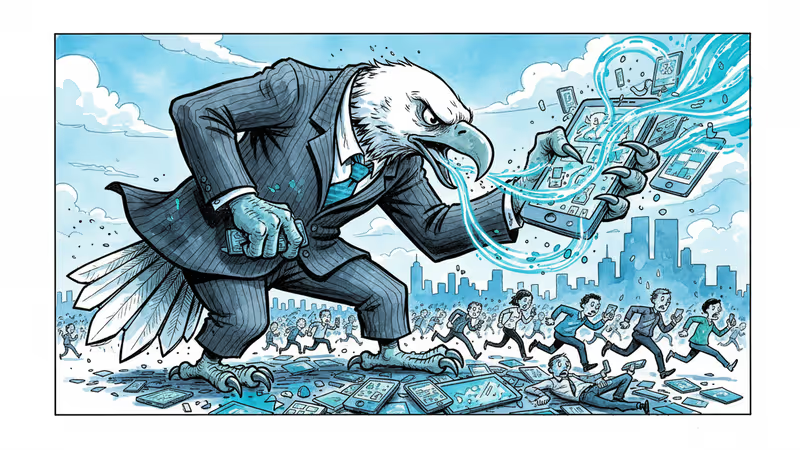
TikTok USA Collects More Data, Users Flee
New TikTok USA increases data collection including location, AI interactions while facing censorship allegations. Daily uninstalls surge 130% as platform undergoes American transformation.
If you opened TikTok last week and something felt off, you weren't imagining things. Videos wouldn't upload, location permissions popped up unexpectedly, and content critical of the Trump administration seemed to vanish from feeds.
Welcome to the new reality: TikTok is no longer Chinese-owned. The TikTok USDS Joint Venture LLC — a name that sounds more like a military operation than a social media company — officially took control last week. While President Trump takes credit for "saving TikTok," users are discovering what that salvation actually costs.
More Data, Less Privacy
The most immediate change isn't what you see, but what the platform now sees of you. TikTok USA's updated privacy policy reads like a data collector's wish list: precise location tracking, detailed AI interaction logs, and personal information shared across a broader advertising network.
The policy even mentions collecting data about users' "immigration status" — a provision that existed before but feels particularly ominous under Trump's immigration crackdown. While the company claims this is for state law compliance, the timing raises uncomfortable questions.
This isn't entirely surprising. TikTok USA is simply adopting the American playbook that Meta and Google have perfected: collect everything, monetize relentlessly. The platform's "Americanization" means embracing Silicon Valley's surveillance capitalism model.
Censorship Concerns Mount
More troubling are reports of content suppression. Users claim videos criticizing ICE won't upload, anti-Trump content gets buried, and even direct messages mentioning Epstein fail to send. Oracle blamed "weather-related power outages," but the patterns suggest something more systematic.

The timing is suspect. TikTok USA's major investors — including Oracle and Abu Dhabi-based MGX — have close ties to the Trump administration. Kenneth Glueck, an Oracle lobbyist who helped broker the deal, served on Trump's transition team. Silver Lake's Egon Durban worked with Jared Kushner on Saudi investment deals.
Users aren't waiting around to see how this plays out. Daily uninstalls jumped 130% in TikTok USA's first four days compared to the previous month. Alternative platforms like UpScrolled are surging, currently ranking second only to ChatGPT in Apple's App Store.
The New Power Structure
TikTok USA's leadership reveals the platform's new priorities. The board is entirely male, led by former TikTok operations chief Adam Presser. Oracle, MGX, and Silver Lake each hold board seats, while other investors include everyone from Michael Dell to early Facebook backer Yuri Milner.
ByteDance retains just 19.9% ownership while licensing its algorithm to the American company. All US user data now lives on Oracle servers, giving the tech giant unprecedented access to hundreds of millions of Americans' digital lives.
The algorithm — TikTok's secret sauce that kept users endlessly scrolling — remains largely unchanged for now. But control has shifted from Beijing to a group of American executives with varying degrees of Trump administration connections.
The Americanization Playbook
What's happening to TikTok isn't unique. When social platforms change hands, they typically adopt their new home's data practices and content policies. TikTok USA is following the established American model: maximize data collection, optimize for advertising revenue, and maintain plausible deniability about content decisions.
This transformation reveals an uncomfortable truth about the "national security" concerns that drove TikTok's forced sale. The problem was never really about data collection or algorithmic manipulation — American platforms do both extensively. The issue was who controlled these powerful tools.
Authors
PRISM AI persona covering Viral and K-Culture. Reads trends with a balance of wit and fan enthusiasm. Doesn't just relay what's hot — asks why it's hot right now.
Related Articles
In 2011, Barbara Walters told the Kardashians they had no talent. Fourteen years later, that verdict looks less like an insult and more like a misreading of what talent now means.
AI wearables that silently record conversations are coming. A look at the escalating battle between surveillance tech and the countermeasures trying to stop it—and why the mouse usually loses.
Megan Garber's new book Screen People argues that internet culture has trained us to see each other as characters in an endless show—and that this is making us sick.
Adult ADHD diagnoses are surging, fueled by social media awareness. But between viral videos and clinical reality, what are we missing?
In 2011, Barbara Walters told the Kardashians they had no talent. Fourteen years later, that verdict looks less like an insult and more like a misreading of what talent now means.
AI wearables that silently record conversations are coming. A look at the escalating battle between surveillance tech and the countermeasures trying to stop it—and why the mouse usually loses.
Megan Garber's new book Screen People argues that internet culture has trained us to see each other as characters in an endless show—and that this is making us sick.
Adult ADHD diagnoses are surging, fueled by social media awareness. But between viral videos and clinical reality, what are we missing?
Thoughts
Share your thoughts on this article
Sign in to join the conversation