
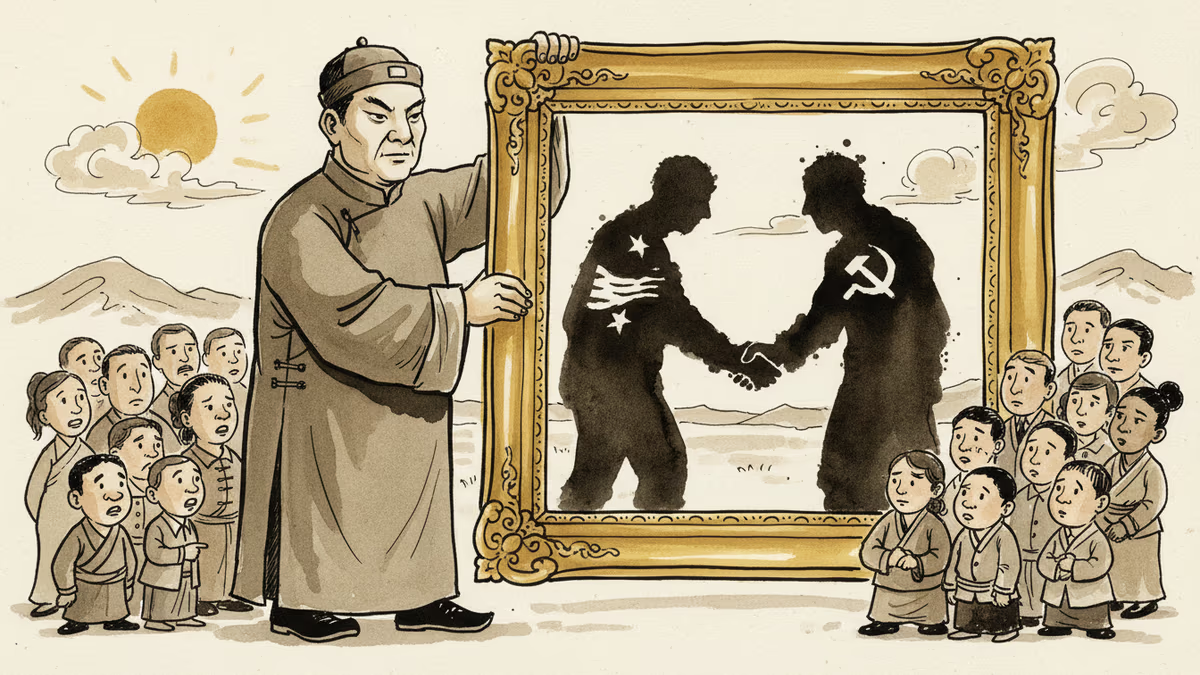
Xi's 'New Relationship' Declaration: Diplomatic Ritual or Real Shift?
Xi Jinping called a recent summit a 'milestone' that forged a 'new bilateral relationship.' What does this language actually signal—and who stands to gain or lose?
When a head of state calls a summit a "milestone" and announces a "new bilateral relationship," the instinct is to nod and move on. But Xi Jinping doesn't use superlatives casually.
The Chinese president's declaration following a recent summit—that the two sides had forged a fundamentally new relationship—landed with unusual weight. The language was deliberate, the framing emphatic. In Chinese diplomatic culture, where understatement is the default, this kind of public declaration signals something beyond routine courtesy.
What Was Actually Said—and What Wasn't
Here's the problem: the substance behind the declaration remains largely opaque. Chinese state media amplified the symbolism but offered little by way of concrete deliverables. No specific trade figures. No binding agreements made public. No joint communiqué with measurable commitments.
This is a recognizable pattern in Beijing's diplomatic playbook. The declaration comes first; the architecture follows—sometimes. The announcement itself becomes the event, creating political momentum that can later be filled with content, or quietly allowed to fade.
What we do know is the context in which this summit occurred. In May 2026, the global trading order is under sustained stress. Washington has escalated tariff pressure across multiple fronts. Supply chain realignment—away from Chinese manufacturing—has become explicit policy for several Western governments. Against this backdrop, Xi has been methodically building alternative partnership structures. This summit, whatever its bilateral specifics, fits that larger architecture.
The Geometry of a 'New Relationship'

Who Xi was talking to matters enormously. A "new relationship" with a major European economy carries different weight than one with a Global South partner. The former would signal a fracture in the transatlantic economic consensus; the latter would indicate China accelerating its parallel trade network among developing nations.
Either way, the announcement functions on two levels simultaneously. Externally, it signals to Washington that China is not isolated—that pressure produces counter-coalitions rather than capitulation. Internally, it offers Xi a narrative of diplomatic momentum at a moment when domestic pressures are real: a property sector still recovering, youth unemployment stubbornly high, and growth targets that require careful management.
Foreign policy victories, even symbolic ones, serve domestic political purposes. This is not unique to China—but in a system where leadership legitimacy rests heavily on competence and strength, the optics of a "milestone" summit carry particular value.
Winners, Losers, and the Companies Watching Closely
For global businesses, the question is whether this declaration translates into altered trade flows, preferential access, or new investment corridors. If the "new bilateral relationship" materializes into concrete economic arrangements, the ripple effects are significant.
Companies that have been executing China+1 diversification strategies—moving production to Vietnam, India, or Mexico—face a recalibration risk. If China successfully deepens alternative partnerships, it reduces its own vulnerability to Western pressure while potentially creating new competitive dynamics in third markets.
For investors, the more immediate signal is geopolitical: China is actively constructing a parallel economic order. That's not new as a trend, but the pace and the explicit framing are intensifying. Sectors most exposed—semiconductors, rare earth supply chains, agricultural commodities—should expect continued volatility tied to diplomatic developments that look, on the surface, like ceremonial summitry.
This content is AI-generated based on source articles. While we strive for accuracy, errors may occur. We recommend verifying with the original source.
Related Articles

Trump's Beijing visit was a masterclass in diplomatic theater. Warm handshakes, viral selfies, and noodle runs. But Taiwan, Iran, and rare earths remain untouched. Here's what the spectacle obscures.
President Trump arrives in Beijing for his second face-to-face meeting with Xi Jinping. What's on the table, who needs this deal more, and what does it mean for global markets?
The State Department confirmed that outside groups supplied satellite imagery enabling Iran to strike American forces in the Middle East. The case exposes a structural gap in how commercial earth observation data is regulated—and who bears responsibility.
Economic sanctions are only as powerful as their depth of damage, the blowback they avoid, and how long allies hold the line. A framework for the era of weaponized trade.
Trump's Beijing visit was a masterclass in diplomatic theater. Warm handshakes, viral selfies, and noodle runs. But Taiwan, Iran, and rare earths remain untouched. Here's what the spectacle obscures.
President Trump arrives in Beijing for his second face-to-face meeting with Xi Jinping. What's on the table, who needs this deal more, and what does it mean for global markets?
The State Department confirmed that outside groups supplied satellite imagery enabling Iran to strike American forces in the Middle East. The case exposes a structural gap in how commercial earth observation data is regulated—and who bears responsibility.
Economic sanctions are only as powerful as their depth of damage, the blowback they avoid, and how long allies hold the line. A framework for the era of weaponized trade.
Thoughts
Share your thoughts on this article
Sign in to join the conversation