
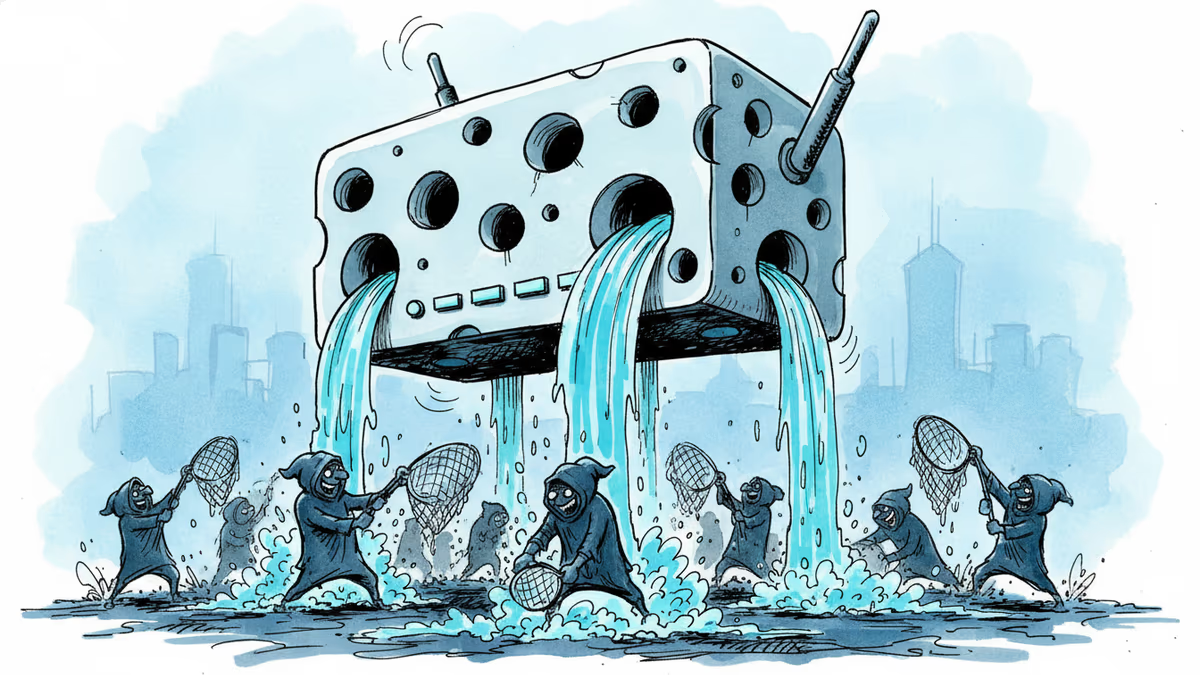
6 Billion Users, 30 Years of Wi-Fi Security Holes
Despite serving 6 billion users globally, Wi-Fi security remains fundamentally flawed. We trace the protocol's security evolution and persistent vulnerabilities.
6 billion people use Wi-Fi daily. Yet the network you're connected to right now? It might be less secure than you think. Since debuting in the late 1990s, 48 billion Wi-Fi devices have shipped worldwide, but security vulnerabilities continue to haunt the protocol that powers our digital lives.
The Wild West Era
Early Wi-Fi networks were digital lawlessness incarnate. Public hotspots became hunting grounds for ARP spoofing attacks, where rogue users could intercept and read others' traffic with relative ease. The fundamental problem? Wi-Fi inherited the security weaknesses of its predecessor, Ethernet.
Back then, anyone on a network could read and modify traffic sent to anyone else. Add Wi-Fi's reliance on radio signals—which anyone nearby can potentially intercept—and you had a perfect storm of vulnerability.
Encryption: The Imperfect Shield
The solution seemed straightforward: build cryptographic protections to prevent unauthorized parties from reading or tampering with user traffic. Whether you were a legitimate user on the network or someone lurking near the access point, encryption would keep you out.
But reality proved messier. From WEP to WPA to WPA2 and now WPA3, each security protocol brought new vulnerabilities. WEP was cracked within years. WPA2, while more robust, still suffers from weaknesses that sophisticated attackers can exploit.
The Corporate Balancing Act

For device manufacturers, Wi-Fi security presents an ongoing dilemma. Implement cutting-edge security, and you risk compatibility issues with older routers. Stick with legacy protocols, and you expose users to known vulnerabilities.
Apple, Google, and other tech giants face constant pressure to balance security with user experience. Too much security friction, and customers complain. Too little, and data breaches make headlines.
Enterprise networks face even thornier challenges. With remote work normalizing, corporate security perimeters now extend into employees' homes. A compromised home Wi-Fi network can become a gateway into corporate systems, regardless of VPN protections.
The 5G Paradox
Many predicted 5G would make Wi-Fi obsolete. Instead, it's made Wi-Fi more critical. As data consumption explodes, Wi-Fi offloading becomes essential for cellular networks. The result? More Wi-Fi networks, more devices, and more attack surfaces.
IoT devices compound the problem. Your smart doorbell, security camera, and thermostat all connect via Wi-Fi, often with minimal security updates. Each represents a potential entry point for attackers.
The Human Factor
Perhaps the biggest Wi-Fi security challenge isn't technical—it's human. How many users actually understand the difference between WPA2 and WPA3? How many check whether their home router supports the latest security protocols?
The answer is sobering. Most users prioritize convenience over security, choosing simple passwords or connecting to any available network without considering the risks.
Authors
Related Articles

UK Visa Portal, a private immigration service mistaken for an official government site, has been exposing passport scans and selfies of over 100,000 applicants. The breach remains unpatched.
Okta CEO Todd McKinnon on why AI agents need identity management, the SaaSpocalypse threat, and why the kill switch might be the most important button in enterprise tech.
Iran and Israel are hacking civilian security cameras for military reconnaissance. How consumer surveillance devices became weapons of war.
A security researcher discovered he could access 7,000 DJI robot vacuums and peek into strangers' homes. This Valentine's Day revelation exposes the hidden privacy risks of our smart home obsession.
UK Visa Portal, a private immigration service mistaken for an official government site, has been exposing passport scans and selfies of over 100,000 applicants. The breach remains unpatched.
Okta CEO Todd McKinnon on why AI agents need identity management, the SaaSpocalypse threat, and why the kill switch might be the most important button in enterprise tech.
Iran and Israel are hacking civilian security cameras for military reconnaissance. How consumer surveillance devices became weapons of war.
A security researcher discovered he could access 7,000 DJI robot vacuums and peek into strangers' homes. This Valentine's Day revelation exposes the hidden privacy risks of our smart home obsession.
Thoughts
Share your thoughts on this article
Sign in to join the conversation