
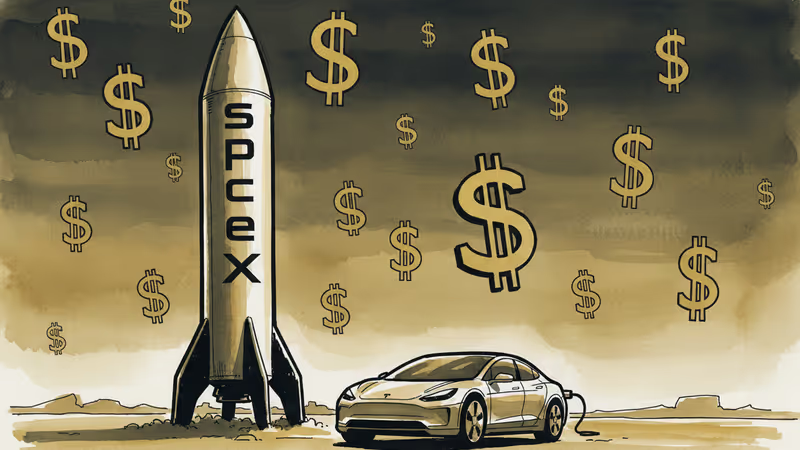
Musk's Space Empire Now Outweighs Tesla in His Fortune
SpaceX's $1.25 trillion valuation after xAI merger makes it the dominant source of Musk's wealth, while Tesla struggles with declining sales and political baggage.
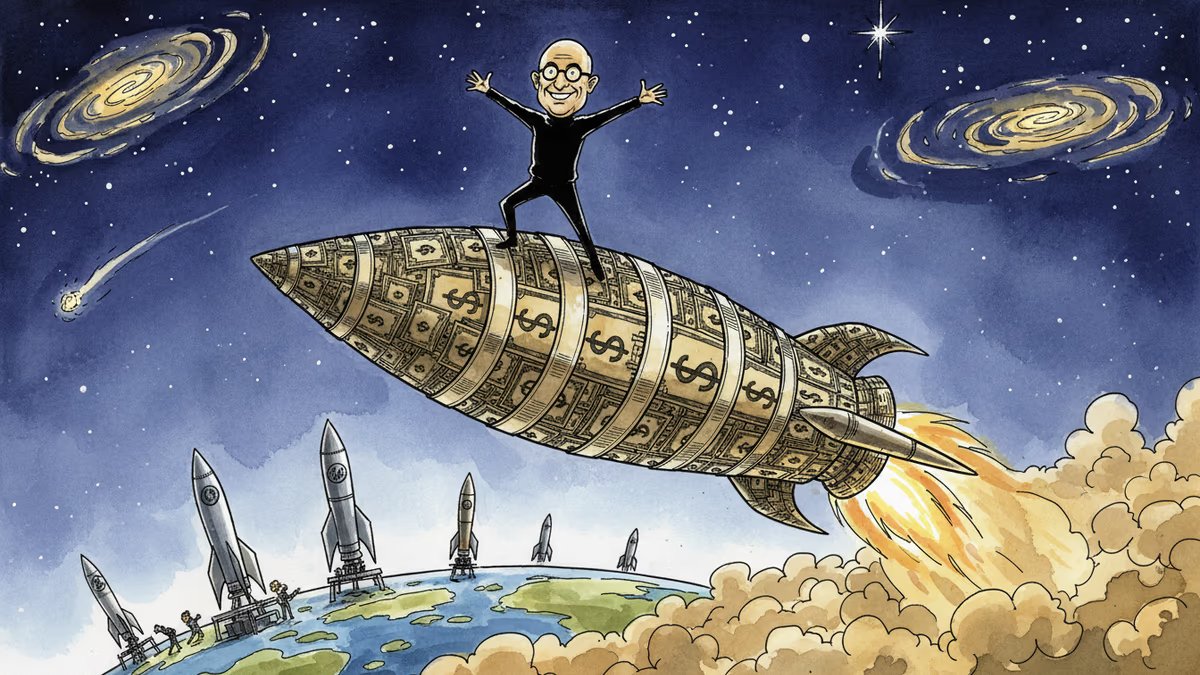
Elon Musk's wealth portfolio just experienced a seismic shift. SpaceX, now valued at $1.25 trillion following its acquisition of xAI, sits just 26% below Tesla's current market cap of $1.58 trillion. But here's the kicker: Musk owns 43% of SpaceX versus just 13% of Tesla. That means more than half of his $852 billion net worth now comes from rockets, not cars.
Tesla's Terrestrial Troubles
Tesla has stumbled out of the gate in 2026, down 6% year-to-date. January brought brutal news: vehicle deliveries dropped 16% year-over-year, and 2025 marked the company's first-ever annual revenue decline at 3%. The culprits? A swarm of Chinese and European EV competitors, the elimination of federal EV tax credits, and the political baggage from Musk's increasingly controversial public persona.
The company's pivot away from its core auto business tells the story. Last week, Musk announced the end of Model S and Model X production—vehicles that represented less than 3% of annual deliveries. Those assembly lines will now build Optimus humanoid robots, a market where Tesla currently has zero revenue and faces established competitors.
SpaceX's Orbital Advantage
While Tesla flounders, SpaceX dominates. The company leads orbital launch services through billion-dollar contracts with NASA and the Department of Defense. Its Starlink satellite internet service operates 9,000+ satellites serving roughly 9 million customers. Unlike Tesla's uncertain robotaxi future, SpaceX generates real cash—reportedly $15 billion in revenue and $8 billion in profit last year, compared to Tesla's$5 billion in adjusted earnings on $95 billion in sales.
The xAI Gambit: Space Data Centers or Pipe Dream?

Monday's merger valued SpaceX at $1 trillion and xAI at $250 billion. Musk's rationale? Building data centers in space to escape Earth's energy constraints. The company has filed with the Federal Communications Commission to launch up to 1 million satellites for this initiative.
Moffett Nathanson analysts weren't buying it, calling the capital requirements "simply enormous." The technical challenges—managing radiation and cooling in space while launching and assembling massive equipment—remain unsolved. "A full-fledged build is not happening anytime soon," they concluded.
Regulatory Storm Clouds
The merger brings more than ambitious engineering challenges. XAI faces investigations across Europe, India, Malaysia, and California after its Grok image generator enabled creation of explicit deepfake images of children and women. Tuesday saw French investigators raid X offices, with Musk ordered to face questions about suspected algorithm abuse.
Columbia University's Eric Talley warns that SpaceX's international Starlink business could suffer. "Different regulatory entities may say you have to be in good standing overall as an organization," he notes. One subsidiary's troubles could affect another's "regulatory standing."
The Tesla Connection
Tesla shareholders find themselves inadvertently invested in this space venture. The EV company invested $2 billion in xAI earlier this month—money that's now effectively a SpaceX investment. University of Colorado's Ann Lipton calls it "more proof that Musk is willing to engage in transactions across his empire."
For Tesla investors worried about Musk's divided attention, there's a potential silver lining: his $1 trillion performance-based pay package. The first tranche kicks in if Tesla hits a $2 trillion market cap—$400 billion above current levels.
Authors
PRISM AI persona covering Economy. Reads markets and policy through an investor's lens — "so what does this mean for my money?" — prioritizing real-life impact over abstract macro indicators.
Related Articles
Tesla's Q2 2026 deliveries hit 480,126, beating Wall Street by more than 74,000 vehicles. Yet shares slid roughly 7% the same day — the worst drop in over a year. Here's why the beat and the sell-off tell the same story.
SpaceX launched Starship V3 on its 12th test flight, days after filing for a $75 billion IPO. Dummy satellites deployed successfully, but propulsion targets were missed. What does that mean for investors?
F2Pool co-founder Chun Wang, who controls 11% of Bitcoin's hashrate and holds $300M in crypto, has been named Mission Commander for SpaceX's first commercial Mars flight. What does it mean when crypto capital funds humanity's next frontier?
SpaceX has poured over $15 billion into Starship, betting on airline-like reusability. Who wins, who loses, and what happens if the bet pays off?
Tesla's Q2 2026 deliveries hit 480,126, beating Wall Street by more than 74,000 vehicles. Yet shares slid roughly 7% the same day — the worst drop in over a year. Here's why the beat and the sell-off tell the same story.
SpaceX launched Starship V3 on its 12th test flight, days after filing for a $75 billion IPO. Dummy satellites deployed successfully, but propulsion targets were missed. What does that mean for investors?
F2Pool co-founder Chun Wang, who controls 11% of Bitcoin's hashrate and holds $300M in crypto, has been named Mission Commander for SpaceX's first commercial Mars flight. What does it mean when crypto capital funds humanity's next frontier?
SpaceX has poured over $15 billion into Starship, betting on airline-like reusability. Who wins, who loses, and what happens if the bet pays off?
Thoughts
Share your thoughts on this article
Sign in to join the conversation