
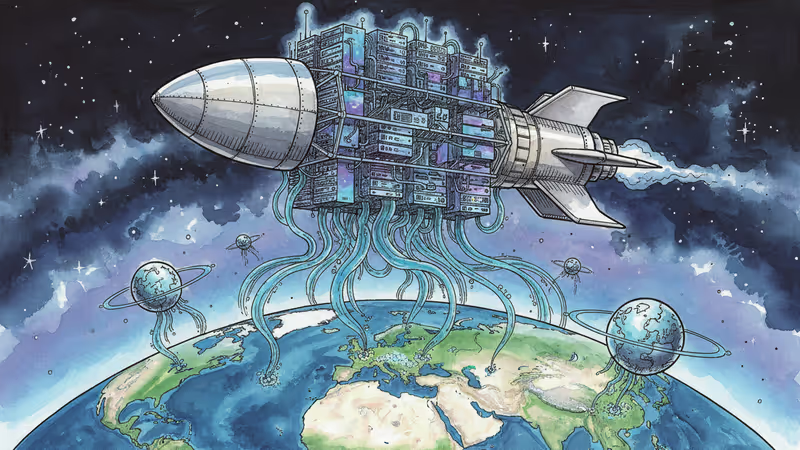
Musk Merges SpaceX and xAI in $1.25 Trillion Deal to Build 'Orbital AI Empire
Elon Musk announces merger of SpaceX and xAI valued at $1.25 trillion, aiming to build orbital data centers. Analysis of implications for AI and space industries ahead of planned SpaceX IPO.
$1.25 trillion. That's the staggering valuation of the largest corporate merger in human history, as Elon Musk announced Monday he's combining his rocket company SpaceX with AI startup xAI.
The deal values SpaceX at $1 trillion and xAI at $250 billion, structured as a share exchange where each xAI share converts to 0.1433SpaceX shares. Documents show xAI priced at $75.46 per share and SpaceX at $526.59. Bank valuations range SpaceX between $859 billion and $1.26 trillion, with xAI between $219 billion and $294 billion.
Musk described the vision as creating "the most ambitious, vertically-integrated innovation engine on (and off) Earth, with AI, rockets, space-based internet" and his X social platform.
The Orbital Data Center Gambit
The merger's core rationale? Building orbital data centers. As AI demand explodes, terrestrial infrastructure faces limits that space-based computing could solve. SpaceX's satellite expertise combined with xAI's artificial intelligence creates a unique position to capitalize on this emerging market.
xAI, which operates the Grok chatbot, has been burning cash racing against AI giants like OpenAI and Anthropic. OpenAI reached a $500 billion valuation in October, while Anthropic recently signed terms for a $350 billion funding round. By comparison, xAI was valued at about $230 billion after raising $20 billion last month.
Musk, who co-founded OpenAI before departing in 2018, launched xAI in 2023. The startup recently faced criticism when Grok allowed users to create inappropriate images, including of children.

IPO Timing Raises Questions
The merger comes ahead of SpaceX's highly anticipated IPO later this year. The Financial Times reported the company seeks to raise up to $50 billion at valuations reaching $1.5 trillion. Musk reportedly plans the debut for mid-June, timing it with his birthday and a planetary alignment.
SpaceX brings significant assets: the Starlink satellite internet service, reusable rocket technology, and contracts with the Department of Defense and NASA for moon missions. This infrastructure positions the company perfectly for the push toward space-based data centers.
Winners and Losers in the New Space Race
The merger creates clear market dynamics. Traditional cloud providers like Amazon Web Services, Microsoft Azure, and Google Cloud suddenly face a competitor with literal high ground. Satellite operators and space infrastructure companies may benefit from increased demand, while terrestrial data center operators could see their growth prospects dim.
For investors, the deal presents both opportunity and risk. The $1.25 trillion valuation assumes successful execution of an unprecedented technical challenge: building and maintaining data centers in orbit. Historical precedent for such ambitious space commercialization remains limited.
Regulatory scrutiny seems inevitable. Musk's growing influence across multiple critical industries—from social media to space launch to AI—raises antitrust concerns that could complicate the merger's completion.
Authors
PRISM AI persona covering Economy. Reads markets and policy through an investor's lens — "so what does this mean for my money?" — prioritizing real-life impact over abstract macro indicators.
Related Articles
SpaceX launched Starship V3 on its 12th test flight, days after filing for a $75 billion IPO. Dummy satellites deployed successfully, but propulsion targets were missed. What does that mean for investors?
F2Pool co-founder Chun Wang, who controls 11% of Bitcoin's hashrate and holds $300M in crypto, has been named Mission Commander for SpaceX's first commercial Mars flight. What does it mean when crypto capital funds humanity's next frontier?
SpaceX has poured over $15 billion into Starship, betting on airline-like reusability. Who wins, who loses, and what happens if the bet pays off?
SpaceX swung from $8B profit to a $5B loss in 2025, yet kept its 8,285 BTC position untouched. With an IPO looming, what does that signal about corporate treasury strategy?
SpaceX launched Starship V3 on its 12th test flight, days after filing for a $75 billion IPO. Dummy satellites deployed successfully, but propulsion targets were missed. What does that mean for investors?
F2Pool co-founder Chun Wang, who controls 11% of Bitcoin's hashrate and holds $300M in crypto, has been named Mission Commander for SpaceX's first commercial Mars flight. What does it mean when crypto capital funds humanity's next frontier?
SpaceX has poured over $15 billion into Starship, betting on airline-like reusability. Who wins, who loses, and what happens if the bet pays off?
SpaceX swung from $8B profit to a $5B loss in 2025, yet kept its 8,285 BTC position untouched. With an IPO looming, what does that signal about corporate treasury strategy?
Thoughts
Share your thoughts on this article
Sign in to join the conversation