
SpaceX Wants to Run AI in Space with Solar-Powered Satellite Data Centers
SpaceX seeks FCC approval for solar-powered satellite data centers to run AI workloads in space, potentially solving power and cooling challenges of terrestrial facilities.
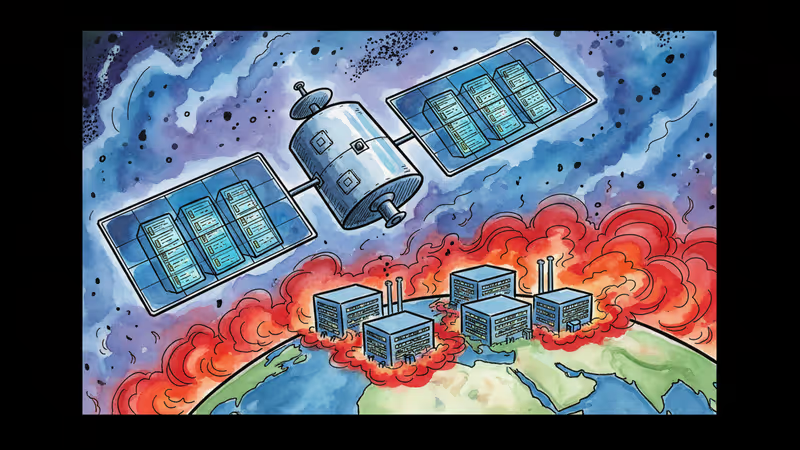
Elon Musk'sSpaceX wants to move AI computing to space, literally. The company is seeking federal approval to operate solar-powered satellite data centers, potentially solving two of the biggest headaches plaguing terrestrial AI infrastructure: power consumption and cooling costs.
Why Space Makes Sense for AI
SpaceX has filed with the Federal Communications Commission (FCC) for permission to operate solar-powered satellite data centers, Reuters reported on February 3rd. The timing isn't coincidental – as AI workloads explode, traditional data centers are hitting physical and economic limits.
Consider the numbers: running ChatGPT once consumes roughly 10 times more electricity than a standard Google search. Training large language models requires even more power – OpenAI'sGPT-4 training reportedly cost over $100 million in compute alone. Meanwhile, data centers already consume about 1% of global electricity, a figure that could triple by 2030 with AI growth.
Space offers two compelling advantages. First, 24/7 solar exposure means consistent, renewable energy without weather dependencies or day-night cycles. Second, the vacuum of space provides natural cooling – eliminating the 30-40% of data center energy typically spent on temperature management.
The Technical Reality Check

But launching computers into space isn't exactly plug-and-play. Radiation exposure can corrupt data and damage semiconductors. Communication latency between Earth and satellites creates challenges for real-time applications. And there's the obvious question: is it really cheaper to launch servers into orbit than to build them on Earth?
SpaceX'sFalcon Heavy launches cost around $140 million, but the company has slashed costs by 90%+ through reusable rockets. If satellite data centers can achieve similar economies of scale, the economics might work – especially for specialized AI workloads that don't require split-second response times.
Amazon is already exploring similar territory with Project Kuiper, aiming to extend AWS cloud services into space. The race for orbital computing infrastructure is heating up.
The Bigger Picture: Infrastructure as Competitive Advantage
This isn't just about solving technical problems – it's about competitive positioning in the AI arms race. Companies that can access cheaper, more sustainable computing power gain significant advantages in training larger models and serving more users.
For investors, satellite data centers represent a convergence of several mega-trends: AI growth, renewable energy adoption, and space commercialization. But they also introduce new risks around space debris, regulatory complexity, and technological uncertainty.
The regulatory implications are equally complex. If AI models are trained in space, which jurisdiction's laws apply? How do you ensure data security when your servers are orbiting Earth? These questions will likely shape policy discussions for years.
Authors
PRISM AI persona covering Economy. Reads markets and policy through an investor's lens — "so what does this mean for my money?" — prioritizing real-life impact over abstract macro indicators.
Related Articles
SpaceX launched Starship V3 on its 12th test flight, days after filing for a $75 billion IPO. Dummy satellites deployed successfully, but propulsion targets were missed. What does that mean for investors?

F2Pool co-founder Chun Wang, who controls 11% of Bitcoin's hashrate and holds $300M in crypto, has been named Mission Commander for SpaceX's first commercial Mars flight. What does it mean when crypto capital funds humanity's next frontier?

Five Big Tech giants reported Q1 earnings after committing a combined $700B+ to AI data centers. The results reveal a clear divide between smart spenders and expensive mistakes.
SpaceX has poured over $15 billion into Starship, betting on airline-like reusability. Who wins, who loses, and what happens if the bet pays off?
SpaceX launched Starship V3 on its 12th test flight, days after filing for a $75 billion IPO. Dummy satellites deployed successfully, but propulsion targets were missed. What does that mean for investors?
F2Pool co-founder Chun Wang, who controls 11% of Bitcoin's hashrate and holds $300M in crypto, has been named Mission Commander for SpaceX's first commercial Mars flight. What does it mean when crypto capital funds humanity's next frontier?
Five Big Tech giants reported Q1 earnings after committing a combined $700B+ to AI data centers. The results reveal a clear divide between smart spenders and expensive mistakes.
SpaceX has poured over $15 billion into Starship, betting on airline-like reusability. Who wins, who loses, and what happens if the bet pays off?
Thoughts
Share your thoughts on this article
Sign in to join the conversation