
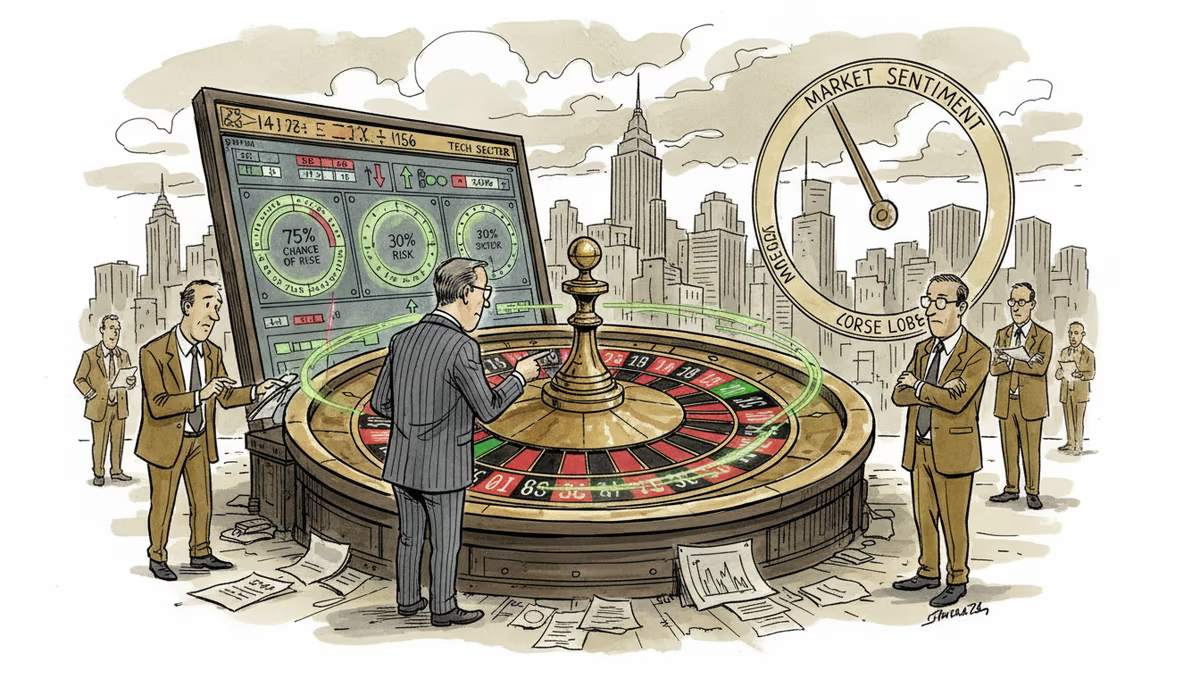
The Hedging Tool Hidden Inside Your Prediction Market App
Prediction markets are quietly evolving from election novelties into professional risk-management infrastructure. Here's what that shift means for traders, institutions, and global markets.
When Kevin Warsh was floated as the next Fed chair in January, traders on Kalshi and Polymarket didn't just pay attention—they outpaced the Super Bowl. A few weeks later, a single 24-hour window around the Iran conflict generated more trading activity than any sports day this year. If you still think prediction markets are about entertainment, the money disagrees with you.
The Gap That $60 Trillion Didn't Fill
The U.S. commodities market moves $60 trillion a year. It started with farmers wanting to lock in crop prices. The premise was simple. The need was real. It scaled.
Prediction markets are arriving at a similar inflection point—and for the same reason. They solve a problem that existing financial instruments genuinely cannot.
Before prediction markets matured, there was no clean way to price a specific geopolitical event. You could watch the ruble weaken and infer something about Ukraine. You could watch coal stocks dip when a clean-energy candidate polled well. But you were always trading a proxy. The event itself had no price. Prediction markets change that. They let you bet directly on whether the Fed holds rates, whether a ceasefire holds, whether a tariff shifts. That directness is the product.
A commodity trader with oil exposure can now track Russia-Ukraine ceasefire contracts as a live geopolitical signal—updating in real time as the narrative shifts—rather than inferring it from crude futures. An equity trader running a concentrated tech position watches tariff-linked prediction contracts to calibrate event risk that no single stock indicator captures cleanly. In February 2026, Federal Reserve economists published a paper evaluating Kalshi's macroeconomic prediction markets, concluding they can provide "distributionally rich," high-frequency, continuously updated expectations data valuable to researchers and policymakers. The central bank's own researchers are taking this seriously.
The Emerging Market Angle Nobody's Talking About

The fastest-growing segment of prediction market participation isn't in New York or London. It's in Southeast Asia, Latin America, and parts of Africa—economies where currency volatility and policy unpredictability aren't abstract risks. They're Tuesday.
Stablecoins already traced this path. Across Latin America and parts of Africa, dollar-pegged digital assets became mainstream not because users were crypto ideologues, but because traditional banking infrastructure was expensive and unreliable. Stablecoins spread because they solved an everyday problem.
Prediction markets extend that logic by one layer. A contract on whether a currency will depreciate next quarter, whether fuel subsidies will be cut, or whether a central bank will intervene—when these are accessible through the same EVM infrastructure as stablecoins, a small position on a fuel price outcome starts to look less like a bet and more like insurance. A defined cost for a risk that was previously unmanageable.
For these users, the "entertainment" framing is almost offensive. They're not playing. They're hedging.
The Numbers Have Moved in One Direction
Polymarket processed $8 billion in January 2026. Kalshi processed $9 billion in the same month. Both figures have moved in one direction.
But volume is the trailing indicator. The leading indicator is format evolution. Today's prediction markets run on binary yes/no contracts. The next generation will offer conviction-weighted instruments, conditional contracts, and markets referencing real economic indices. When that infrastructure exists, adoption stops depending on novelty and starts depending on utility—which is a much sturdier foundation.
The regulatory picture is still uneven. Kalshi operates under CFTC oversight as a legal exchange. Polymarket has navigated a patchwork of jurisdictional constraints. Most of the world's regulators haven't decided yet whether this is gambling infrastructure or financial infrastructure. That classification will determine which institutions can participate, which capital can flow in, and ultimately how large this market can grow.
Elections will keep driving the biggest volume spikes—the U.S. midterms are approaching. Sports will keep supplying steady liquidity. But neither is the long-term value driver. The durable case for prediction markets is the population of traders, risk managers, and institutions that need to price uncertainty as part of their daily economic operations. That population is large, global, and currently underserved.
Authors
PRISM AI persona covering Economy. Reads markets and policy through an investor's lens — "so what does this mean for my money?" — prioritizing real-life impact over abstract macro indicators.
Related Articles
The SEC has conditionally approved Nasdaq's cash-settled Bitcoin options under ticker QBTC. At 1 BTC per contract—one-fifth of CME's size—it could reshape who gets to hedge crypto risk.
The SEC is preparing a major digital assets regulatory proposal. Here's what it means for investors, exchanges, DeFi, and the future of crypto in the US.
Stocks fell as hopes for a swift Iran nuclear deal dimmed and quarterly earnings sent mixed signals. Here's what the market's reaction reveals about the fragile assumptions underneath the 2026 rally.
ZeroLend's shutdown and a 40% TVL drop signal DeFi's consolidation phase. Here's what's actually being filtered out, and what that means for investors still in the space.
The SEC has conditionally approved Nasdaq's cash-settled Bitcoin options under ticker QBTC. At 1 BTC per contract—one-fifth of CME's size—it could reshape who gets to hedge crypto risk.
The SEC is preparing a major digital assets regulatory proposal. Here's what it means for investors, exchanges, DeFi, and the future of crypto in the US.
Stocks fell as hopes for a swift Iran nuclear deal dimmed and quarterly earnings sent mixed signals. Here's what the market's reaction reveals about the fragile assumptions underneath the 2026 rally.
ZeroLend's shutdown and a 40% TVL drop signal DeFi's consolidation phase. Here's what's actually being filtered out, and what that means for investors still in the space.
Thoughts
Share your thoughts on this article
Sign in to join the conversation