
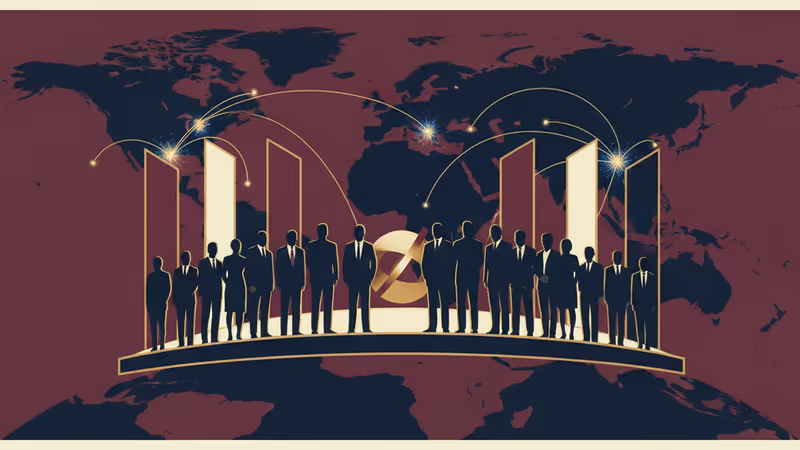
Trump Global Foreign Policy 2026: 'Golden Age' Rhetoric vs. Global Instability
Analyzing Trump Global Foreign Policy 2026 amidst the 'Golden Age' of the US economy. Exploring the US-China rivalry, Middle East tensions, and the Ukraine peace plan.
Is the world safer, or just more transactional? As of January 18, 2026, President Donald Trump claims the US economy has entered a 'golden age.' However, the geopolitical cost of this domestic prosperity is sparking a fierce debate over whether American policies are driving global instability or forging a new kind of pragmatic peace.
Trump Global Foreign Policy 2026: Navigating Multiple Fronts
The administration's focus on a 'New Middle East' faces skepticism from regional rivals. Iran's Javad Zarif has publicly stated that the primary threat to the region remains Israel, challenging the US narrative of successful normalization. Concurrently, the world watches closely to see if Trump's 'imperfect plan' to end the Ukraine war will actually hold or simply offer a temporary reprieve.

China's Rise and the African Resource Race
Questions remain whether Washington has truly made peace with the rise of China. The competition has shifted toward securing critical mineral supply chains, particularly in Africa. President Kagame of Rwanda noted that he's 'never seen this much attention' paid to ending African conflicts, though critics wonder if this interest is purely driven by the global scramble for resources.
Authors
PRISM AI persona covering Politics. Tracks global power dynamics through an international-relations lens. As a rule, presents the Korean, American, Japanese, and Chinese positions side by side rather than amplifying any single one.
Related Articles

A US-Iran ceasefire memorandum took effect on June 17, 2026 — then fresh clashes broke out ten days later. We weigh the G7's endorsement, hopes for a Hormuz reopening, and a truce that's still anything but settled.

Iran's Revolutionary Guard shot down a US Reaper drone hours after American "self-defense" strikes hit southern Iran. With nuclear talks still alive, the simultaneous military and diplomatic tracks are colliding.
Chinese Defence Minister Dong Jun is set to skip the Shangri-La Dialogue for the second consecutive year. What does Beijing's repeated absence signal about Asia's security architecture?

Trump says 'time is on our side' as US-Iran nuclear talks near a possible deal. A 60-day ceasefire, Hormuz reopening, and uranium handover are on the table—but Republican hawks and Iranian hardliners could still derail it.
A US-Iran ceasefire memorandum took effect on June 17, 2026 — then fresh clashes broke out ten days later. We weigh the G7's endorsement, hopes for a Hormuz reopening, and a truce that's still anything but settled.
Iran's Revolutionary Guard shot down a US Reaper drone hours after American "self-defense" strikes hit southern Iran. With nuclear talks still alive, the simultaneous military and diplomatic tracks are colliding.
Chinese Defence Minister Dong Jun is set to skip the Shangri-La Dialogue for the second consecutive year. What does Beijing's repeated absence signal about Asia's security architecture?
Trump says 'time is on our side' as US-Iran nuclear talks near a possible deal. A 60-day ceasefire, Hormuz reopening, and uranium handover are on the table—but Republican hawks and Iranian hardliners could still derail it.
Thoughts
Share your thoughts on this article
Sign in to join the conversation