
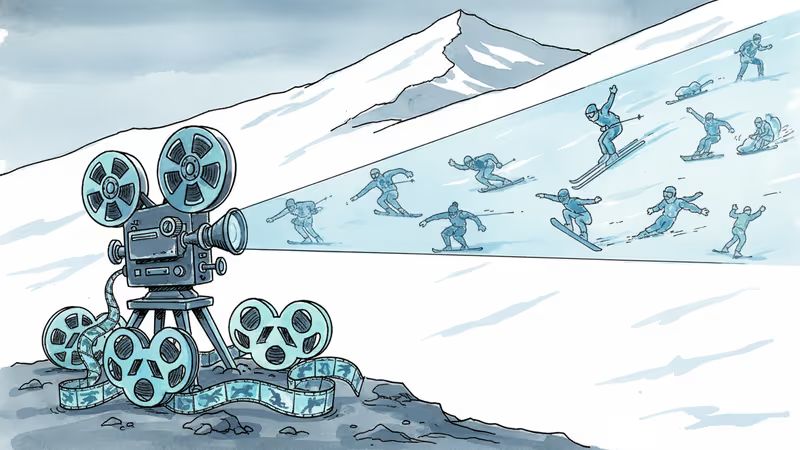
Five Winter Olympics Movies That Redefine What Winning Really Means
From Miracle to Cool Runnings, the greatest Winter Olympics films reveal that true victory isn't always about gold medals. Sometimes it's about something much more valuable.
What legacy has the 100-year-old Winter Olympics left on Hollywood? Since the first Games in 1924, the drama on ice has been reborn countless times on the silver screen.
Looking at WIRED's recent selection of five Winter Olympics masterpieces, an intriguing pattern emerges. Most tell stories of people who discovered something more valuable than gold medals.
When the Impossible Becomes Possible
Miracle (2004) captures one of the Cold War's most dramatic moments. The 1980 Lake Placid Winter Olympics saw the US ice hockey team defeat the Soviet Union, fresh off four consecutive gold medals. Kurt Russell's portrayal of coach Herb Brooks shows how he transformed players "who didn't even believe in themselves" into a collective capable of beating the world's strongest team.
This isn't just about winning a game. It's about transcending individual limitations to become something greater, and discovering your true self in the process.
Eddie the Eagle (2015) takes this even further. At the 1988 Calgary Olympics, Michael Edwards became Britain's first ski jumper not because he was the best, but because he dared to try. The short, stocky athlete became everyone's hero, proving that "the real victory is against the limits others impose on us."
The Shadow of Perfection
Downhill Racer (1969) offers the opposite perspective. Robert Redford's David Chappellet sacrifices everything—teamwork, relationships, humanity—to become world champion. The film asks a haunting question: If you lose yourself while chasing your dreams, is that really victory?
With breathtaking ski sequences and beautiful cinematography, this remains arguably the greatest Winter Olympics film ever made. Its question about the cost of ambition feels more relevant than ever in today's hyper-competitive world.
Scandal and Redemption

I, Tonya (2017) revisits the 1994Tonya Harding and Nancy Kerrigan incident that dominated headlines for months. But rather than rehashing the scandal, it examines how classism and prejudice destroyed a talented athlete's career.
The film presents Harding not as a simple villain, but as someone whose "earnest efforts were destroyed by poor choices and horrible people in her orbit." It's a grotesque dramedy that forces viewers to reconsider what they thought they knew about one of sports' most infamous stories.
The Warmest Underdogs
Cool Runnings (1993) might be the most beloved Winter Olympics movie ever made. The 1988 Calgary Games featured Jamaica's first bobsled team—a Caribbean country competing in winter sports for the first time.
While the film takes liberties with the true story, its message is crystal clear: "There is room for everyone" in the Olympic spirit. John Candy's coaching performance helps create a comedy that's endured for 30 years because it celebrates participation over perfection.
What These Movies Reveal About Modern Sports
These films arrived during different eras of Olympic history, yet they share a common thread: skepticism about traditional definitions of success. In an age where athletes face unprecedented pressure—from social media scrutiny to commercial expectations—these stories feel prophetic.
Eddie the Eagle's celebration of the amateur spirit seems almost quaint in today's professionalized Olympic landscape. Yet his story resonates precisely because it reminds us what we've lost in the pursuit of excellence.
Cool Runnings champions diversity and inclusion decades before these became corporate buzzwords. The Jamaican bobsledders didn't just compete; they changed what Olympic participation could look like.
The Streaming Wars Meet Olympic Spirit
Interestingly, these films now live across different streaming platforms—Disney+, Apple TV, Amazon Prime, Tubi. Their scattered availability mirrors how Olympic storytelling has fragmented in the digital age. No longer do we gather around a single television to watch the Games; we consume Olympic content on our own terms, on our own screens.
This shift raises questions about shared cultural experiences. When Olympic movies are spread across multiple platforms, do they lose their power to unite audiences around common dreams?
Authors
Related Articles

At the 2026 Milano Cortina Olympics, bobsledding teams are using 3D-printed spikes, energy-return insoles, and AI analysis to shave hundredths of seconds off race times.
The global success of gay hockey drama 'Heated Rivalry' has sparked conversations about LGBTQ+ inclusion in professional sports, revealing a stark gap between entertainment and reality.

Amazon's Project Hail Mary adapts Andy Weir's bestseller about an amnesiac biologist-turned-teacher who must solve a cosmic mystery to save Earth, starring Ryan Gosling

From 293-gram carbon fiber brooms to precision-engineered shoes, the 2026 Winter Olympics showcase how technology is revolutionizing the ancient sport of curling.
At the 2026 Milano Cortina Olympics, bobsledding teams are using 3D-printed spikes, energy-return insoles, and AI analysis to shave hundredths of seconds off race times.
The global success of gay hockey drama 'Heated Rivalry' has sparked conversations about LGBTQ+ inclusion in professional sports, revealing a stark gap between entertainment and reality.
Amazon's Project Hail Mary adapts Andy Weir's bestseller about an amnesiac biologist-turned-teacher who must solve a cosmic mystery to save Earth, starring Ryan Gosling
From 293-gram carbon fiber brooms to precision-engineered shoes, the 2026 Winter Olympics showcase how technology is revolutionizing the ancient sport of curling.
Thoughts
Share your thoughts on this article
Sign in to join the conversation