
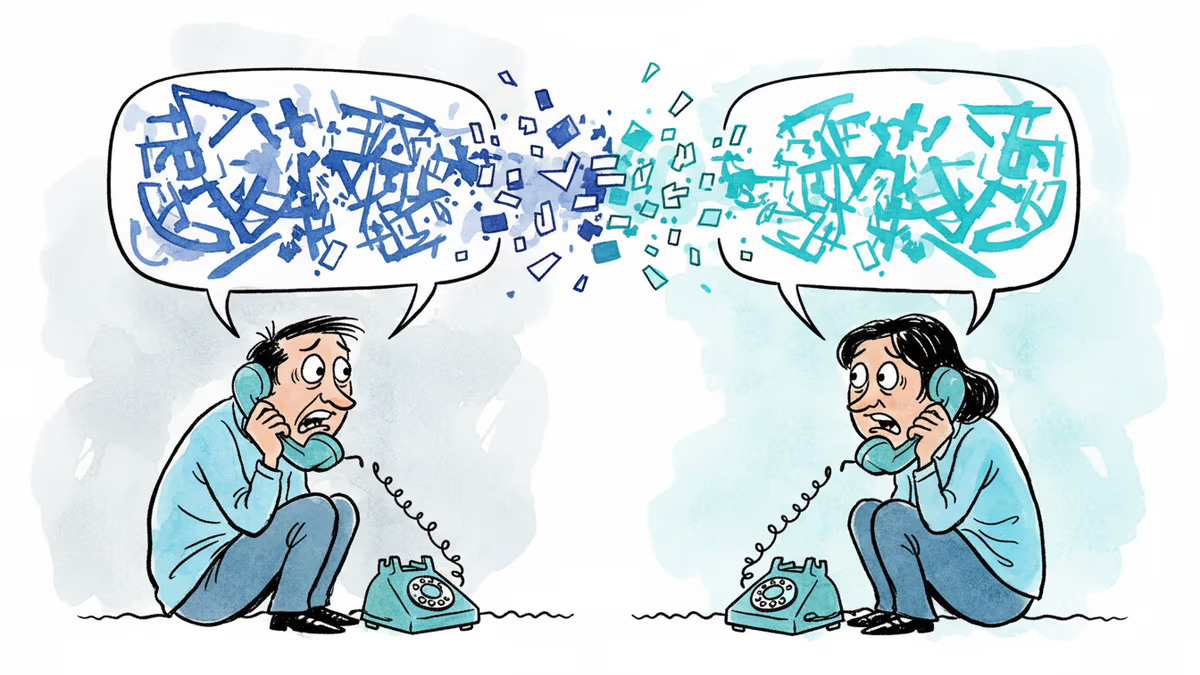
T-Mobile's Network-Level Translation Could Break Down Language Barriers
T-Mobile launches Live Translation beta for real-time phone call translation in 50+ languages, built directly into the network infrastructure.
Your grandmother in Seoul calls, speaking only Korean. Your colleague from São Paulo needs urgent project details in Portuguese. Your taxi driver in Bangkok explains directions in Thai. Until now, these conversations meant fumbling with translation apps or awkward misunderstandings.
T-Mobile just announced it's embedding AI translation directly into its network, promising to translate live phone calls across more than 50 languages starting this spring. But here's what makes this different from Google Translate on your phone: it works at the carrier level, meaning even your old flip phone could potentially access real-time translation.
Beyond the App Store
Most translation tools today require smartphones, specific apps, and often decent internet connections. T-Mobile's Live Translation flips this model by processing the AI at the network level rather than on your device. CEO Srini Gopalan positioned this as "bringing real-time AI directly into our network," suggesting the heavy computational lifting happens in T-Mobile's infrastructure, not your phone.
This network-based approach could solve several practical problems. International travelers with basic phones wouldn't need to download apps or worry about data plans. Emergency situations where language barriers matter most—medical calls, safety issues—could benefit from immediate translation without the friction of launching an app.
The beta launches this spring, with registration opening today for eligible T-Mobile customers. The company hasn't detailed which plans qualify or whether this will eventually become a premium feature.

The Skeptical View
But network-level AI translation isn't without concerns. Privacy advocates might question what happens to conversation data when it's processed through carrier infrastructure. Unlike app-based translation where you control what gets translated, network-level processing could theoretically access any call content.
There's also the accuracy question. Phone calls often involve poor audio quality, background noise, and overlapping speech—conditions that challenge even the best AI translation systems. T-Mobile hasn't shared details about which AI models power the feature or how it handles regional dialects and technical terminology.
Competitors like Verizon and AT&T haven't announced similar network-level translation services, suggesting this could either be a significant differentiator or a feature that proves more challenging to execute than anticipated.
The Bigger Communication Shift
This move reflects a broader trend of carriers trying to add value beyond basic connectivity. As 5G networks mature and voice calls become increasingly commoditized, features like Live Translation represent attempts to justify higher service fees and reduce customer churn.
For immigrants, international families, and global business travelers, seamless translation could transform how they use their phones. Instead of switching between calling and translation apps, conversations could flow more naturally. Small businesses serving diverse communities might find new customers they previously couldn't effectively communicate with.
Authors
Related Articles

Deutsche Telekom partners with ElevenLabs to launch app-free AI translation during phone calls. But the convenience comes with privacy trade-offs that could reshape how we communicate.

Charter's $34.5B Cox acquisition creates largest US ISP with 35.6M customers, surpassing Comcast. FCC approves despite monopoly concerns over pricing power
Mobile World Congress 2026 kicks off with 6G discussions, but 5G's promised revolution remains largely unfulfilled. What does the next generation really mean?
Mistral AI releases tiny speech-to-text models that run locally on phones, processing 13 languages in real-time without cloud dependency. A game-changer for privacy and accessibility?
Deutsche Telekom partners with ElevenLabs to launch app-free AI translation during phone calls. But the convenience comes with privacy trade-offs that could reshape how we communicate.
Charter's $34.5B Cox acquisition creates largest US ISP with 35.6M customers, surpassing Comcast. FCC approves despite monopoly concerns over pricing power
Mobile World Congress 2026 kicks off with 6G discussions, but 5G's promised revolution remains largely unfulfilled. What does the next generation really mean?
Mistral AI releases tiny speech-to-text models that run locally on phones, processing 13 languages in real-time without cloud dependency. A game-changer for privacy and accessibility?
Thoughts
Share your thoughts on this article
Sign in to join the conversation