
Pocket-Sized AI Translator Could End Language Barriers
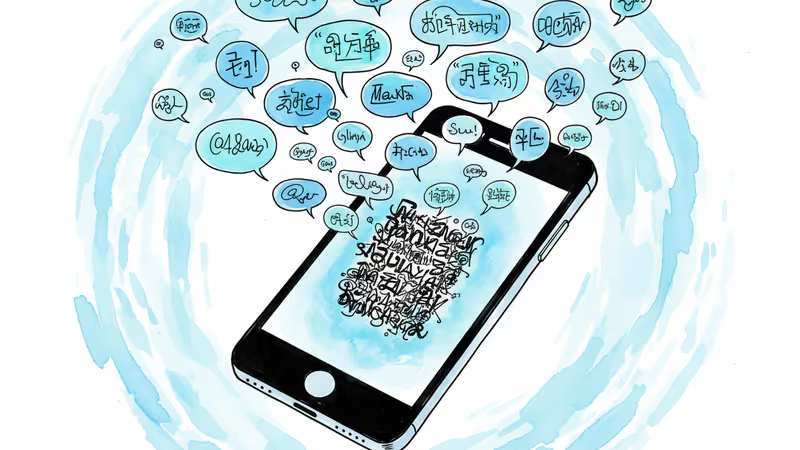
Mistral AI releases tiny speech-to-text models that run locally on phones, processing 13 languages in real-time without cloud dependency. A game-changer for privacy and accessibility?
Four billion parameters. That's all it takes to fit real-time translation into your pocket—no internet required.
Mistral AI just dropped two speech-to-text models that could reshape how we think about language barriers. Voxtral Mini Transcribe V2 and Voxtral Realtime can process 13 languages within 200 milliseconds, small enough to run locally on smartphones and laptops. More importantly? Your private conversations never leave your device.
The Local Revolution
While Google and Apple battle over cloud-based translation with two-second delays, Mistral is taking a different path entirely. The Paris-based AI lab—founded by Meta and Google DeepMind alumni—has cracked the code on making powerful AI models compact enough for local processing.
"What we are building is a system to be able to seamlessly translate," explains Pierre Stock, VP of Science Operations at Mistral. "This model is basically laying the groundwork for that. I think this problem will be solved in 2026."
It's a bold claim, especially coming from a European startup competing against American giants with virtually unlimited resources. But Mistral's approach might be exactly what the market needs.
David vs. Goliath Strategy
Mistral can't match OpenAI's war chest or Google's compute power. Instead, they're winning through efficiency and clever design. "Frankly, too many GPUs makes you lazy," Stock argues. "You just blindly test a lot of things, but you don't think what's the shortest path to success."

Annabelle Gawer, director at the Centre of Digital Economy at the University of Surrey, puts it perfectly: "It might not be a Formula One car, but it's a very efficient family car." While American companies chase artificial general intelligence with hundreds of billions, Mistral builds specialized tools that actually solve real problems.
This creates an interesting dynamic. As Raphaëlle D'Ornano from tech advisory firm D'Ornano + Co notes, "Their question has always been: How do we build a defensible position in a market dominated by hugely financed American actors?"
The Sovereignty Play
The answer increasingly lies in European digital sovereignty. As US-EU relations face new tensions, businesses and governments are reconsidering their dependence on American AI infrastructure. Dan Bieler, principal analyst at PAC, observes: "There's a trend in Europe where companies and particularly governments are looking very carefully at their dependency on US software and AI firms."
Mistral positions itself as the "sovereign alternative"—European-native, multilingual, and crucially, open source. When sensitive business negotiations or confidential conversations need translation, keeping data local isn't just convenient—it's strategic.
Beyond the Hype Cycle
What makes this release particularly interesting isn't the technology itself, but the timing. We're entering what Bieler calls the "return on AI investment" phase, where businesses need practical solutions, not just impressive demos.
"The LLMs are the giants dominating the discussions, but I wouldn't count on this being the situation forever," Bieler predicts. "Small and more regionally focused models will play a much larger role going forward."
For consumers, this means translation tools that work in subway tunnels, remote locations, or anywhere internet connectivity is spotty. For businesses, it means sensitive conversations can stay truly private.
Authors
Related Articles
T-Mobile launches Live Translation beta for real-time phone call translation in 50+ languages, built directly into the network infrastructure.

OpenAI challenges Google with the OpenAI ChatGPT Translate launch. Supporting 50+ languages with style presets, this new tool focuses on contextual accuracy.

Five stories from late September, traced to where the paper trail stops: Korea's export record, Nvidia's Hugging Face 8-K, a US-China AI channel, the UN on AI, and rising births.

Huawei's CANN is open source under a license barring software for non-Ascend chips. Inside China's second CUDA, and the two links still outside it: pre-training compute and 5nm capacity.
T-Mobile launches Live Translation beta for real-time phone call translation in 50+ languages, built directly into the network infrastructure.
OpenAI challenges Google with the OpenAI ChatGPT Translate launch. Supporting 50+ languages with style presets, this new tool focuses on contextual accuracy.
Five stories from late September, traced to where the paper trail stops: Korea's export record, Nvidia's Hugging Face 8-K, a US-China AI channel, the UN on AI, and rising births.
Huawei's CANN is open source under a license barring software for non-Ascend chips. Inside China's second CUDA, and the two links still outside it: pre-training compute and 5nm capacity.
Thoughts
Share your thoughts on this article
Sign in to join the conversation