

Federal Occupation of Minneapolis Tests Democracy's Limits
Trump's deployment of 3,000 federal agents to Minneapolis against local wishes exposes fundamental flaws in American federalism. When federal power becomes a weapon against states, who protects democracy?
3,000 masked federal agents now occupy Minneapolis. They're there against the loud, repeated wishes of every elected official in Minnesota.
This isn't normal law enforcement. It's something America has never seen in modern times—federal forces snatching people off streets based on skin color, staking out schools and daycares, shooting civilians within seconds of contact. On Saturday, Border Patrol agents killed 37-year-old nurse Alex Pretti outside a donut shop. It was the second fatal shooting by federal agents in Minneapolis this month.
Mayor Jacob Frey and Governor Tim Walz have begged President Trump to withdraw his forces. They've been ignored. The question haunting Minnesota: Why can't elected officials do more to stop this federal occupation?
The Federalism Trap
The answer lies in American federalism's basic structure—and its fatal flaw. States can't really resist federal authority or kick out federal law enforcement. That principle exists because the federal government is supposed to be the "protector" of last resort when local officials fail citizens.
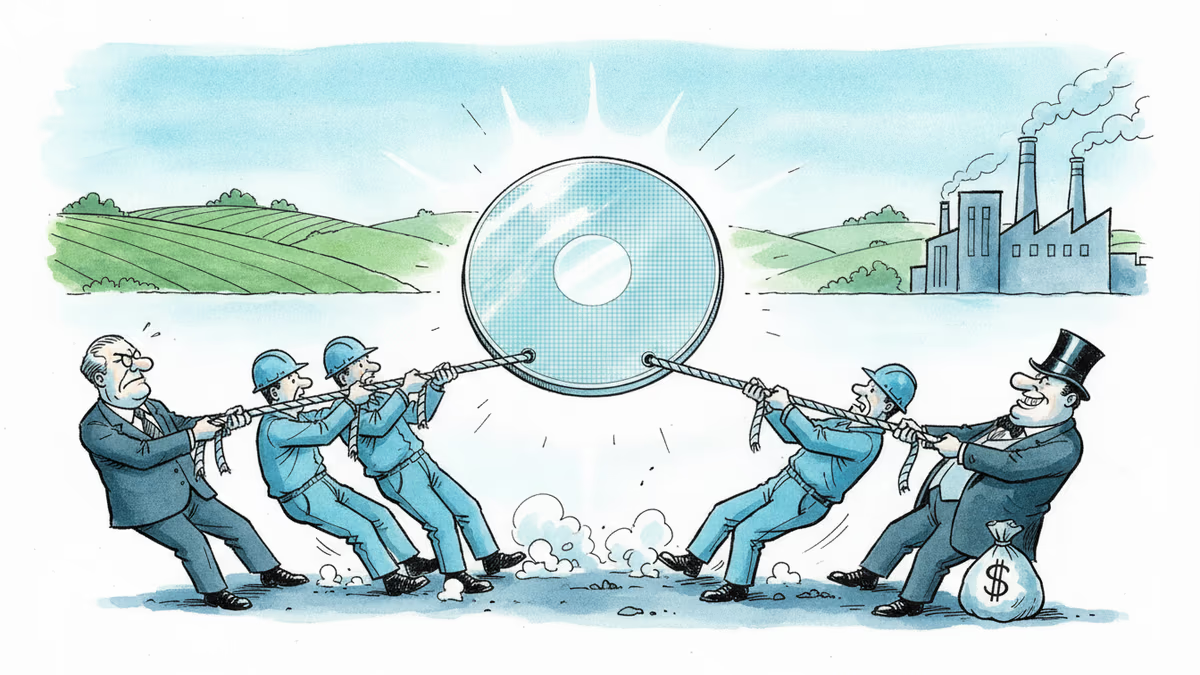
Trump has weaponized this arrangement, using it to punish political opponents. It's as un-American an action as any president has undertaken, threatening the very union of the United States.
Minnesota could deploy its National Guard, but that risks giving Trump an excuse to invoke the Insurrection Act and send in federal troops. He's already positioned 1,500 federal soldiers in Alaska, waiting for that excuse.
Constitutional Crisis in Real Time
This goes far beyond immigration enforcement. Department of Homeland Security agents are now declaring that people who simply record them are being entered into a national "domestic terrorist" database. Attorney General Pam Bondi offered to withdraw federal forces only if Minnesota hands over its voter rolls.
The mask is off. This is political retribution masquerading as law enforcement.

Even local police are in conflict with federal agents. Minneapolis cops condemned both fatal shootings and complained that off-duty officers of color are being harassed by immigration agents. DHS agents tried to bar local police from Saturday's shooting scene, forcing them to return with a court order.
"We're in uncharted territory here," said the head of the state's investigation bureau.
Historical Precedent—Or Lack Thereof
Federal military deployment domestically is strictly limited by the Posse Comitatus Act of 1878 and the Insurrection Act dating to 1792. Since Reconstruction, presidents have rarely sent federal forces against state wishes.
When they did—like Eisenhower sending troops to Arkansas in 1957 to enforce school integration—it was to protect civil rights, not suppress them. What's happening in Minneapolis is the inverse: federal power being used to intimidate and harm civilians.
As national security scholar Scott Anderson noted in 2024, "Few principles of American government are more foundational than the idea that the US military should not be used against Americans, except in the most dire of circumstances. But even fewer foundational principles are so loosely grounded in the law."
Democracy Under Siege
The Minnesota crisis exposes federalism's fundamental vulnerability. The system designed to protect citizens from state government failures is being perverted to protect federal government from accountability.
Walz and Frey's restraint may be strategic—preventing further escalation that could justify federal troop deployment. But citizens are already mounting massive street resistance, while officials pin hopes on federal courts for relief.
Meanwhile, Trump has launched unprecedented criminal investigations against both governors, apparently creating pretexts for invoking the Insurrection Act.
The Precedent Problem
What happens in Minneapolis won't stay in Minneapolis. If a president can deploy thousands of federal agents against any city or state based on political grievance, what's left of local democracy? What's to stop future presidents from using the same playbook?
The situation is so unprecedented that it's impossible to predict how it unfolds. State and local leaders are walking a tightrope—too little resistance looks like capitulation, too much could trigger actual federal military occupation.
Authors
Related Articles

Minnesota sues federal government over massive immigration operation, claiming it's designed to punish sanctuary policies. Two US citizens killed, 2000+ agents deployed

Five stories from late September, traced to where the paper trail stops: Korea's export record, Nvidia's Hugging Face 8-K, a US-China AI channel, the UN on AI, and rising births.

Huawei's CANN is open source under a license barring software for non-Ascend chips. Inside China's second CUDA, and the two links still outside it: pre-training compute and 5nm capacity.
Samsung Electronics' union branch revealed that 84% of survey respondents oppose the government's roughly $290 billion (₩400 trillion) semiconductor megaproject in Gwangju. Government, management, the union and shareholders are all reading the same national project in sharply different ways.
Minnesota sues federal government over massive immigration operation, claiming it's designed to punish sanctuary policies. Two US citizens killed, 2000+ agents deployed
Five stories from late September, traced to where the paper trail stops: Korea's export record, Nvidia's Hugging Face 8-K, a US-China AI channel, the UN on AI, and rising births.
Huawei's CANN is open source under a license barring software for non-Ascend chips. Inside China's second CUDA, and the two links still outside it: pre-training compute and 5nm capacity.
Samsung Electronics' union branch revealed that 84% of survey respondents oppose the government's roughly $290 billion (₩400 trillion) semiconductor megaproject in Gwangju. Government, management, the union and shareholders are all reading the same national project in sharply different ways.
Thoughts
Share your thoughts on this article
Sign in to join the conversation