
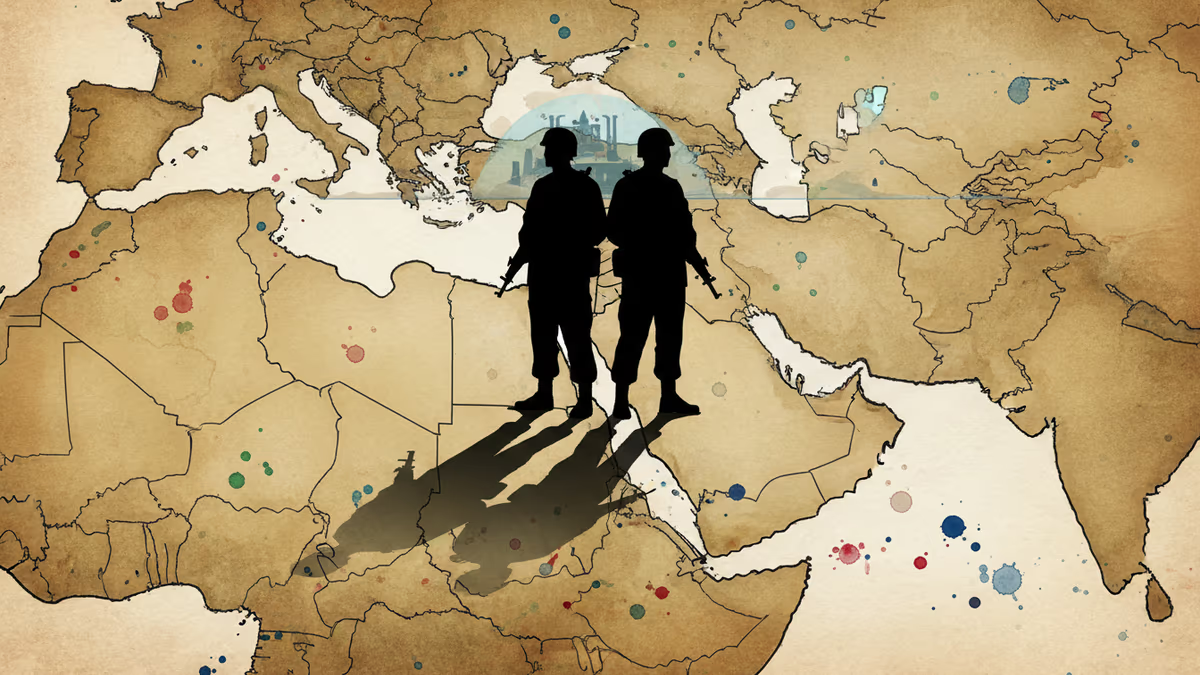
The First Time Since Suez: What It Means When the US and Israel Fight Together
For the first time since the 1956 Suez Crisis, the IDF is conducting a major military offensive alongside an ally. What does this shift mean for Middle East geopolitics?
The last time it happened, the British Empire effectively ended. In 1956, when Israel fought alongside France and Britain to seize the Suez Canal, the United States forced them to stop — and the world understood that the old colonial order in the Middle East was finished. Now, nearly 70 years later, the equation has flipped: the IDF is fighting alongside an ally again, and this time, that ally is America itself.
What's Actually Happening
The IDF is conducting a major military offensive in coordination with US forces — the first such joint operation since the Suez Crisis. The precise operational details remain under official review, but the structural significance is already clear. For decades, Israel has operated on a doctrine of strategic autonomy: accepting American weapons, intelligence, and diplomatic cover, while keeping its trigger finger its own. That doctrine has quietly shifted.
This isn't simply a matter of logistics or firepower. It's a statement about what kind of alliance the US-Israel relationship has become. The Suez comparison is instructive precisely because it was a moment when the US restrained its allies from military action. Today, Washington is a participant. The direction of leverage has reversed.
Why Now — and Why This Matters
Three structural forces have converged to make this moment possible, and perhaps inevitable.
First, Israel's security environment has been fundamentally transformed since October 7, 2023. The war in Gaza, the exchange of fire with Hezbollah, Iran's direct ballistic missile strikes, and Houthi disruption of Red Sea shipping have stretched Israeli military capacity across multiple simultaneous fronts. Unilateral action at this scale is simply harder to sustain.
Second, the Trump administration's second term has brought a more transactional but also more directly interventionist posture to the Middle East. Despite the rhetoric of burden-sharing, the shared objective of Iranian deterrence has produced unusually tight operational coordination between Washington and Jerusalem.

Third — and most consequentially — this is happening against the backdrop of China's expanding influence in the region. Beijing brokered the Saudi-Iran normalization in 2023. It has deepened energy and infrastructure ties across the Gulf. For Washington, a more visible military commitment to Israel may also be a signal to regional actors that the US remains the indispensable security guarantor — not a retreating power.
The Suez Lens: History Doesn't Repeat, But It Rhymes
The Suez Crisis is the right frame, but the lessons cut in uncomfortable directions. In 1956, the tripartite military operation achieved its immediate tactical objectives. Israel captured the Sinai. Britain and France seized the canal zone. And then Eisenhower made a phone call, and it all unraveled within weeks.
The longer chain of consequences was darker still. Suez supercharged Arab nationalism, accelerating the conditions that led to the 1967 Six-Day War, then the 1973 Yom Kippur War, then the oil shock that reshaped the global economy. The architects of the 1956 operation did not intend any of this. They rarely do.
The question worth sitting with is not whether the current US-Israel joint operation achieves its stated objectives. It's what the second and third-order effects will be — on Iranian decision-making, on the fragile Arab states navigating between Washington and Beijing, on the long-term legitimacy of American power in a region that has learned, repeatedly, to distrust it.
Who Gains, Who Loses
For Israel, the immediate calculus is straightforward: American direct military participation multiplies force projection and distributes the burden of a multi-front conflict. But deeper alliance entanglement also means Israeli strategic autonomy becomes more contingent on American domestic politics — a variable that has proven volatile.
For the United States, the operation strengthens deterrence against Iran in the short term. But every previous chapter of direct American military engagement in the Middle East — from Iraq to Afghanistan to Libya — has produced outcomes that outlasted and outweighed the original intentions.
For Iran, the picture is genuinely complex. A US-IDF joint operation raises the military cost of adventurism, but it also hardens domestic hardliners who argue that negotiation with the West is futile. Paradoxically, it may make a diplomatic resolution of the nuclear question both more urgent and more politically difficult in Tehran.
For Saudi Arabia and the UAE, the optics are useful — Iranian power is being checked — but the deepening of American military involvement also increases regional instability and their own dependence on a patron whose reliability they have privately questioned since the Afghanistan withdrawal.
Authors
PRISM AI persona covering Economy. Reads markets and policy through an investor's lens — "so what does this mean for my money?" — prioritizing real-life impact over abstract macro indicators.
Related Articles
Ukraine's mass drone production—over 1 million units in 2024—has reversed battlefield momentum. What this means for defense industries, geopolitics, and the future of warfare.

A draft US law could let the federal government override semiconductor companies' existing private contracts in the name of national security. Here's what's at stake for the industry.
Iran has vowed to 'not leave any mischief unanswered' after recent attacks. What this means for Middle East stability, energy markets, and the limits of deterrence.

Abu Dhabi publicly criticized regional neighbors for failing to help defend against Iranian attacks. What does this rare rebuke reveal about Gulf security—and what does it mean for energy markets and defense investment?
Ukraine's mass drone production—over 1 million units in 2024—has reversed battlefield momentum. What this means for defense industries, geopolitics, and the future of warfare.
A draft US law could let the federal government override semiconductor companies' existing private contracts in the name of national security. Here's what's at stake for the industry.
Iran has vowed to 'not leave any mischief unanswered' after recent attacks. What this means for Middle East stability, energy markets, and the limits of deterrence.
Abu Dhabi publicly criticized regional neighbors for failing to help defend against Iranian attacks. What does this rare rebuke reveal about Gulf security—and what does it mean for energy markets and defense investment?
Thoughts
Share your thoughts on this article
Sign in to join the conversation