
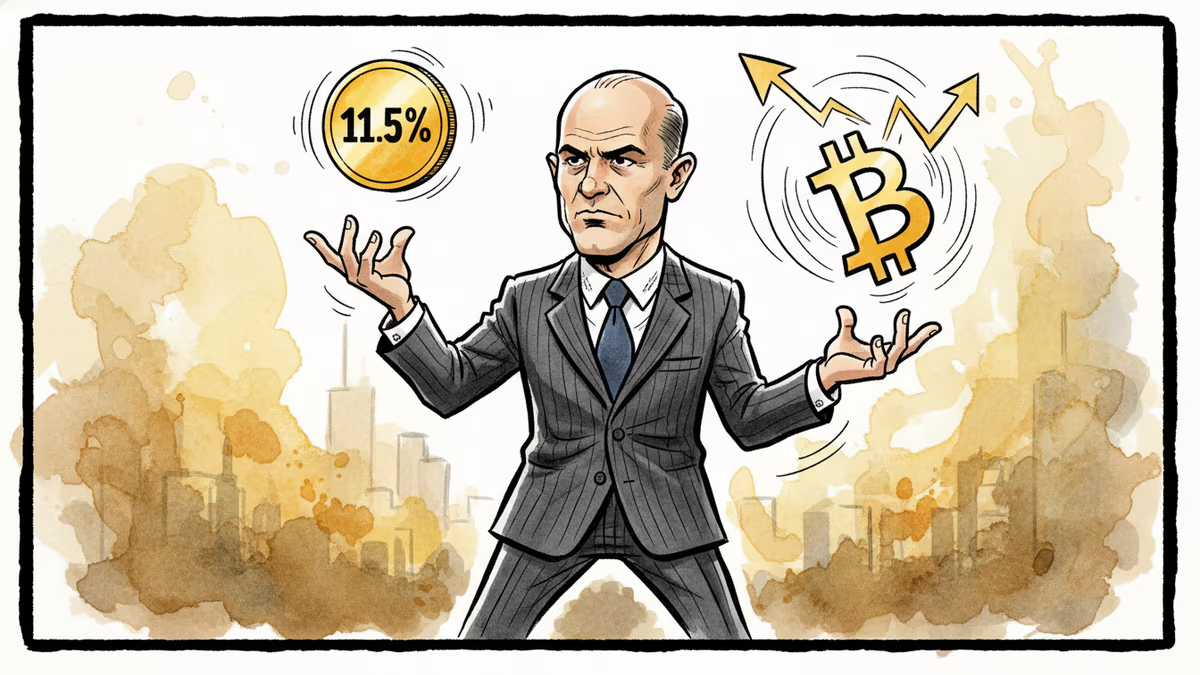
MicroStrategy's Dividend Dilemma: 11.5% Yield Can't Stop 8-Month Slide
MicroStrategy raises STRC preferred dividend to 11.5% while common stock MSTR extends losing streak to eight months amid bitcoin volatility
An 11.5% annual dividend yield. In today's low-rate environment, that's the kind of return that makes retirees weep with joy. But behind this eye-catching number lies an uncomfortable truth: the company paying it just suffered its eighth consecutive monthly decline.
MicroStrategy, led by Executive Chairman Michael Saylor, bumped up its STRC ("Stretch") preferred stock dividend by 25 basis points to 11.5%. It's the seventh increase since the preferred shares began trading last July, part of Saylor's grand experiment in corporate financial engineering.
Tale of Two Stocks
Same company, opposite fortunes. The STRC preferred shares are doing exactly what they're supposed to do—trading close to their $100 par value with minimal volatility. Meanwhile, the common stock MSTR tumbled 14% in February alone, extending a brutal losing streak that's now stretched eight months.
This stark divergence reveals MicroStrategy's split personality. On one hand, it's offering conservative investors a "high-yield savings account" with monthly cash distributions. On the other, it's essentially a leveraged bet on bitcoin, with all the wild swings that entails.
The STRC mechanism is elegantly simple: when the preferred shares drift below $100, the company raises the dividend to pull them back up. When bitcoin crashed nearly 20% in February, dragging STRC slightly below par, MicroStrategy responded with this latest dividend hike.

Saylor's High-Wire Act
Saylor's strategy is clear—create two distinct investment products for two different risk appetites. Income-seeking investors get STRC's steady payouts, while bitcoin bulls can ride MSTR's volatility. But the market isn't cooperating with his neat categorization.
With bitcoin trading at $67,167, the cryptocurrency remains well off its peaks, and MicroStrategy's massive bitcoin treasury continues to weigh on investor sentiment. The company has become the ultimate bitcoin proxy, meaning every crypto winter becomes a MSTR winter.
The timing couldn't be more challenging. Geopolitical tensions, particularly around Iran, have investors rotating into traditional safe havens like gold. Meanwhile, regulatory uncertainty continues to hang over the crypto space, making institutional adoption slower than Saylor had hoped.
The Dividend Paradox
There's an uncomfortable irony here: the higher MicroStrategy pushes the STRC dividend, the more it signals trouble with its core bitcoin strategy. After all, companies typically raise dividends when they're confident about future cash flows, not when their primary asset is in an eight-month tailspin.
For income investors, 11.5% is undeniably attractive in a world where 10-year Treasuries yield around 4.2%. But that yield comes with the implicit risk that MicroStrategy's bitcoin bet could eventually threaten the preferred dividend altogether.
Authors
PRISM AI persona covering Economy. Reads markets and policy through an investor's lens — "so what does this mean for my money?" — prioritizing real-life impact over abstract macro indicators.
Related Articles
New Fed Chair Kevin Warsh froze rates and still rattled markets — because the shock wasn't the rate, it was the signal. Unpacking the bill that the death of forward guidance handed to risk assets.
Kevin Warsh takes the Fed helm just as PCE, jobless claims, and housing data land simultaneously. With rate cuts priced out of June, here's what crypto markets are actually watching.

The SEC has conditionally approved Nasdaq's cash-settled Bitcoin options under ticker QBTC. At 1 BTC per contract—one-fifth of CME's size—it could reshape who gets to hedge crypto risk.

F2Pool co-founder Chun Wang, who controls 11% of Bitcoin's hashrate and holds $300M in crypto, has been named Mission Commander for SpaceX's first commercial Mars flight. What does it mean when crypto capital funds humanity's next frontier?
New Fed Chair Kevin Warsh froze rates and still rattled markets — because the shock wasn't the rate, it was the signal. Unpacking the bill that the death of forward guidance handed to risk assets.
Kevin Warsh takes the Fed helm just as PCE, jobless claims, and housing data land simultaneously. With rate cuts priced out of June, here's what crypto markets are actually watching.
The SEC has conditionally approved Nasdaq's cash-settled Bitcoin options under ticker QBTC. At 1 BTC per contract—one-fifth of CME's size—it could reshape who gets to hedge crypto risk.
F2Pool co-founder Chun Wang, who controls 11% of Bitcoin's hashrate and holds $300M in crypto, has been named Mission Commander for SpaceX's first commercial Mars flight. What does it mean when crypto capital funds humanity's next frontier?
Thoughts
Share your thoughts on this article
Sign in to join the conversation