
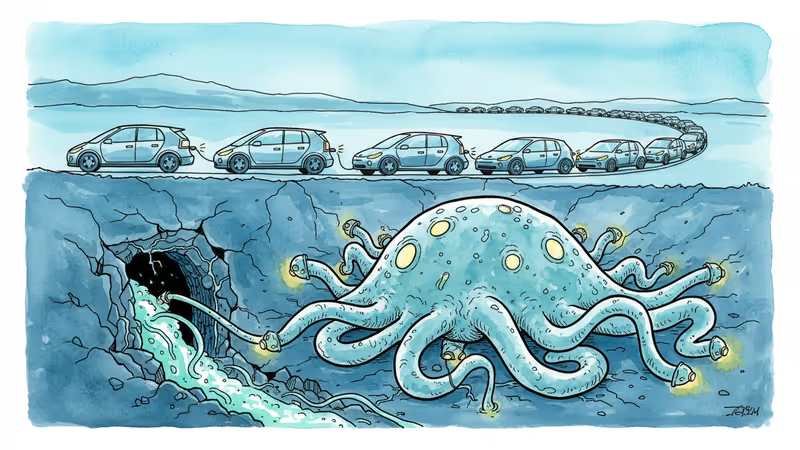
When Mines Run Dry, Microbes Step In
As high-grade ore depletes, biotech startups are engineering microbes to extract metals from aging mines and waste. But can biology scale fast enough for the EV boom?
In a pine forest on Michigan's Upper Peninsula, America's only active nickel mine is facing an uncomfortable truth: the good stuff is running out. Eagle Mine has been digging deeper for years, but nickel concentration keeps dropping. Soon, it might not be worth the effort.
Yet in two shipping containers recently installed at the site, something remarkable is happening. A fermentation-derived broth developed by startup Allonnia is being mixed with low-grade ore, capturing impurities that would normally make extraction impossible. It's like finding a way to squeeze the last drops from an empty toothpaste tube—except the tube is a billion-dollar mining operation.
The Great Metal Squeeze
The timing couldn't be more critical. Global demand for nickel, copper, and rare earth elements is exploding as data centers multiply, electric vehicles hit the mainstream, and renewable energy projects scale up. But here's the problem: miners have already picked the low-hanging fruit. The best ore deposits—those with high metal concentrations and easy access—are largely tapped out.
Kent Sorenson, Allonnia's chief technology officer, puts it simply: "The low-hanging fruit is to keep mining the mines that we have." It's a pragmatic approach born from necessity. Opening new mines takes decades and billions of dollars. Extending the life of existing ones? That's something the industry can do now.
The mining sector has actually been using microbes for decades, particularly for copper extraction. At bioleaching sites, crushed copper ore gets piled into massive heaps, doused with sulfuric acid, and colonized by acid-loving bacteria like Acidithiobacillus ferrooxidans. These organisms produce chemicals that break the molecular bonds holding copper and sulfur together, liberating the metal.
But until recently, that process was largely passive—miners would maintain acidity levels and pump in air, then wait for nature to take its course.
Engineering Evolution
Now, a new generation of biotech companies is trying to take active control of these microbial communities. Endolith, a Denver-based startup, analyzes DNA and RNA in the metal-rich liquid flowing from ore heaps to understand which microbes are thriving and which aren't. Armed with this genetic intelligence, they can seed heaps with specific organisms to optimize extraction.

Elizabeth Dennett, Endolith's CEO, credits falling costs of genetic tools for making this precision approach possible. "The technology we're using now didn't exist a few years ago," she says. In November, the company raised $16.5 million to move from lab testing to real-world mining operations.
The startup 1849 is taking an even bolder approach: genetically engineering microbes from scratch. CEO Jai Padmakumar frames it as a moonshot bet. "You can do what mining companies have traditionally done, or you can try to take the moonshot bet and engineer them. If you get that, you have a huge win."
Meanwhile, companies like Alta Resource Technologies and REEgen are sidestepping the challenges of keeping engineered organisms alive by using the products of microbial fermentation instead of live microbes. REEgen relies on organic acids produced by engineered Gluconobacter oxydans to extract rare earth elements from everything from ore to old electronics. As CEO Alexa Schmitz puts it: "The microbes are the manufacturing."
The Skeptic's View
Not everyone is convinced this biological revolution will pan out. Corale Brierley, who has worked on metal bioleaching since the 1970s, questions whether lab success will translate to commercial scale. "What guarantees are you going to give the company that those organisms will actually grow?" she asks.
The mining industry's conservatism adds another layer of complexity. Diana Rasner, a mining technology analyst at Cleantech Group, notes that big mining firms have already optimized every component of their operations. "They are acutely aware of what it takes to scale these technologies because they know the industry. They'll be your biggest supporters, but they're going to be your biggest critics."
There's also the venture capital timeline problem. Mining companies want years of data before adopting new processes, but VC-backed biotech startups need to show returns much faster. "This is not software," Rasner emphasizes.
Even established players move cautiously. Nuton, a subsidiary of mining giant Rio Tinto, has been developing its copper bioleaching process for decades but only started demonstrating it commercially in late 2023 at an Arizona mine.
Racing Against Demand
The clock is ticking. Buz Barstow, a Cornell University microbiologist studying biomining applications, believes biotechnology could transform mining the way fracking revolutionized natural gas. But he warns that to make a real dent in growing metal demand, these technologies need to go beyond traditional targets like copper and gold.
In 2024, Barstow launched a project to map genes useful for extracting a wider range of metals. The potential is enormous, but so is the challenge. "Biomining is one of these areas where the need is big enough," he says.
The question isn't whether biology can help extract more metal from depleted mines and waste materials—early results suggest it can. The question is whether these technologies can scale fast enough to meet the voracious appetite of our electrifying world.
Authors
Related Articles
Despite EV success, electric sports cars struggle with consumer rejection, technical hurdles, and emotional disconnect from traditional performance enthusiasts
Exploring the used EV market at $15,000 budget point. BMW i3 and Chevrolet Bolt options compared with lower mileage, newer features, and better value propositions.
German study reveals shocking truth about plug-in hybrids - most owners rarely charge them. Porsche drivers averaged just 0.8% electric usage over two years.
Used EV market explodes with sub-$10k options as battery degradation fears prove overblown. Mass adoption accelerates with improved reliability data
Despite EV success, electric sports cars struggle with consumer rejection, technical hurdles, and emotional disconnect from traditional performance enthusiasts
Exploring the used EV market at $15,000 budget point. BMW i3 and Chevrolet Bolt options compared with lower mileage, newer features, and better value propositions.
German study reveals shocking truth about plug-in hybrids - most owners rarely charge them. Porsche drivers averaged just 0.8% electric usage over two years.
Used EV market explodes with sub-$10k options as battery degradation fears prove overblown. Mass adoption accelerates with improved reliability data
Thoughts
Share your thoughts on this article
Sign in to join the conversation