
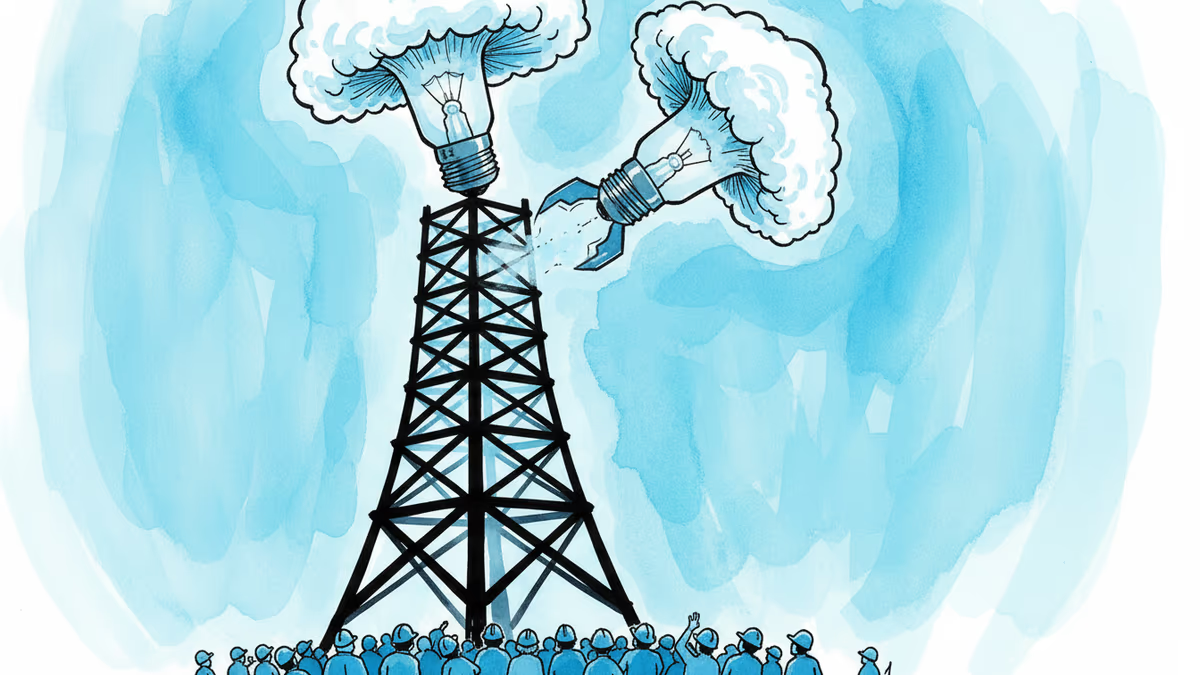
The Nuclear Deal Nobody Remembers That Lit Up America
For 18 years, Soviet warhead uranium powered one in ten American light bulbs. As nuclear arsenals grow and climate pressure mounts, can the Megatons to Megawatts deal be revived?
For two decades, one in every ten light bulbs in America was powered by uranium that had once been aimed at American cities.
Most people have never heard of the program that made this possible. It doesn't appear in the memoirs of Cold War statesmen. The physicist who conceived it, Thomas Neff, died in July 2024 at 80 with little fanfare beyond a pair of admiring obituaries. And yet what unfolded between 1995 and 2013 may be the most consequential arms-reduction initiative in modern history — and one of the least celebrated.
The Idea Born in a Hotel Hallway
The Soviet Union was coming apart in 1991. The government was bankrupt, centralized authority had collapsed, and tens of thousands of nuclear warheads sat in crumbling facilities with broken windows. Workers in the nuclear sector hadn't been paid in months. The nightmare scenario — weapons-grade material leaking to terrorist networks or hostile states — felt less like a hypothetical than a countdown.
Neff, a uranium market specialist at MIT's Center for International Studies, saw both the problem and an elegant solution. In October 1991, he published an op-ed in The New York Times proposing what he called "A Grand Uranium Bargain." The logic was almost disarmingly simple: the highly enriched uranium (HEU) inside Soviet warheads, diluted down to low-enriched uranium (LEU), becomes useless for bombs but ideal for reactor fuel. The U.S. buys it, Russia gets hard currency, the weapons threat dissolves, and American households get cheap, low-carbon electricity.
Days before the op-ed ran, Neff was at a Washington hotel for a conference on nuclear proliferation risks. He found Victor Mikhailov, head of the Soviet weapons program, taking a cigarette break in the hallway. Speaking through an interpreter, Neff sketched out his idea and handed Mikhailov a draft. Mikhailov grasped it immediately.
What followed was years of relentless back-channel diplomacy — unsolicited memos faxed to government officials, repeated trips to the former Soviet Union, showing up to Washington meetings with luggage still in hand. By September 1992, the Bush administration announced the framework of a deal. A Department of Energy official told The New York Times: "Instead of lighting up mushroom clouds, this stuff is going to light up homes in the United States with electricity. It's kind of incredible."
How It Actually Worked
The first shipment arrived at the Port of Baltimore in June 1995. Over the following 18 years, a methodical industrial process unfolded across four formerly secret Russian "nuclear cities." Technicians sliced warhead components into fine metal shavings, then oxidized, purified, and fluorinated them before blending the material down to a concentration of roughly 3–5% — from roughly 90% weapons-grade enrichment. American inspectors visited Russian facilities; Russian experts visited U.S. facilities in Paducah, Kentucky and Portsmouth, Ohio. The mutual monitoring built a layer of trust that became, for some participants, professionally defining. Several reportedly postponed retirement to stay involved.
By the time the final shipment left St. Petersburg on a rainy November day in 2013 — with messages scrawled on the canisters, including "Happy Trails to Baltimore" — the numbers were staggering. Weapons-grade uranium equivalent to roughly 20,000 warheads had been converted into reactor fuel. That fuel supplied approximately 10% of all U.S. electricity over those 18 years, and about half the country's nuclear power. The U.S. paid Russia roughly $17 billion — entirely through commercial contracts, with no taxpayer funds. 101 of 103 American nuclear reactors received fuel from former Soviet bombs.
Ernest Moniz, President Obama's Energy Secretary, called it "one of the most successful nuclear nonproliferation partnerships ever undertaken." Daniel Poneman, who served as Deputy Secretary of Energy under Obama, put it more precisely: "The genius of the HEU deal was to tie a national security imperative to a genuine market need."

And then, almost immediately, the world forgot about it.
Can It Happen Again?
The question feels both obvious and absurd. Russia and the U.S. are not on speaking terms. The New START treaty expired in February. Ukraine is still at war. Trump has retreated from the multilateral architecture that made the original deal possible.
But the structural logic that made Megatons to Megawatts work hasn't disappeared — it has, in some ways, grown stronger.
Russia still holds an estimated 5,459 nuclear warheads — the world's largest arsenal. Its economy has been hammered by sanctions and a war that has produced an estimated 1.2 million Russian casualties. Growth last year was 0.6%. A post-war, post-Putin Russia facing reintegration into the global economy might find the same commercial lifeline attractive that a post-Soviet Russia did in the 1990s.
Beyond Russia, there are other possibilities. Iran has enriched approximately 440 kilograms of uranium to 60% — enough for roughly 10 bombs if enrichment continued. Scott Roecker of the Nuclear Threat Initiative has suggested relocating that material to U.S. national laboratories, down-blending it into HALEU (high-assay low-enriched uranium, enriched to 5–20%), and using it as fuel for next-generation reactors. Reports indicate that financial compensation — potentially $20 billion in unfrozen assets — has already come up in U.S.-Iran negotiations.
Then there's the unilateral option. Last year, the Department of Energy announced plans to down-blend 2.2 metric tons of its own highly enriched uranium at a facility in South Carolina, partly to meet growing demand for HALEU from nuclear startups developing small modular reactors (SMRs). The U.S. has self-interested reasons to shrink its HEU stockpiles: the material is expensive and risky to maintain.
Pranay Reddy Vaddi, a senior nuclear fellow at MIT's Center for Nuclear Security Policy, is direct: "The idea that Dr. Neff came up with is one that we could use again and should use again."
The Limits of the Precedent
Not everyone is sanguine. The original program had a significant flaw: it undercut the domestic U.S. uranium enrichment industry. When the deal ended in 2013, Russia continued supplying LEU enriched from scratch. By the time Russia invaded Ukraine in 2022, the U.S. relied on Russia for roughly a quarter of its uranium enrichment. President Biden signed legislation restricting Russian uranium imports in May 2024, but rebuilding domestic capacity will take years.
There are also the inherent complications of civilian nuclear power itself — long-lived radioactive waste chief among them — that any expansion of the fuel cycle will have to reckon with.
And the geopolitical ceiling is real. Neff himself, in one of his final interviews in March 2023, acknowledged that the original deal succeeded partly because the Soviet collapse created an unusually "propitious" moment — a desperate counterpart with urgent need for hard currency. That kind of leverage doesn't always exist.
But Greg Dwyer, who oversaw the program at the Energy Department during the Obama years, resists fatalism. "The beauty of the HEU Purchase Agreement was it set a precedent that it can be done. No one can come back and say that's impossible."
What it would take, Jeffrey Hughes of Columbia's Megatons to Megawatts Evaluation Project suggests, is a new Neff: someone with the technical fluency, market knowledge, network, and sheer obstinacy to apply the concept to today's conditions — combined with political commitment at the highest level and a federal workforce capable of executing it.
Neff's own summary of the challenge, written in 1998, remains the most honest: "A new idea is much like a child: conceiving one is nowhere near as hard or time-consuming as raising one."
This content is AI-generated based on source articles. While we strive for accuracy, errors may occur. We recommend verifying with the original source.
Related Articles
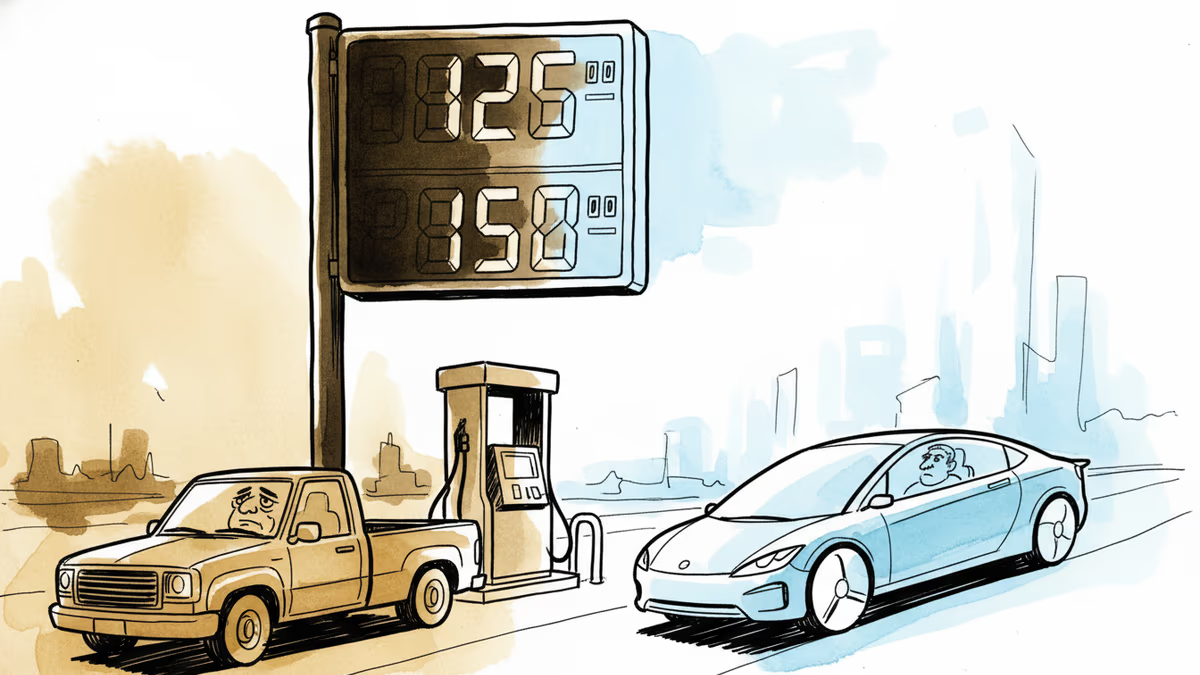
Gas station price signs weren't just numbers—they were America's shared economic pulse. As EVs rise, we're not just changing how we fuel up. We're losing something harder to replace.
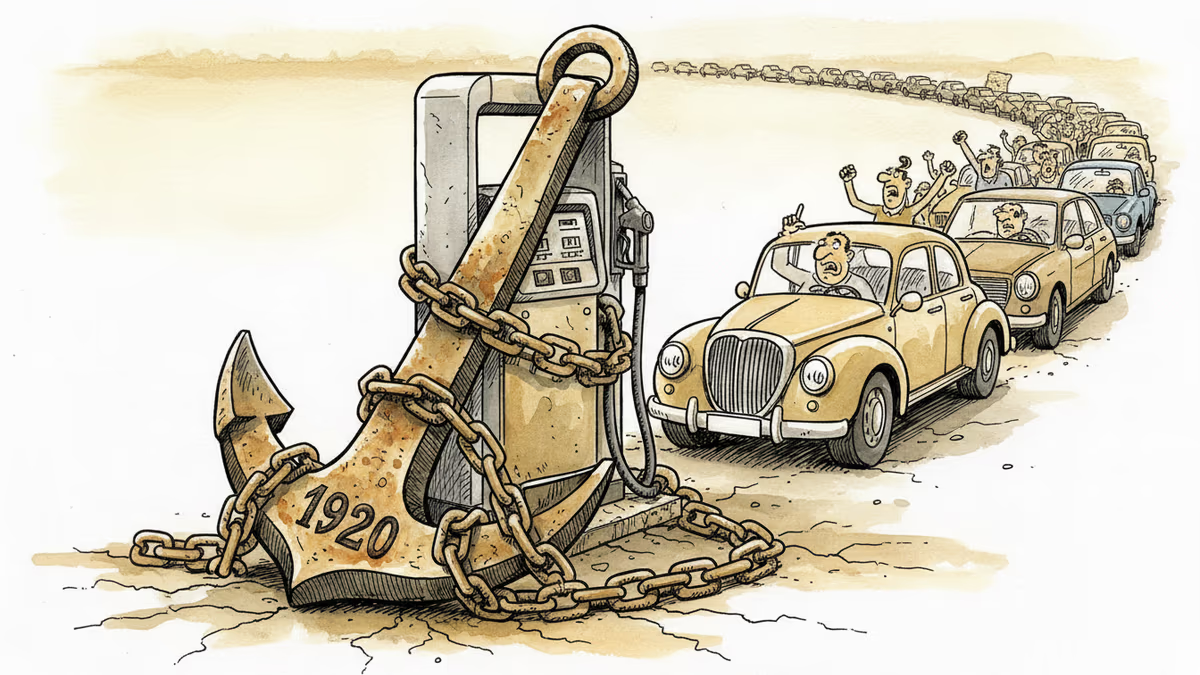
The Trump administration suspended the Jones Act for 60 days to fight soaring gas prices. But can a century-old shipping law really fix a geopolitical fuel crisis—and at what cost?
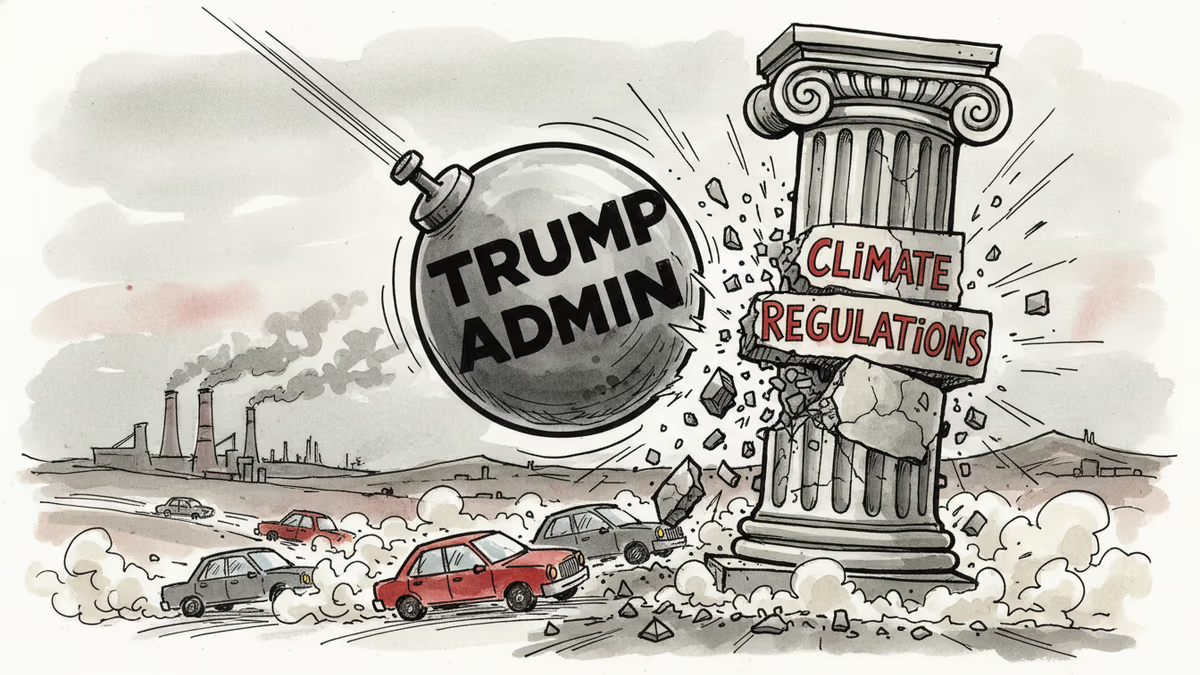
Trump administration repeals 2009 endangerment finding, the legal backbone of US climate regulation, starting with vehicle emissions standards rollback
The Trump administration's move to dismantle the endangerment finding for greenhouse gases threatens to unravel major climate regulations while creating regulatory uncertainty for businesses.
Gas station price signs weren't just numbers—they were America's shared economic pulse. As EVs rise, we're not just changing how we fuel up. We're losing something harder to replace.
The Trump administration suspended the Jones Act for 60 days to fight soaring gas prices. But can a century-old shipping law really fix a geopolitical fuel crisis—and at what cost?
Trump administration repeals 2009 endangerment finding, the legal backbone of US climate regulation, starting with vehicle emissions standards rollback
The Trump administration's move to dismantle the endangerment finding for greenhouse gases threatens to unravel major climate regulations while creating regulatory uncertainty for businesses.
Thoughts
Share your thoughts on this article
Sign in to join the conversation