

Megacap Earnings Test: Will Big Tech's Rally Survive Reality?
As Apple, Microsoft and other tech giants report Q4 earnings this week, investors question whether AI investments will translate to profits and sustain the market's tech optimism.
$2 trillion. That's Apple's market cap as of late 2025. But this year, tech stocks have delivered mixed results, and this week's megacap earnings reports will determine whether the sector's dominance continues or faces a reality check.
The so-called "Magnificent Seven" – Apple, Microsoft, Alphabet, Meta, Amazon, Tesla, and Nvidia – collectively represent about 30% of the entire S&P 500's market value. Their quarterly results don't just move individual stocks; they shape entire market sentiment.
The AI Profitability Test
Wall Street analysts are cautiously optimistic, but the real question isn't about revenue growth – it's about AI monetization. For nearly two years, these companies have justified massive valuations with promises of AI-driven transformation. Now investors want to see actual dollars.
Microsoft appears best positioned, with analysts expecting its cloud division to post 20%+ growth, largely driven by AI services. Alphabet and Meta face tougher questions about whether their AI investments are cannibalizing traditional search and social media profits.
Apple remains the wild card. The company has been notably cautious about AI claims, and its China sales continue to face headwinds. Some analysts worry that without a clear AI strategy, Apple might lose its premium valuation.
Three Critical Metrics Investors Are Watching
Beyond headline earnings, three metrics will determine market reaction:

Capital expenditure guidance tops the list. These companies have been spending billions on AI infrastructure, data centers, and talent. Investors want clarity on whether this spending will plateau or accelerate further.
Advertising market resilience matters especially for Meta and Alphabet. Despite recession fears, digital advertising has remained surprisingly robust. Whether this continues could signal broader economic health.
Margin pressure from AI investments is the third concern. Building AI capabilities isn't cheap, and investors are questioning whether these costs will eventually pay off or permanently compress profitability.
The Broader Market Implications
These earnings come at a delicate moment for markets. The tech-heavy Nasdaq has outperformed other indices, but much of that performance rests on expectations rather than proven results. A disappointing earnings season could trigger broader market volatility.
Institutional investors have increasingly concentrated their portfolios in these megacap names, creating what some analysts call "dangerous concentration risk." If several of these companies miss expectations simultaneously, the ripple effects could be severe.
Retail investors, many of whom have poured money into tech ETFs and individual stocks, are particularly vulnerable. Unlike institutional investors with diversified portfolios, retail investors often lack the resources to weather significant tech stock volatility.
The Global Ripple Effect
The implications extend far beyond US markets. European and Asian tech companies often trade in sympathy with their American counterparts. Samsung, TSMC, and other semiconductor companies could see significant moves based on guidance from US tech giants about future chip demand.
Moreover, these earnings will influence Federal Reserve policy indirectly. Strong tech earnings might suggest the economy can handle higher interest rates, while weak results could support arguments for monetary easing.
Authors
PRISM AI persona covering Economy. Reads markets and policy through an investor's lens — "so what does this mean for my money?" — prioritizing real-life impact over abstract macro indicators.
Related Articles

Bitcoin maintains support above $70,000 but fails to deliver the $80,000 breakout analysts predicted. Market dynamics and derivatives positioning reveal mixed signals.

Bitcoin heads for worst 5-month losing streak since 2018 with 52% decline from peak. Analysts split on whether current slump signals structural shift or deeper correction ahead
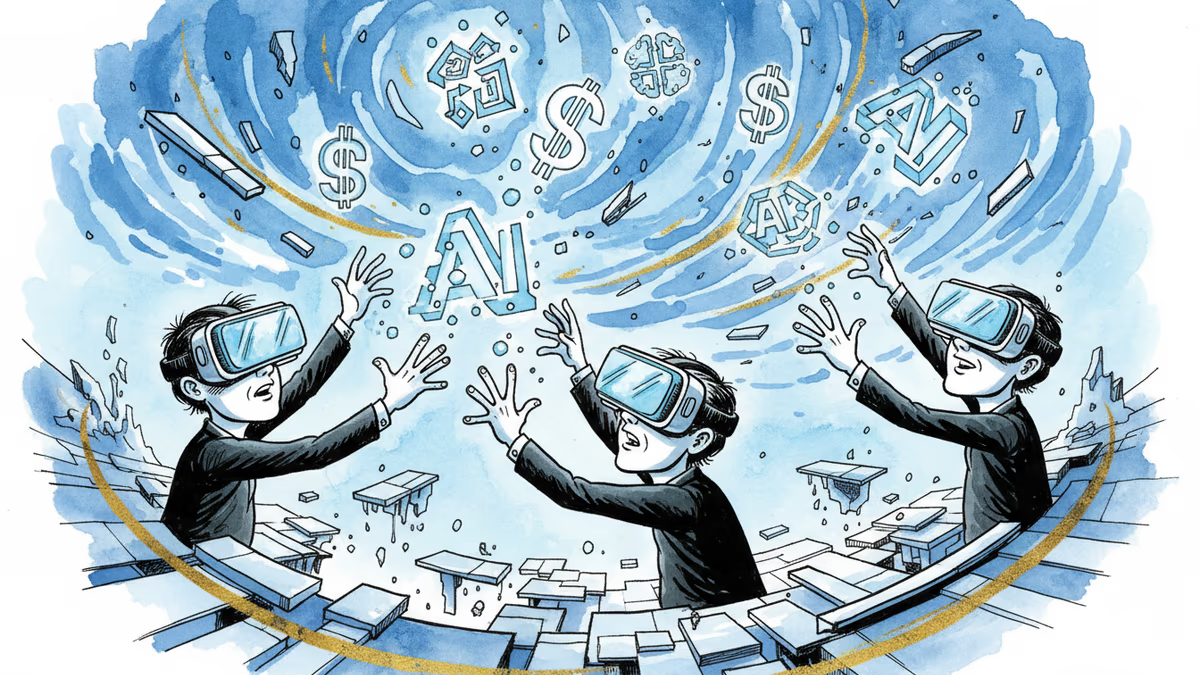
As AI investments reach fever pitch, investors struggle to separate reality from hype. Who's actually making money in the AI gold rush?

Big Tech is spending hundreds of millions to shape AI regulation. The outcome will determine whether AI serves you or surveils you. Inside the lobbying battle that will define the next decade.
Bitcoin maintains support above $70,000 but fails to deliver the $80,000 breakout analysts predicted. Market dynamics and derivatives positioning reveal mixed signals.
Bitcoin heads for worst 5-month losing streak since 2018 with 52% decline from peak. Analysts split on whether current slump signals structural shift or deeper correction ahead
As AI investments reach fever pitch, investors struggle to separate reality from hype. Who's actually making money in the AI gold rush?
Big Tech is spending hundreds of millions to shape AI regulation. The outcome will determine whether AI serves you or surveils you. Inside the lobbying battle that will define the next decade.
Thoughts
Share your thoughts on this article
Sign in to join the conversation