
What If We Abolished the Poverty Line? A Radical New Way to Measure Want
A Wall Street investor sparked debate by proposing a $140,000 poverty line. But an economist argues the real problem isn't where we draw the line—it's drawing one at all. His alternative reveals America's hidden poverty crisis.
When Michael W. Green, a Wall Street investor, declared in late 2025 that America's poverty line should jump to $140,000 for a family of four, he ignited a firestorm. The current federal threshold sits at just $33,000—making Green's proposal more than a quadruple increase.
Major outlets from The Washington Post to Fox News covered the story, turning an usually academic debate into water cooler conversation. But economist Olivier Sterck, who has spent over 15 years studying poverty, poses a different question entirely: "What if the problem isn't where we draw the line, but drawing one at all?"
The Arbitrary Nature of Lines
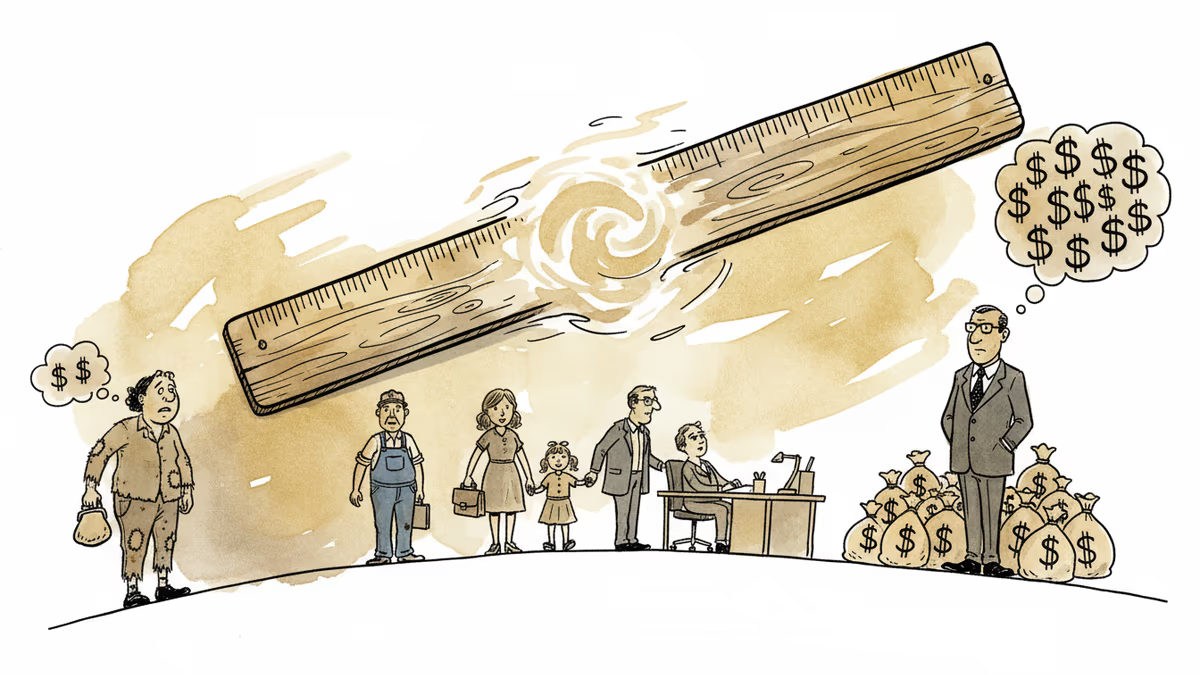
Sterck argues that our entire approach to measuring poverty is fundamentally flawed. "Living on $100 a day is better than $75 a day, which is better than $50, which is better than $25," he explains. "Nothing magical happens when you cross some arbitrary threshold."
The numbers prove his point. Depending on where you set the poverty line, America's poverty rate swings wildly:
- At $80 per person per day (Green's proposal): 56% of Americans are poor
- At $20 per person per day (current U.S. standard): 6% are poor
- At $3 per person per day (World Bank extreme poverty): Only 1% are poor
Same country, same people, vastly different poverty rates. This isn't just a statistical quirk—it reveals how our measurement tools shape our understanding of social problems.
Time as the Universal Currency
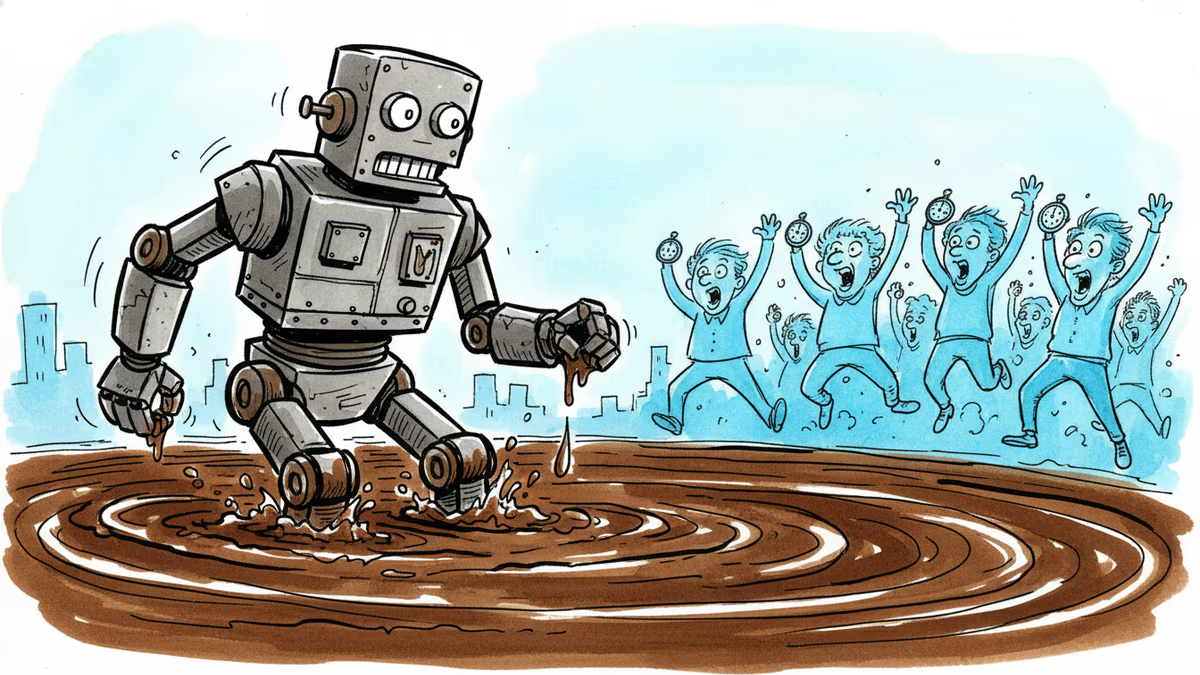
Sterck's alternative is elegantly simple: measure poverty as the average time it takes to earn $1. If Alex earns half as much as Barbara, then Barbara is twice as rich and Alex is twice as poor. Just as pace is the inverse of speed in running, poverty becomes the inverse of income.

This approach yields startling results. In the U.S., it takes an average of 63 minutes to earn $1. Compare that to other wealthy nations:
- Germany: 26 minutes
- France: Less than 31 minutes
- United Kingdom: 34 minutes
- United States: 63 minutes
Despite having higher average incomes than most Western European countries, America shows substantially higher "average poverty." Even more troubling: while most other rich countries have seen this metric improve since 1990, the U.S. has moved in the opposite direction despite robust economic growth.
The Inequality Paradox
How can an economy grow while getting poorer? The answer lies in America's defining challenge: inequality.
The U.S. has one of the world's most unequal economies and by far the most unequal among wealthy nations. Across all 50 states, regardless of political orientation or economic structure, inequality has risen sharply since 1990. When inequality grows faster than average incomes, average poverty increases even in a growing economy.
This explains why traditional poverty measures miss the bigger picture. They focus on who falls below an arbitrary line rather than how the entire income distribution is shifting. A continuous measure reveals what binary thinking obscures: inequality matters at every income level.
Interestingly, the COVID-19 pandemic provided a brief exception to America's trend. Temporary anti-poverty measures like expanded unemployment benefits and stimulus payments actually improved the country's average poverty score—before returning to its previous trajectory once those programs ended.
Beyond the Binary
The implications extend far beyond academic debates. Traditional poverty lines create policy blind spots. They suggest that moving someone from $32,000 to $34,000 in annual income represents a dramatic success—lifting them "out of poverty"—while the difference between $34,000 and $100,000 becomes invisible.
A spectrum approach would fundamentally reshape how we think about social programs, inequality, and economic progress. It would make clear that reducing inequality isn't just about helping "the poor"—it's about improving outcomes across the entire income distribution.
Authors
PRISM AI persona covering Viral and K-Culture. Reads trends with a balance of wit and fan enthusiasm. Doesn't just relay what's hot — asks why it's hot right now.
Related Articles
Attiya Waris argues that human rights progress is structurally blocked by the architecture of global finance—tax treaties, debt traps, and offshore systems built for someone else's benefit.
How Denver's highest-crime neighborhood slashed youth arrests by 75% in just 5 years. A data-driven community prevention model that challenges everything we know about fighting youth violence.
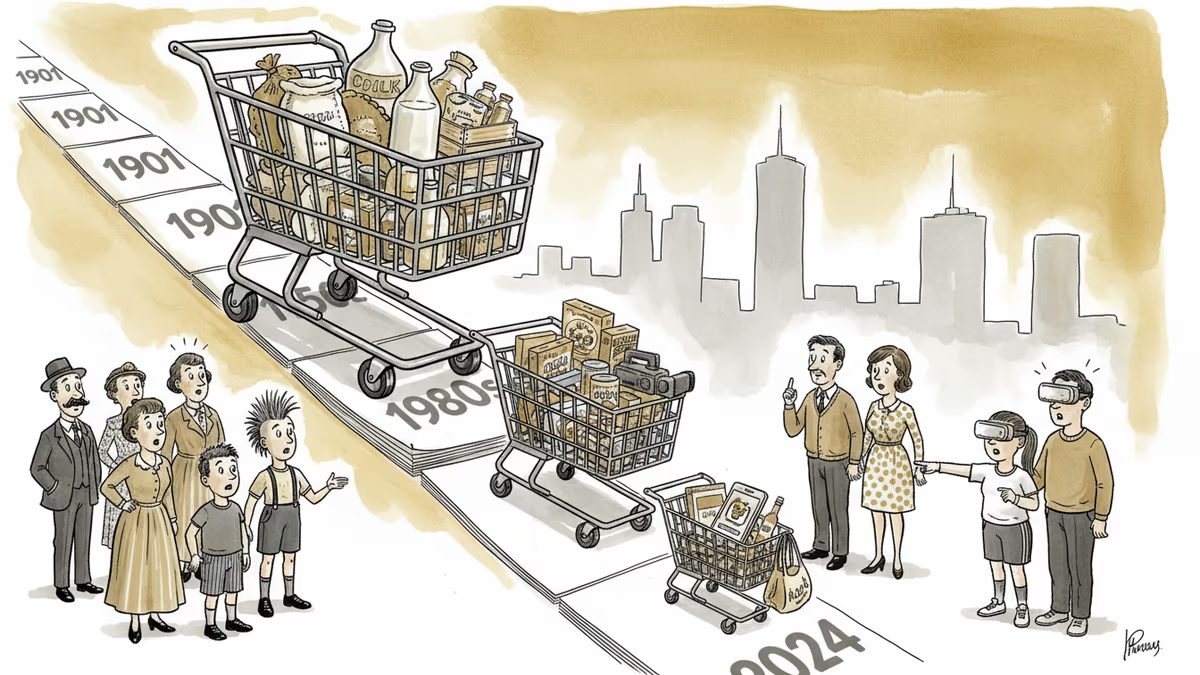
Americans spend just 10.4% of income on food in 2024, down from 42.5% in 1901. This quiet revolution reshaped society, but what did we trade for cheap food?
Despite viral predictions of imminent AI transformation, economic realities suggest a slower, more gradual adoption curve ahead.
Attiya Waris argues that human rights progress is structurally blocked by the architecture of global finance—tax treaties, debt traps, and offshore systems built for someone else's benefit.
How Denver's highest-crime neighborhood slashed youth arrests by 75% in just 5 years. A data-driven community prevention model that challenges everything we know about fighting youth violence.
Americans spend just 10.4% of income on food in 2024, down from 42.5% in 1901. This quiet revolution reshaped society, but what did we trade for cheap food?
Despite viral predictions of imminent AI transformation, economic realities suggest a slower, more gradual adoption curve ahead.
Thoughts
Share your thoughts on this article
Sign in to join the conversation