
Mars Was Warm and Wet 4 Billion Years Ago—What This Means for Life
New research reveals Mars was warm and wet during the Noachian epoch, challenging cold-and-icy theories and reigniting debates about ancient Martian life possibilities.
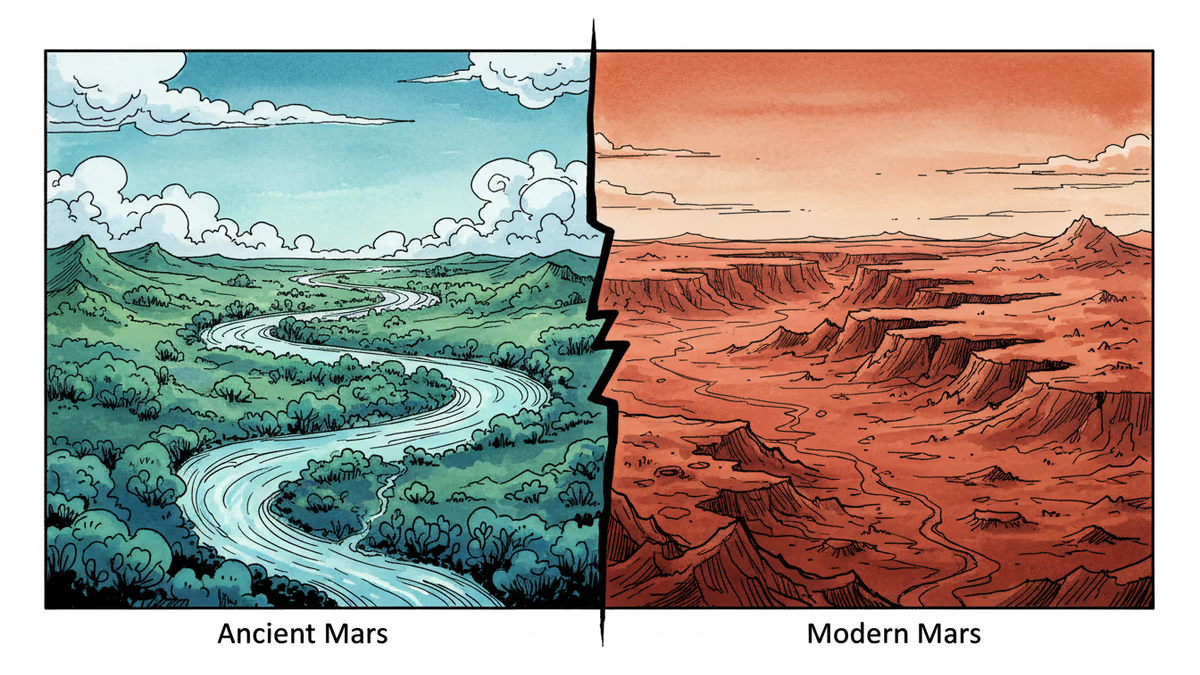
4.1 billion years ago, Mars looked nothing like the barren red desert we know today. A groundbreaking study reveals that during the planet's Noachian epoch, Mars was warm, wet, and potentially teeming with the ingredients for life.
This finding directly challenges the prevailing "cold and icy" theory that has dominated Mars research for decades. The implications? We might need to completely rethink when and where life could have emerged in our solar system.
The Warm Mars Revolution
The Noachian epoch (4.1 to 3.7 billion years ago) coincided with one of the most violent periods in solar system history—the Late Heavy Bombardment. Massive asteroids pummeled planets across the solar system, leaving the Moon's crater-scarred surface as evidence of this cosmic chaos.
Yet somehow, Mars maintained a warm climate during this bombardment. How? Scientists believe a thick atmosphere rich in greenhouse gases could have trapped enough heat to keep water liquid on the surface, despite the Sun being 25% dimmer than today.
This wasn't just a brief warm spell. Evidence suggests Mars remained habitable for hundreds of millions of years—longer than it took life to emerge on Earth.
The Life Equation Changes
Here's why this matters: if Mars was warm and wet for such an extended period, the probability of life emerging there becomes significantly higher. On Earth, life appeared around 3.8 billion years ago—right in the middle of the Noachian epoch.

The timing isn't coincidental. Both planets had similar conditions during this crucial window. Some scientists now speculate that life might have emerged on Mars first, then potentially traveled to Earth via meteorites—a theory called panspermia.
But skeptics remain. Dr. Robert Haberle from NASA's Ames Research Center cautions: "Warm doesn't necessarily mean habitable. We still need to understand the atmospheric chemistry and radiation environment."
Investment and Exploration Implications
This research is already reshaping space exploration priorities. NASA's Perseverance rover is currently searching for signs of ancient life in Jezero Crater, a site that likely contained a lake during the Noachian epoch. Private companies like SpaceX are factoring these findings into their Mars colonization timelines.
The astrobiology market, currently valued at $8.2 billion, could see massive growth as investors bet on Mars life detection technologies. Companies developing life-detection instruments, sample return missions, and even Mars terraforming technologies are attracting unprecedented funding.
Universities are also responding. Applications to astrobiology and planetary science programs have surged 40% in the past two years, according to the American Geophysical Union.
The Bigger Picture: Are We Alone?
This research extends far beyond Mars. If life could emerge on two planets in the same solar system during similar time periods, it suggests life might be more common in the universe than we thought.
The James Webb Space Telescope is already searching for biosignatures on exoplanets. If Mars was indeed habitable, it provides a template for identifying potentially life-bearing worlds around other stars.
Yet questions remain. Why did Mars lose its atmosphere while Earth kept its? Could Martian life have survived underground as the planet cooled? Are there still living organisms in Mars' subsurface today?
Authors
Related Articles
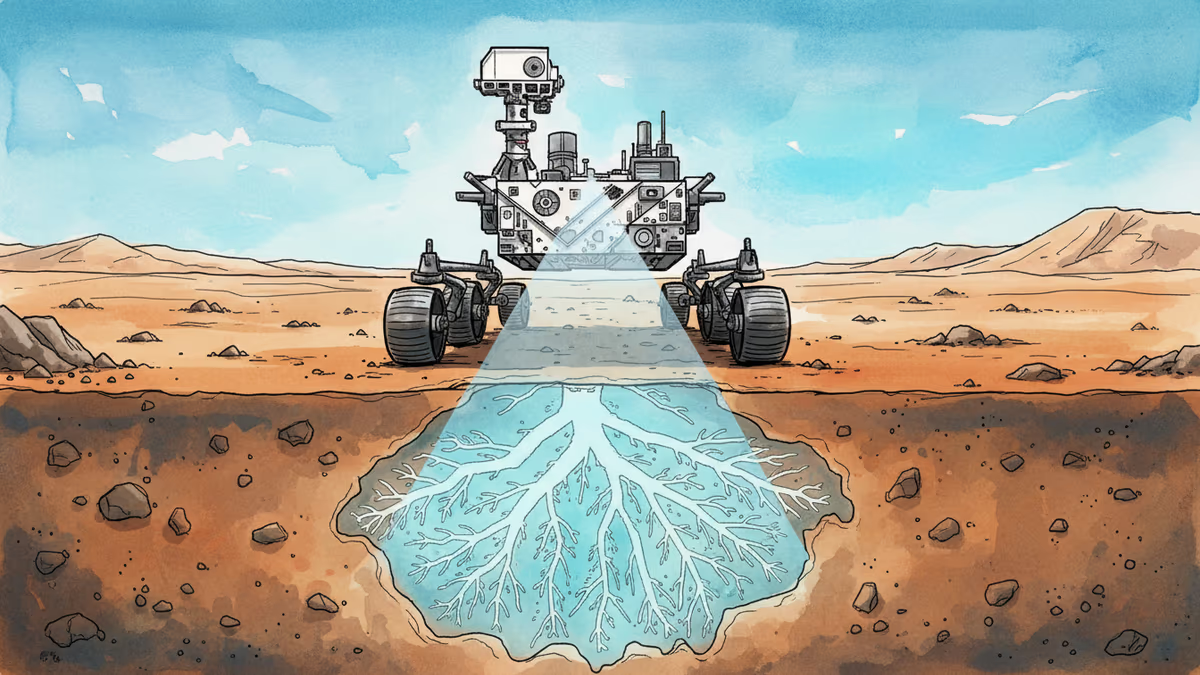
NASA's Perseverance rover has detected a buried ancient river delta beneath Jezero Crater's surface. The discovery opens new possibilities in the search for signs of ancient Martian life.

A Texas senator's attempt to favor one contractor backfired, opening up NASA's Mars orbiter competition. The unintended consequences of space politics.
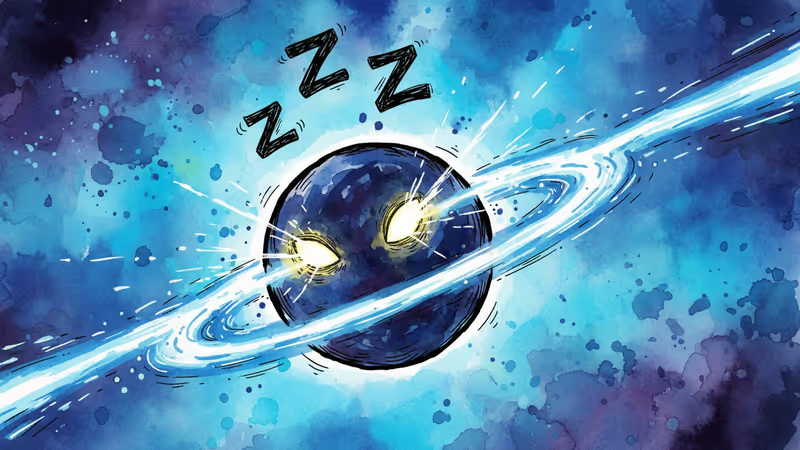
A black hole discovered in 2018 has defied expectations by reactivating after three years and continuing to brighten. Scientists predict it won't peak until 2027, raising new questions about cosmic physics.
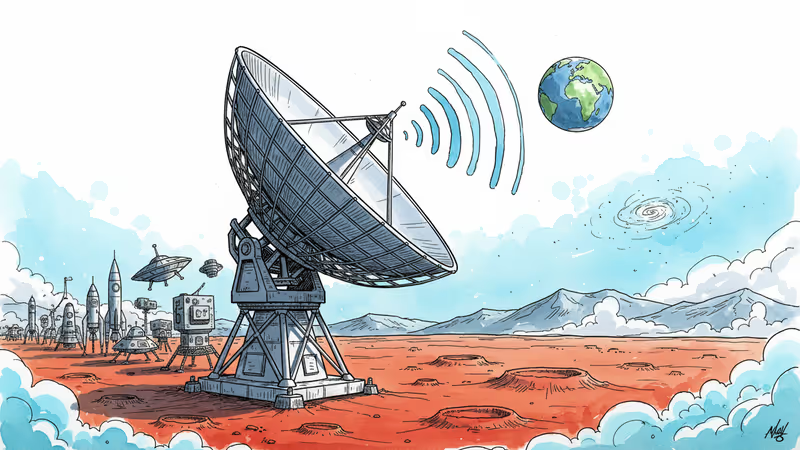
NASA faces a critical decision on selecting its next Mars telecommunications spacecraft with $700 million in funding. This choice will define Mars exploration strategy for the next decade.
NASA's Perseverance rover has detected a buried ancient river delta beneath Jezero Crater's surface. The discovery opens new possibilities in the search for signs of ancient Martian life.
A Texas senator's attempt to favor one contractor backfired, opening up NASA's Mars orbiter competition. The unintended consequences of space politics.
A black hole discovered in 2018 has defied expectations by reactivating after three years and continuing to brighten. Scientists predict it won't peak until 2027, raising new questions about cosmic physics.
NASA faces a critical decision on selecting its next Mars telecommunications spacecraft with $700 million in funding. This choice will define Mars exploration strategy for the next decade.
Thoughts
Share your thoughts on this article
Sign in to join the conversation